



I became Google-eyed (adj.) after I Googled (v.) all my friends' names in a bout of Google-mania (n.).
Everybody does it.
Google — a search engine run by CEO Eric Schmidt '76 — lets users get the low down on their friends, enemies and everybody in between.
Just pop in a name, and get all the web pages mentioning that person.
"Now, if you can't remember your college years because of everything you consumed," Schmidt says, "Google remembers all of it for your friends."
Type "Shirley Tilghman" and get some 2,000 results, starting with the University president's resume. Did you know Tilghman — whose birthday was Wednesday — spent 1968-1970 in Sierra Leone as a teacher?
As for another president, USG leader Pettus Randall '04, his second Google listing is a biographic page that's part of a Class of 2004 introduction website from a few years ago.
I don't know if he had political ambitions back then, but Randall chose perennial Princeton favorites like "This Side of Paradise" as his favorite book, "Crash" by Dave Matthews as his choice recording and "The Simpsons" as his top TV show.

The USG president's favorite source of news is the Wall Street Journal. (Well, let's say favorite source of off-campus news.)
There must be some dirt to find.
How about Googling celebrity economics professor Paul Krugman?
You get his personal website — in fact, the "new" version, which says that "If someone reading this site wants to get in touch with me for radio, TV, karaoke, whatever, I run such things through" a New York PR company.
The site includes myriad links, including pictures of Krugman in France, "vacationing with the enemy."
He even references Google's research bureau, where someone offered $100 to Google staffers for "as much information as possible about the personal and professional life of Paul Krugman, the Princeton economics professor who writes a column for the New York Times."

But is all this ethical? To use the web to spy on teachers, students and administrators?
Granted, here I've chosen examples of information deliberately put up on the web.
But course enrollments, off the hand commentaries, message board posts and all sorts of personal stuff can be found through Google. Often, unless someone has Googled himself — which I'm not discounting — it can be up there without the object of espionage knowing.
Last term, when a University student got in trouble with the music industry's trade group in a high publicity case, the University tried to remove a version of his website from Google's cache — which saves copies of sites — to protect his privacy.
I've asked a computer science professor, Szymon Rusinkiewicz, to consider this issue.
"It's Google's mission to store all information. They're starting with the web but eventually they want to store all information," Rusinkiewicz says. "It's definitely tilting the scales of privacy. Nosy neighbors now have even more tools to get the information they want."
Confident that Rusinkiewicz name wouldn't yield too many off-the-mark results, I plopped it in Google.
There they were: I got his webpage first and then many pages referencing his leading work in computer science, primarily in graphics.
Sometimes it can make a big difference if you put quotation marks around the name or add some more context. With common names, it can be mighty difficult to find the person you're looking for.
I think of David Robinson '04, a colleague here at the newspaper who is one of the editors of the opinions page.
Most of the pages that come up focus on the N.B.A. star of the same name.
So let me try my own name, which, while not common, also is perhaps not as uncommon as Rusinkiewicz.
I find a few links to 'Prince' articles.
But the chief of emergency medical services in Brooklyn, N.Y., also seems to be a Zachary Goldfarb, as does someone who made the fall dean's list at the City University of New York in 1997.
I wonder if any of my roommates, Googling me before coming here, thought he'd be rooming with an M.D. or CUNY graduate.
O.K. — sometimes Google espionage makes a lot of sense.
If I'm going to see a new doctor, I won't mind checking if he's had any malpractice suites recently filed against him.
And as a budding reporter, I find Google invaluable to get background info on people whom I may interview.
Please indulge me as I offer one concluding prayer. Let's not turn our Googlicious tendencies into an AOL Instant Messenger away message-like fetish, with routine checks of what our friends are up to.
Instead, let's ask them.
Read More
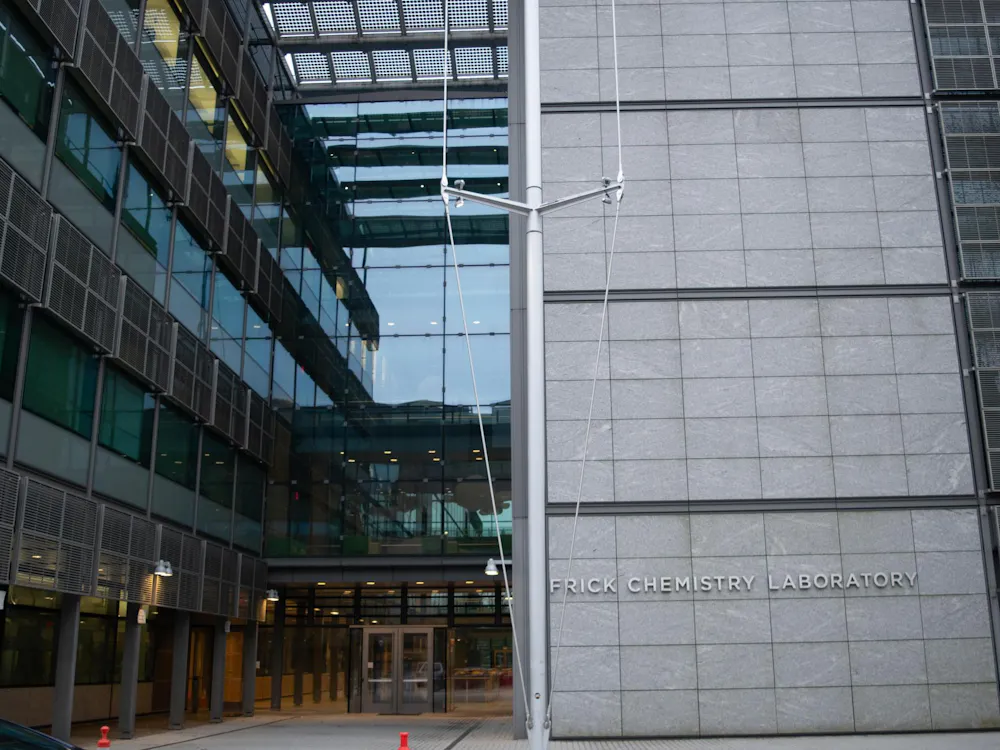
Two Princeton professors win 2027 American Chemical Society awards
Kimberly HutchinsonPrinceton chemistry professors David MacMillan and Paul Chirik were named 2027 American Chemical Society national award winners for their contributions to the field of chemistry.
Princeton chemistry professors David MacMillan and Paul Chirik were named 2027 American Chemical Society national award winners for their contributions to the field of chemistry.

Federal court blocks elimination of duration of status for international students
Luke GrippoA federal court has temporarily stopped the Department of Homeland Security from implementing its new final rule that would limit how long international students and exchange visitors can stay in the country. The next update on the case is set for Oct. 2.
A federal court has temporarily stopped the Department of Homeland Security (DHS) from implementing its new final rule that would limit how long international students and exchange visitors can stay in the country. The next update on the case is set for Oct. 2.

Forbes renovation scope still undecided as Hobson prepares to open
Gus Vogel and Daphne LewisAs Forbes students prepare to become the first cohort to live in Hobson College next year, specifics on Forbes' own renovation remains unsettled by the University nearly six months after the University announced it was accepting consultant bids for a campus-wide dorm renovation plan.
As Forbes students prepare to become the first cohort to live in Hobson College next year, specifics on Forbes' own renovation remains unsettled by the University nearly six months after the University announced it was accepting consultant bids for a campus-wide dorm renovation plan.