



A. Scott Berg '71 clunked an inky right fist on his forehead.
"So far I haven't faced writers' block," he said, knocking on "wood." A chart-topping Pulitzer Prizewinning biographer, Berg is currently on a promotional tour for "Kate Remembered" — a "cradle-to-grave" look at four-time Academy Award-winning actress, Katharine Hepburn." He must clunk regularly.
After signing copies of "Kate" at the U-Store on Monday, The Daily Princetonian caught up with Berg for a few minutes on what he called "the push push push" book tour.
Berg has had a busy, emotionally charged summer. Highlights of his "summer vacation," included his last meeting with Hepburn on May 30, his receipt of an honorary University degree on June 2 and his retirement from the Board of Trustees. Finally, Berg jetted back to his California office to write the last pages of the Hepburn bio.
"Then she died and I hit the ground running," Berg said of his routine since "Kate Remembered" came rolling off the presses less than two weeks after Hepburn's June 29 death.
Berg's contact with Hepburn began in 1983 when Esquire Magazine asked him to write an article for its 50th anniversary issue. Though Berg pulled the story before it was published, that first two-day interview laid the foundation for their 20-year friendship and Hepburn's much-anticipated posthumous bio-memoir, which was released on July 11.
"It was really good timing," Berg said. "It was a moment in her life when she was facing mortality for the first time. She was 75 and was just in a near-fatal car accident. She was playing in her head the tapes of her life."
"Who rang the doorbell? But a 33-year-old biographer whose first book ["Max Perkins: Editor of Genius"] she read and liked," Berg said. "Subconsciously, she was looking for me."

Berg describes their attachment as "instantaneous," and Hepburn invited Berg for dinner for the following five nights. A week after their first meeting, she presented him with a key to her home.
"She really was an inspirational figure on many levels," Berg said. "She had a contagious energy and was a lot of fun to be around."
Hepburn and her 65-year career — which included movies such as "The Philadelphia Story," "Adam's Rib," and "On Golden Pond" — continue to fascinate him.
"Even if you're not interested in Hepburn or the movies, she sustained a career for 65 years. She is the only one," he said. "She was a star into her late 80s. She was constantly reinventing herself."
"Kate Remembered" continues to enjoy a long run on the Bestseller lists. But the book, written through Berg's subjective lens, has drawn some criticism.
It was, as Berg put it, "slammed" in The New York Times. Reviewers primarily took issue with Berg's insertion of himself into the memoir.

He maintains that he anticipated criticism, especially in a book so deeply personal.
"It is her life story," Berg said. "The point is the memoir. I put myself in the book only so much as to illuminate her."
In his author's note, Berg "made a contract" with readers, warning that in the ensuing pages, he never intended to assume a veil of objectivity.
Berg has made his career on talking about the idiosyncrasies of others, but if asked, he reveals everything from his "desert island book" — F. Scott Fitzgerald's "Tender is the Night"— to his regimented vitamin consumption and fondness for "The Young and the Restless."
Berg also meditates twice a day, and hasn't missed a meditation since 1974.
Whatever the formula, it seems to be working. Berg received the Pulitzer Prize for his 1998 biography of Charles Lindbergh.
Berg writes in two and a half hour chunks of time, always working on an empty stomach. He picked up this technique in a psychology class he took as an undergraduate: "the rat goes through the maze faster if he's hungry," he said.
As an undergraduate, Berg spent much of his time dabbling in the activities Fitzgerald references in "This Side of Paradise." Berg joined Cottage Club and lived on Prospect Avenue when he was the club's social chair.
Most of Berg's time was spent writing comedy sketches for the Triangle Club.
"I almost dropped out of school because of it," he said. After a show at Lincoln Center in New York, agents wanted to put Berg to work.
Berg "came really close" to diving into the musical theater scene, but his adviser in the English department, Carlos Baker, talked him out of it.
After passing up the allure of Broadway, Berg focused on his fascination with Fitzgerald. Spending nearly every afternoon in Firestone Library, he leafed through files of letters donated to the University by Charles Scribner's Sons, Fitzgerald's publisher.
Aside from learning about Max Perkins — editor to Fitzgerald, Hemingway and Thomas Wolfe — Berg got an inside look at the creative process from "primary source" personal correspondence between writer and editor.
"It was virginal material," he said. "Nobody had been through these before."
During his research, which led to an award-winning senior thesis and a popular biography "Max Perkins: Editor of Genius," Berg learned another lesson.
"Hemingway wrote," Berg said, " 'Always stop when you're going good' even if that means in the middle of a sentence or paragraph."
Berg practices the stopping mid-sentence technique, he said, so "there's always a thread to pick up."
But Berg, who is "going good," and looking forward to the book-on-tape release of "Kate Remembered" as well as a Woodrow Wilson biography due in 2009, isn't stopping any time soon.
Read More

Princeton University Orchestra and men’s ultimate frisbee team named in University’s latest hazing report
Andrew ArthurTwelve students in the Princeton University Orchestra and Men's Ultimate Frisbee team were found responsible for hazing violations in the University's latest Campus Hazing Transparency Report. Sanctions ranged from Dean's warnings to disciplinary probation.
Twelve students in the Princeton University Orchestra and Men's Ultimate Frisbee team were found responsible for hazing violations in the University's latest Campus Hazing Transparency Report. Sanctions ranged from Dean's warnings to disciplinary probation.

Murray-Dodge Café celebrates 50th Anniversary, drawing over 260 students
Hifza KaleemOn Wednesday, Murray Dodge Cafe celebrated its 50th anniversary, drawing more than 260 students to celebrate with free cookies and merchandise.
On Wednesday, Murray Dodge Cafe celebrated its 50th anniversary, drawing more than 260 students to celebrate with free cookies and merchandise.
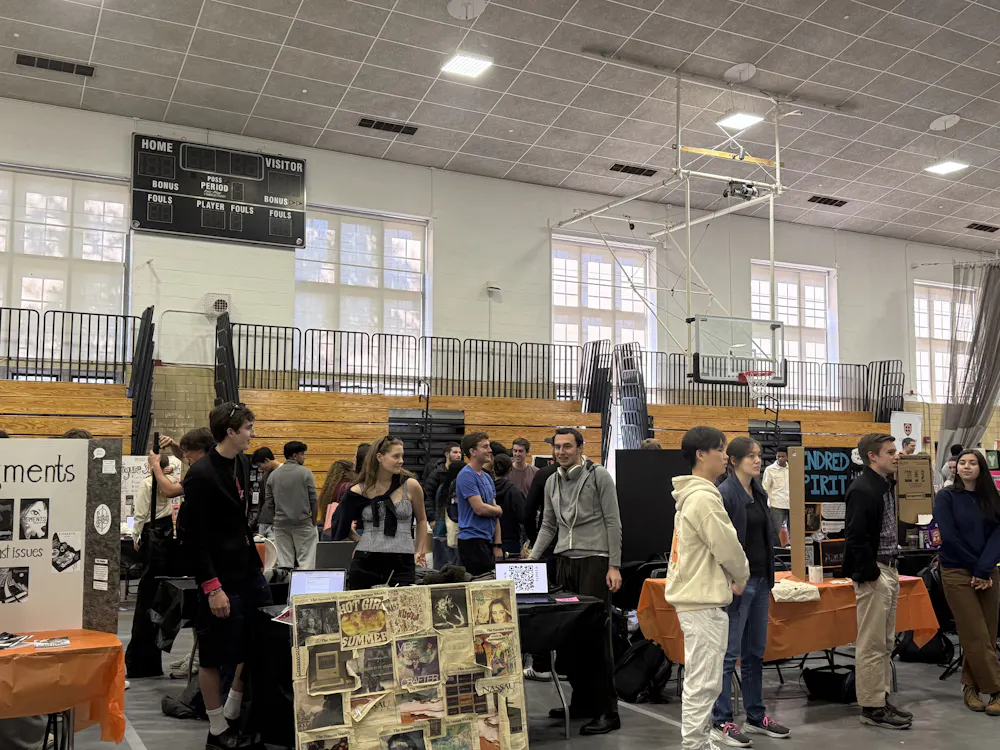
Students share mixed reactions as mandated officer and treasurer trainings return to in-person format
David EstradaThe University's student organization officers and treasurers returned to mandatory in-person training this fall after years of online sessions. Student reactions found parts of the training redundant or tedious, though most agreed the sessions were important.
The University's student organization officers and treasurers returned to mandatory in-person training this fall after years of online sessions. Student reactions found parts of the training redundant or tedious, though most agreed the sessions were important.