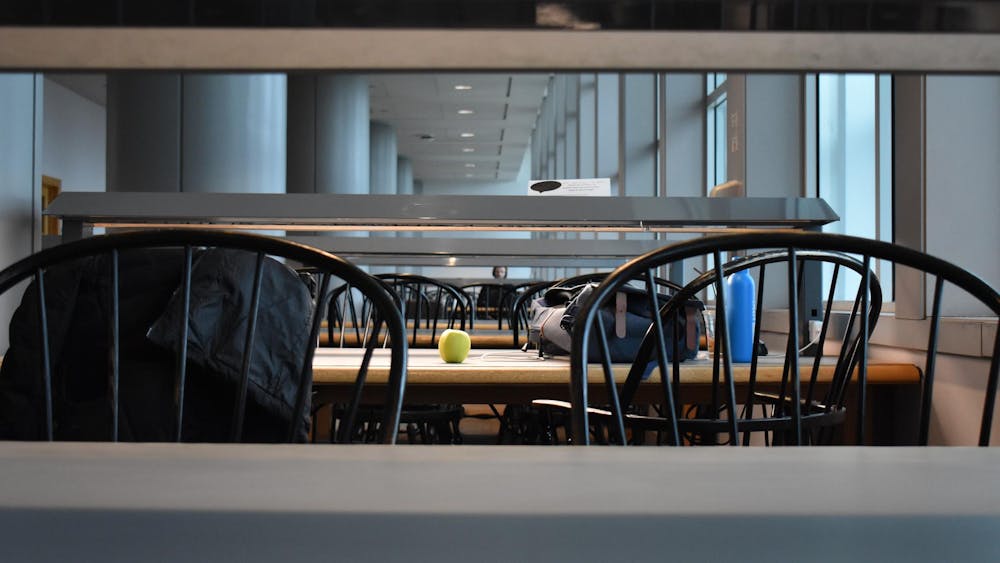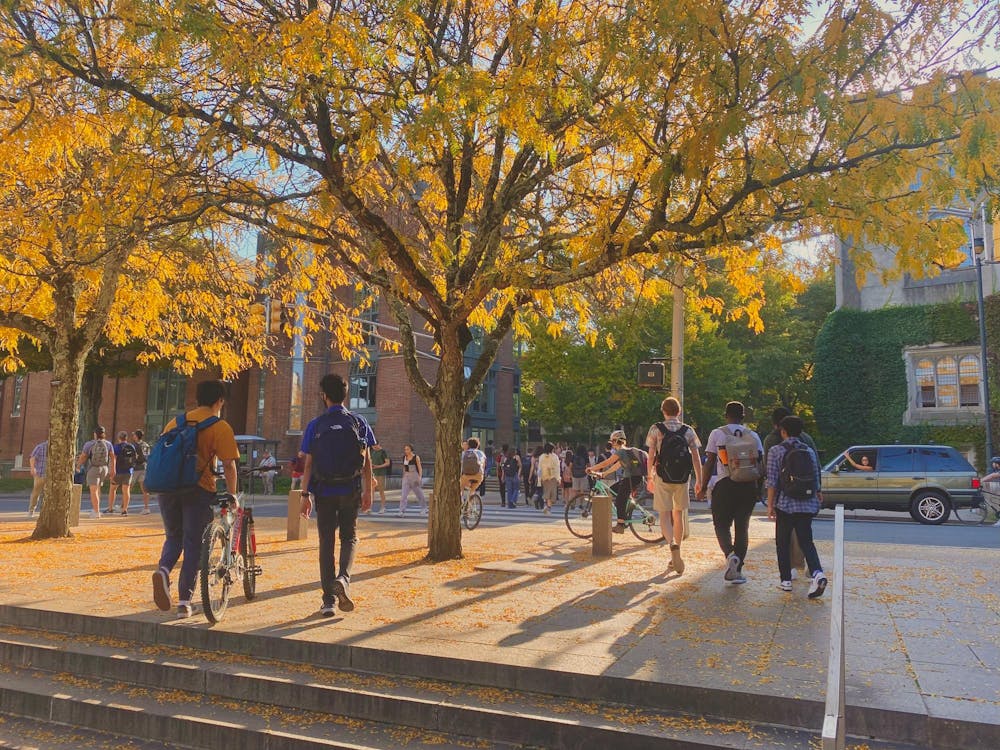



As midterm week continues for students like Aparajita Bijapurkar ’13 — who is studying for a calculus exam — it is becoming apparent that the limit of academic stress is reaching infinity.
Academics

U. releases Kindle pilot data

The University’s e-reader pilot program, which experimented with the use of the Kindle DX in three courses last semester, reduced the amount of paper students printed for their respective classes by nearly 50 percent, the University plans to announce today.

But in spite of the cost savings, some students and professors said they found the technology limiting.

Four graduate students awarded Jacobus Fellowship

The University awarded Porter Ogden Jacobus Fellowships to graduate students Vaneet Aggarwal, Melinda Baldwin, Charles Conroy and Joseph Moshenska on Saturday.

Google awards $500,000 to professors for web projects

Google announced last Tuesday that it will award five Princeton professors combined grants of $500,000 for their promising research on Internet energy efficiency and privacy.

Nearly half drop out of humanities sequence

“Frantic” is how Gabrielle Haigh ’13 describes her experience in the four-course Humanities Sequence, HUM 216-219, an intensive year-long introduction to the Western canon.

Juniors picked as Adel Mahmoud scholars

While many students scrounge and scramble for summer internships and jobs, this year’s eight Adel Mahmoud Global Health Scholars already have research grants lined up.

Engineers devise new battery

Mechanical and aerospace engineering professor Michael McAlpine and his team developed a new type of energy-generating device that can be powered by the human body. Their rubber films, made of silicone and a ceramic material known as lead zirconate titanate (PZT), capture mechanical energy from body movements and convert it to an electric current.

Admins: Data suggest law, medical school admissions unaffected by deflation

Princeton graduates continue to be successful in gaining admission to the most selective law schools and medical schools, despite the University’s grading policy, administrators said at the Monday meeting of the Council of the Princeton University Community (CPUC).

New advising plan revealed

The Office of the Dean of the College is creating a new director position which will focus exclusively on postgraduate fellowship advising, the University announced on Monday. The new director, who will start next fall, will take on the role currently held by Associate Dean of the College Frank Ordiway, who was dismissed from the University effective this June.

Alternatives emerge for selling back used books

Over a four-day period last May, Carlos Roque ’10 trekked across campus from “Scully, to Bloomberg, then all the way to Holder,” collecting more than $15,000 worth of textbooks. Roque wasn’t hoping to start a library, but rather to make some cash.

Roque, a buyer for third-party vendor Belltower Books, made $1,000 last spring by purchasing students’ used textbooks with money provided by Belltower and then shipping them to the distributor.

Sculpture, sketching and stereotypes

Princeton’s art and archaeology department reflects the field’s changing demographics, with a predominantly male faculty and a primarily female student body.

Sahi '10 finds piracy on BitTorrent

It is common knowledge that most Internet file sharing is illegal, but Sauhard Sahi ’10 has proof. Analyzing a random sample of 1,021 files available on a variant of the file-sharing application BitTorrent, Sahi found that 85 to 99 percent of files were shared in violation of copyright law.

Three win Gates, Churchill scholarships to study in Cambridge

George Boxer ’10, David Karp ’10 and Scott Arcenas ’09 won scholarships to study at Cambridge University this fall, the University announced on Friday. 

Tigers for a term

An admission rate less than 10 percent may seem low to applicants for undergraduate degrees, but it’s safety-school territority compared to the hurdle that students must overcome to study at Princeton as exchange students. Only 17 visiting students entered the University this year, all admitted through exchange programs between Princeton and their home schools.

'Stereotype threat' negatively affects students

Princeton students fall victim to the “stereotype threat,” according to a study led by Adam Alter GS ’09. The “stereotype threat” is the phenomenon in which reminding people of negative stereotypes associated with their group identity can encourage the fulfillment of those stereotypes.

Lab hopes to build ties with undergraduates

Nestled away on the University’s Forrestal Campus, dozens of the world’s top geoscientists are revolutionizing our understanding of global climate change. Though unknown to most Princetonians, researchers at the Geophysical Fluid Dynamics Laboratory (GFDL) produce  mathematical models that track atmospheric, oceanic and climate patterns, providing vital information for scientists and policymakers.

Seven awarded Sloan grants

Seven University professors, representing disciplines ranging from economics to neuroscience to mathematics, have been awarded 2010 Sloan Research Fellowships. Princeton ties with Harvard for the school with the most fellowship winners this year.

Professors blog to explore ideas, reach wider audience

In 2007, when art and archaeology professor Chika Okeke-Agulu wanted to address controversy surrounding the 52nd Venice Biennale — a global exposition of contemporary art held in Venice, Italy — he took to the Internet.

Three win ReachOut 56-81 Fellowships

By Nan Hu
ReachOut 56-81 — a partnership between the classes of 1956 and 1981 that offers funding for graduating seniors to complete yearlong public service projects — has chosen three seniors for fellowships.

Eight named Liman fellows

Five undergraduate and three graduate students were named 2010 Arthur Liman Fellows in Public Interest Law, the Program in Law and Public Affairs (LAPA)  announced on Tuesday.

Acting out environmentalism

Students flipping through the course catalog this year may have wondered what a course cross-listed in Atelier, environmental science and theater entailed. An interdisciplinary course in environmental theater, ATL/THR/ENV 496: Environmental Documentary and Music Theater combines the scientific methods of the Princeton Environmental Institute (PEI) with the artistic approach of the Lewis Center for the Arts.

Futurity.org addresses decline in university research coverage

In early 2009, University Vice President and Secretary Bob Durkee ’69 met with communications representatives from a handful of universities in Washington, D.C. The meeting’s purpose was to discuss the sharp decline in coverage of University-based research following steep newsroom cutbacks in science and research reporting.

Buried in blueprints, sans accreditation

Architecture majors at most universities with specialized programs receive a Bachelor of Architecture degree (B.Arch.). Princeton students in the School of Architecture, however, receive a Bachelor of Arts degree (A.B.).

Unlike other universities’, Princeton’s architecture school is unaccredited. While many architecture programs concentrate on building regulations and construction, Princeton takes the unconventional approach of focusing on both liberal arts and architectural curricula.

Most back Van Jones' hiring

When he arrives on campus to teach next fall, former White House adviser Van Jones will be greeted by students and faculty generally supportive of his appointment.

Tilghman talks about genome, race in annual Baldwin lecture

At the genome level, individuals are 99.9 percent identical to one another, President Tilghman said  during the annual James Baldwin lecture in Richardson Auditorium on Tuesday evening. In “The Meaning of Race in the Post-Genome Era,”  Tilghman charted the historical basis of the intersection between scientific inquiry and racial classifications, beginning with an early attempt by 18th-century Swedish taxonomist Carl Linnaeus to divide the human race into five categories based on skin color.

Earning a master’s mid-career

When she took a seat on the first day of JRN 452: Journalism on the Screen: The Digital Journalist, Darragh Paradiso GS felt a little out of place. Paradiso, along with 20 other students earning a Master’s in Public Policy degree (M.P.P.) at the Wilson School, does not fit the typical graduate student profile. Most students pursuing their M.P.P. are mid-career professionals with at least seven years of work experience, who take a year of courses at the Wilson School before heading to public service jobs.

Botstein wins $500K prize

Molecular biology professor David Botstein, director of the Lewis-Sigler Institute for Integrative Genomics, was named one of three recipients of the annual $500,000 Albany Medical Center Prize in Medicine and Biomedical Research on Wednesday. 

Full ’13 develops cheap solar tech alternative

The Ashoka-Lemelson Tech4Society Celebration was a natural attraction for Eden Full ’13. At the February gathering in Hyderabad, India, she met more than 250 social entrepreneurs and business leaders from around the globe who had set out to transform the world. But the freshman wasn’t just attending the conference. She had been invited to present her ideas for using inexpensive solar energy to power the developing world.

UNICEF to implement undergraduate computer science project

A group of University undergraduates have made use of a ubiquitous device — cell phones — to provide a solution to the challenge of obtaining accurate survey information in developing countries. Colin Ponce ’10, Peter Schulam ’11 and Woongcheol Yang ’10 developed a cell phone-based survey system in COS 597E: Advanced Topics in Computer Science: Civic Technologies.

Authors decry gender inequity

Sheryl WuDunn GS '88 and New York Times columnist Nicholas Kristof spoke about their new book “Half the Sky” before a packed crowd in Dodds Auditorium on Thursday afternoon. The nonfiction work identifies gender inequity as the moral challenge of the century.

Waitlist policies vary by course

For students locked out of popular courses, their enrollment prospects are determined at the discretion of individual professors — one of the few areas of academic life not regulated by official University policy.

From B.S.E. to A.B.

Peter Bogucki, associate dean for undergraduate affairs in the School of Engineering and Applied Science (SEAS), said in an e-mail that “of the 268 students who began in the Class of 2012 in September 2008, 45 students — or 17 percent — have left to join the A.B. program.”

Notes on Nunokawa

English professor and Rockefeller College master Jeff Nunokawa’s has been at the University for more than two decades. He was filled with excitement as he began to talk about the community he has overseen for two years.

Kiplinger: University education is affordable, high quality

Princeton offers the second-best value among private colleges for providing academic excellence at an affordable price, according to rankings published by Kiplinger’s Personal Finance magazine last week.

Westminster policy presents barriers for students

 University students can take courses at Westminster Choir College (WCC) and at Princeton Theological Seminary (PTS), a Presbyterian institution unaffiliated with Princeton University, to supplement their regular University courses. But while both schools are open to Princeton students, the logistical hurdles and accreditation policies involved vastly differ.

Tiger teachers not deterred by low pay

"Really? Do you really want to be a teacher?” This is a question Marlise Jean-Pierre ’12 and other Princetonians interested in becoming educators often face. For people who pose that question, the teaching profession’s low salary and prestige may seem incongruous with the high cost of a Princeton education.