



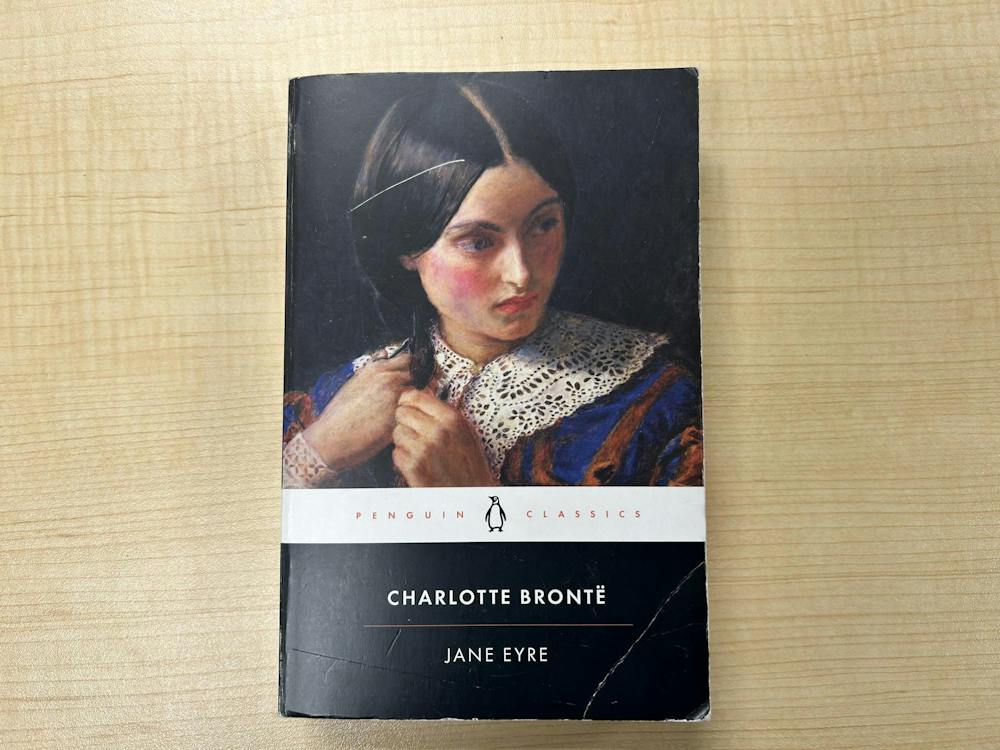
Despite being a lifelong reader, I have always struggled to name my favorite book. After this question has come up again and again during icebreakers and new meetings at the beginning of the semester, I’ve started to truly reflect on the books that have contributed to shaping who I am. While I must say that I’m not even close to a definitive answer, it’s impossible to ignore the call of Charlotte Brontë’s powerful writing in “Jane Eyre.” Beyond being an intensely emotional and passionate novel, its dark, mysterious Gothic setting amid pouring rain and a slight chill in the air makes it a perfect autumn read as the leaves on campus turn brilliant hues of red and gold.
The novel is narrated by Jane, an orphan girl who suffers under the cruelty of her aunt and cousins, as well as in the unlivable environment of Lowood School. After leaving Lowood to take up the position of governess at Thornfield Hall, she at last begins to find joy and meaning in her life through her relationship with her employer, Rochester. What begins as an intellectual bond strengthens into a passionate and burning love that is made deeper through its transcendence from a physical connection to one of the soul.
Brontë’s idea of true love through the union of Jane and Rochester’s souls continues to define how I think about love in my own life. At the same time, Jane’s acceptance of her continuous solitude in order to choose her self-respect and individual autonomy has also influenced me to remain true to my own sense of self. Even though love is an important part of my relationships, learning to love myself is also essential to how I live my life.
While Brontë’s novel is known for exploring suffering, loneliness, and identity, it was also revolutionary in its portrayal of and focus on a complex female character in a time period where this was unprecedented. Published in 1847 under a male pseudonym, the novel received both praise and criticism for not conforming to what society deemed moral and proper for women at the time.
When I was 12 years old, “Jane Eyre” was my introduction to the world of literature, a world that was darkly enchanting, captivating me with the power of Brontë’s language. I’ve always been a quiet, shy person, feeling out of place among others who always had something to say and seemed to fit into any social situation. I almost felt as if I had faded into the background of my life, like I was living as a ghost and couldn’t find a place where I felt I truly belonged. Yet somehow, in the intimacy of sharing Jane’s loneliness and suffering, I felt understood. Charlotte Brontë gave a voice to the emotions of loneliness and melancholy within myself that I couldn’t express, but Jane’s success gave me strength and hope to believe that happiness, belonging, and love could be possible.
Returning to the novel for ENG 345 with English professor Jeff Nunokawa, a class on 19th-century fiction, I am reminded of these past experiences and emotions. My love for reading and literature is renewed again and again by books that speak across time and space, reaching us at different moments in our lives. During this second reading of “Jane Eyre,” I’m once again enchanted by the intense emotional language and the deeply personal narration. Jane is filled with empowering words such as, “I am no bird; and no net ensnares me; I am a free human being with an independent will.” Such statements instantly become mottos of individuality to live by, and the novel now brings to light more complex thoughts about who I am as a person, especially as a woman, in the relationships central to my life. I’ve come across difficulties where I’ve had to remain true to myself, even if it meant distancing myself from a friendship that was beginning to dictate the direction of my life and confusing the values that were central to who I am.
Everyone comes to Princeton with different backgrounds and values, and it is important to listen and consider them. However, like Jane, I think it’s essential to uphold your identity and not change to fit into someone else’s perception of who you are. Jane continually displays this fortitude in the face of suffering and is determined to protect her self-respect and independence, even above her passion for Rochester. She demonstrates the importance of retaining this sense of individuality and self-worth, no matter how people and experiences influence our lives. We want to be found in love, but at the same time we can’t lose ourselves to it.
It is these ideas about how to live and love that make me look forward to lectures and precept each week. Lectures allow me to reflect on these past impressions of the novel, but also open my eyes to new insights and observations. The opportunity to learn about such ideas as love and disincarnation, the movement of desire from the physical body to the soul, strengthens the impact of the novel in making me believe that such a profound love can be possible.

Reading something like “Jane Eyre” can reveal insights about ourselves, but it is even more extraordinary when strengthened by the human connection that comes from our classes. This novel is one example of how literature and reading can communicate with us across time and space, highlighting the experiences that shape who we are. Through such compelling and moving stories, literature shows us what it means to be alive and how we create meaning in our own lives through sharing these experiences together. Whether a novel speaks about the desire to be loved or the journey to self-discovery, each book takes on unique meanings for each of us, shaping how we choose to live our lives. I might not have figured out what my favorite book is, but revisiting “Jane Eyre” at Princeton has strengthened my sense of identity and inspired me with the courage to live out the values that are important to me.
Katharine Vennink is a contributing member for The Prospect. She is a member of the Class of 2029 and can be reached at kev[at]dailyprincetonian.com.
Read More

Two new fast food restaurants open on Nassau Street
Walker VivianTwo new fast food restaurants, Hotbirds and 7th Street Burger have opened in Princeton over the summer. This comes after three other new fast food spots, BurgerRunn, Food Street, and Best Grill and Fries opened last winter.
Two new fast food restaurants, Hotbirds and 7th Street Burger have opened in Princeton over the summer. This comes after three other new fast food spots, BurgerRunn, Food Street, and Best Grill and Fries opened last winter.

Princeton football defeats Columbia 35–7 in Ivy League opener
Ethan ColeIn their Ivy League opener, Princeton football defeated Columbia with a standout performance from Kai Honda.
In their Ivy League opener, Princeton football defeated Columbia with a standout performance from Kai Honda.

Trustees advise dissociation committee to ‘quickly dispose’ of some petitions, avoid ‘intensifying division’
Sena ChangIn a public statement, Princeton’s Board of Trustees advised the Resources Committee to dispose of petitions that lack potential for campus consensus. The statement also reiterated the Board’s “strong presumption against dissociation.”
In a public statement, Princeton’s Board of Trustees advised the Resources Committee to dispose of petitions that lack potential for campus consensus. The statement also reiterated the Board’s “strong presumption against dissociation.”