



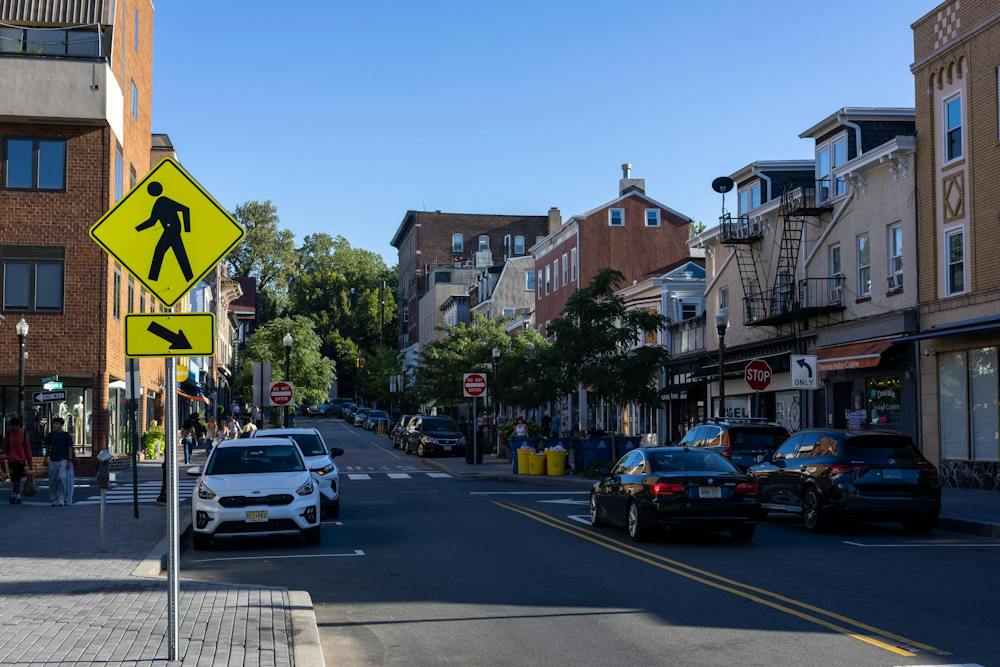
As the Princeton Fire Department transitions to a primarily paid force, preliminary design concepts for the expansion of its firehouse have been completed, according to Fire Chief Adam Kooker. However, the project is currently paused as the Princeton Council works to identify funding for the expansion.
The Princeton Fire Department has historically consisted of an all-volunteer firefighting force, but declining volunteer numbers led the department to hire its first full-time, paid firefighters in 2020. The department now has 13 paid firefighters and seven active fully-trained volunteers.
“Over the coming years, our goal is to continue strategically expanding both our career personnel and volunteer ranks,” Kooker wrote in a statement to The Daily Princetonian. “Due to our geographic footprint and the time required for outside mutual aid to arrive, adding on-duty staffing directly in town is the single most effective way to eliminate response delays and ensure a rapid, multi-person crew for concurrent or high-risk emergencies.”
The declining number of volunteer firefighters in Princeton comes amid a national decline in volunteers for fire departments and first aid squads over recent decades. The firehouse expansion plans and increased number of paid staff will place a substantial cost on the municipal budget. However, municipal officials have characterized the move as necessary to maintain the Fire Department’s services as volunteerism rates decline in the municipality.
“There is going to be a very significant cost required to expand the Witherspoon Street firehouse sometime in the next three to five years,” councilmember Brian McDonald ’83 said in an interview with the ‘Prince.’ “My guess is that it will be in the range of $10 to 20 million.”
Since three historic neighborhood fire companies in Princeton were consolidated in the firehouse of one of the companies, Mercer Engine Company No. 3., in 2011, the unified Princeton Fire Department has operated from the firehouse at 363 Witherspoon Street. The facility was designed in the late 1980s and opened in 1992. It ran into concerns over space constraints soon after the fire companies consolidated.
Plans to expand the firehouse began in November 2024 when the Princeton Council hired the architectural firm Manns Woodward Studios to develop conceptual designs. The firm was tasked with addressing existing issues within the building, including a leaking roof, and redesigning the space to serve more full-time paid firefighters.
“Today’s operations require a different style facility with updated living quarters, kitchen areas, and operational spaces to support career shift crews and volunteer personnel who spend 24-hour shifts at the station,” Kooker wrote. “Modern station design also incorporates ‘clean/dirty’ zoning and decontamination areas to keep gear carcinogens out of living spaces to protect firefighter health, while providing necessary office workspace for our daily operations and Fire Prevention Bureau that did not exist in 1992.”

Historically, the neighborhood fire companies operated on a home-response volunteer model. The department now has paid firefighters on duty at the firehouse around the clock, leading to reduced response times.
“You want that fire truck leaving the firehouse within a minute or two and not waiting for people to come from their home or work, which means if you’re the old model where you waited for people to come from home or office or whatever, that fire truck might not have left the firehouse for five or six minutes,” Princeton Mayor Mark Freda, who has been a volunteer firefighter in Princeton for over half a century, said in an interview with the ‘Prince.’ “If your house is on fire, that difference of just a few minutes is drastic for the damage that can happen to your house and how quickly the fire is going to accelerate.”
The Fire Department operates on a schedule of three rotating crews to maintain continuous coverage, so adding one additional firefighter to each daily shift means hiring three full-time staff members. The department is “currently in the process of hiring three additional career firefighters this year,” Kooker wrote.
Princeton First Aid and Rescue Squad, an independent EMS and technical rescue squad that serves Princeton, has also experienced a decrease in volunteers and is moving to a combination staffing model that includes paid staff.
The Princeton Fire Department and PFARS are individual emergency services, with the former leading mostly in fire-related incidents and the latter responding to EMS, trauma care, and ambulance requests, alongside other rapid response responsibilities. The municipality has overall responsibility for the two local emergency services.
Freda and Ari Meisel, the executive director of PFARS, attributed the decrease in volunteer firefighters in Princeton partly to demographic changes brought by a rising cost of living in town.

“Part of it is a changing demographic. It is much more expensive to live in Princeton than it used to be,” Freda said. “Over the last 10 to 15 years, you’ve seen this trend where property values have continued to increase, taxes are higher, and the availability of working class, middle class, ‘missing middle’ housing … has continued to shrink.”
“It’s almost disappeared in Princeton, and that is where the majority of your volunteers used to come from,” Freda added.
“Rising costs of living in town have made it harder for many people who’d historically volunteered to stay in the area, and call volume has climbed steadily as the community has grown, so the coverage math simply stopped working with a volunteer-only model,” Meisel wrote in a statement to the ‘Prince.’
The University supports the fire department and PFARS through voluntary contributions. In 2024, it pledged $1 million over five years to support career fire department personnel. Calls from the University made up around 9 percent of the fire department’s total call volume in 2025, according to Kooker. According to Meisel, calls from the University campus make up around 14 percent of PFARS’s total call volume each year.
Some University employees also serve the Fire Department through the Princeton Fire Department Associate Member Program, a formal partnership between the University and the Fire Department that allows employees to assist firefighters when necessary during working hours.
Fifteen University employees were in the program as of March. However, the program is currently under review by University and municipality leadership, according to Kooker, as participation and call response from the program has declined since the pandemic.
Students and staff have also independently volunteered with the Fire Department and PFARS. Three University affiliates are currently fully-certified volunteer firefighters, according to Kooker, including two professors. Nearly a decade ago, in 2017, five University students served as volunteer firefighters.
“My decision to become a volunteer firefighter emerged out of my academic work at the university. I am an environmental historian, and I teach a course in Princeton’s Environmental Studies program on the history of global warming and the various natural disasters it is exacerbating,” Matthew Johnson, a postdoctoral research associate at the High Meadows Environmental Institute, wrote in a statement to the ‘Prince.’ Johnson has volunteered with the Fire Department since January.
“With emissions continuing at a high clip and extreme weather worsening, I was inspired by stories of emergency medical and fire response during some of the historical natural disasters I teach about,” Johnson added.
Elizabeth Chen ’28 joined PFARS as a first-year as a way to get clinical hours as a pre-med student and get to know Princeton better. Chen, who is one of approximately 20 student volunteers from the University, told the ‘Prince’ that she typically does three EMT shifts a month, two of which go from 7 p.m. to 7 a.m. She noted that, to encourage more volunteers, PFARS created a community responder program that allows people to assist in non-medical capacities after completing a more limited training.
“Nowhere else can you get a simulated cardiac arrest. Not that it’s good to have that, but if it’s going to happen and I’m there to see it, it’s a good learning experience for everyone on the call, but then also we’re working together to save someone’s life,” Chen said. “That’s not a small thing.”
Meiya Xiong is a News contributor for the ‘Prince’ and a member of the Class of 2030. She can be reached at mx1[at]dailyprincetonian.com.
Please send any corrections to corrections[at]dailyprincetonian.com.
Read More

Trustees advise dissociation committee to ‘quickly dispose’ of some petitions, avoid ‘intensifying division’
Sena ChangIn a public statement, Princeton’s Board of Trustees advised the Resources Committee to dispose of petitions if it lacks potential for campus consensus. The statement also reiterated the Board’s “strong presumption against dissociation.”
In a public statement, Princeton’s Board of Trustees advised the Resources Committee to dispose of petitions if it lacks potential for campus consensus. The statement also reiterated the Board’s “strong presumption against dissociation.”

Staff Picks: Football vs. Columbia
Brooklyn Fraser, Alex Beverton-Smith, and Antonio TakataThe Daily Princetonian Sports section provides its predictions on the upcoming matchup between Princeton football and Columbia.
The Daily Princetonian Sports section provides its predictions on the upcoming matchup between Princeton football and Columbia.

Roundup: Theater Intime’s latest production, Porchfest, and the CPUC meeting
Marie Felix, Meret Stauber, Devon Rudolph, Wesley Bartlett, and Fabian CamejoBehind the scenes with Theater Intime’s production of the Glass Menagerie, an indoor Porchfest, and tensions at Tuesday’s CPUC meeting.
Behind the scenes with Theater InTime’s production of the Glass Menagerie, an indoors Porchfest, and tensions at Tuesday’s CPUC meeting.