



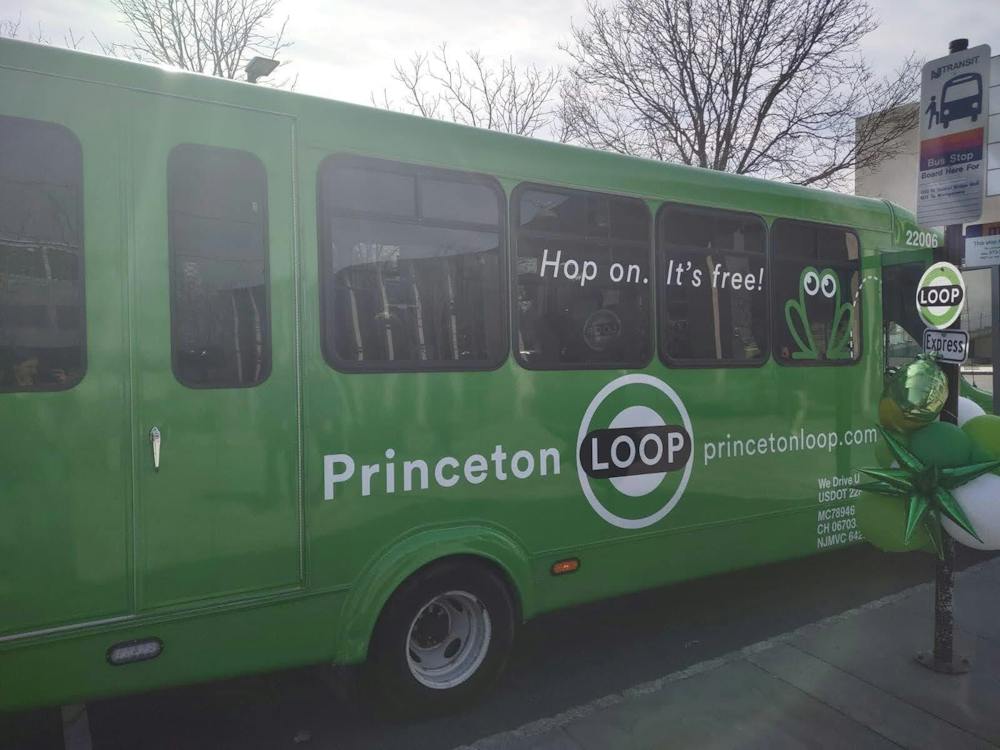
The Princeton Council voted at its Monday meeting to move forward with the purchase of two electric buses, subsidized by a state grant. The change comes as WeDriveU, the municipality’s current bus operator, decided to end service this winter.
Deputy administrator Deanna Stockton told the ‘Prince’ that WeDriveU cut the contract with the municipality short. The contract will now end on Dec. 16 rather than on Dec. 31, with the possibility of renewal afterwards. The municipality is currently seeking bids for a new operator.
It is unclear what the municipality will do after Dec. 16, as WeDriveU owns the two buses currently in operation in town. The new electric buses are not anticipated to arrive for around eight months. WeDriveU did not respond to a request for comment.
Princeton currently has two bus routes, the Princeton Loop Local and the Princeton Loop Express, the latter of which debuted earlier this year. Both the Local and Express routes are free. The buses are owned and operated by WeDriveU, which also operates the University’s TigerTransit service.
Unlike TigerTransit, which uses all-electric buses, the two municipal buses are gas-powered.
WeDriveU’s contract with the University is also set to expire later this year. In a statement to The Daily Princetonian, University spokesperson Ahmad Rizvi wrote that the University’s contract is ending on Nov. 20. A new provider is taking over service, though Rizvi did not share further details about the change in time for publication.
The Council’s decision on the electric buses came after a proposal at the meeting by Sustainable Princeton, a local nonprofit focused on reducing emissions, to fully electrify Princeton’s public transit system.
The proposal centered around a state grant awarded to the municipality in 2023, which is set to expire on Oct. 30. Under the grant, which is part of the Regional Greenhouse Gas Initiative, the municipality was awarded $434,000 by the New Jersey Department of Environmental Protection for the purchase of two electric buses.

Princeton University also received a RGGI grant in 2023 for 11 electric buses. However, the University had begun its transition to electric buses a year prior and made plans to purchase 17 electric buses in 2022. Rizvi wrote that the University did not use the state grant in a statement to the ‘Prince.’
While the Council had authorized a contract in 2023 with National Auto Fleet Group for the purchase of two electric Phoenix Motorcars Shuttle Vehicles, repeated issues in the acquisition of the vehicles led the municipality to explore different options in 2025.
The Sustainable Princeton proposal asks that the municipality utilize its RGGI grants to purchase a Micro Bird-150 and a Micro Bird-200 electric shuttle at a sum of $704,335. It also suggests the municipality own the buses itself to cut costs, though a contractor will still operate the buses.
With the RGGI grant included, the overall cost of the purchase for the municipality is estimated to be around $300,000, excluding the potential costs involved with furnishing designated charging sites for the electric buses.
According to the proposal, Princeton currently spends approximately $671,000 annually to operate the two Loop bus routes, with most of that expense coming from the contract with WeDriveU. The routes are supported by municipal revenue from parking facilities as well as other financial contributions for sustainable transit. Owning the buses is estimated to save the municipality around $100,000 per year.
Some officials initially expressed caution about the purchase, citing concerns including financing, the range of the electric buses, how they would fare in inclement weather, and the infrastructure and adjustments needed for adequate charging of the vehicles.

Princeton Mayor Mark Freda expressed reservations about the potential effect of cold weather in the battery ranges.
“I have an electric truck, so I know how much that battery power dips on a cold day, and if we start to have winters like we did last year, on those cold days, the mileage could be easily cut in half,” Freda said.
The subject of funding was also discussed at length, with the Council discussing the potential need for issuance of municipal bonds or paying lump sums for the electric vehicles.
Councilmembers Brian McDonald ’83 and David Cohen also spoke about the need for a site with fast electric chargers to recharge the electric buses during the day, and the potential impact of fast-charging during the day on battery performance.
Stockton, who is also a municipal engineer, recommended against moving forward at the meeting. “There’s a lot of things to consider based on what we heard tonight: the difference within the community, the demand for service.” Stockton said.
“It’s a very awkward moment now, being out on the streets for a bid to replace a service, and I think we need time to sit back and talk to the new vendor as well, about what goes into operating these,” Assistant Municipal Engineer James Purcell added, noting his concerns.
Ultimately, Cohen motioned for a vote, saying that he was “confident that we’re close enough to the solution that we’ll figure them out before they arrive.”
The purchase was approved to move forward with a 5–1 vote, with only Councilmember Leighton Newlin opposing the sale on grounds that it would unfairly disadvantage the “most vulnerable people,” as the electric buses will have fewer seats than the current buses.
“We’re going from 19 seats to 12 seats. We’re losing 40 percent capacity on every single one of these buses at a time when we’re trying to increase ridership both on the Local and on the Loop Express,” Newlin said.
While the discussion on electric buses took up the largest portion of the meeting, the Council also discussed the municipality’s ongoing efforts to improve Community Park South and results from a flood study conducted on Harrys Brook.
The Princeton Council typically meets at 7 p.m. on the second and fourth Monday of each month. The next meeting is scheduled for Oct. 26.
Joshua Kim is a reporter-in-training for the ‘Prince’ from Auburn, Ala. He is a member of the Class of 2030.
Please send any corrections to corrections[at]dailyprincetonian.com.
Read More

Staff Picks: Football vs. Brown
Saad Akhtar, Alex Beverton-Smith, and Juha ImPrinceton football is set to take on Brown this weekend at home. The Daily Princetonian Sports section makes their picks for the game.
Princeton football is set to take on Brown this weekend at home. The Daily Princetonian Sports section makes their picks for the game.

Roundup: Marvel Jem Roth and Isaac Barsoum on their advocacy related to the Title IX process at Princeton, ‘hearing math,’ and proctors in the classrooms
Tendai Jobarteh, Devon Rudolph, and Danny ShingAn in-depth interview with Undergraduate Student Government treasurer Marvel Jem Roth ’28 and U-Council chair Isaac Barsoum ’28 on their advocacy related to the title IX process at Princeton, ‘hearing math,’ and proctors in the classrooms, ‘hearing math,’ and proctors in classrooms during the midterms.
An in-depth interview with Undergraduate Student Government treasurer Marvel Jem Roth ’28 and U-Council chair Isaac Barsoum ’28 on their advocacy related to the title IX process at Princeton, ‘hearing math,’ and proctors in the classrooms, ‘hearing math,’ and proctors in classrooms during the midterms.

Women’s rugby sees early success under new coaching staff
Devon RudolphPrinceton women’s rugby made several strides in their team with hopes to participate in the championship league next season.
Princeton women’s rugby made several strides in their team with hopes to participate in the championship league next season.