



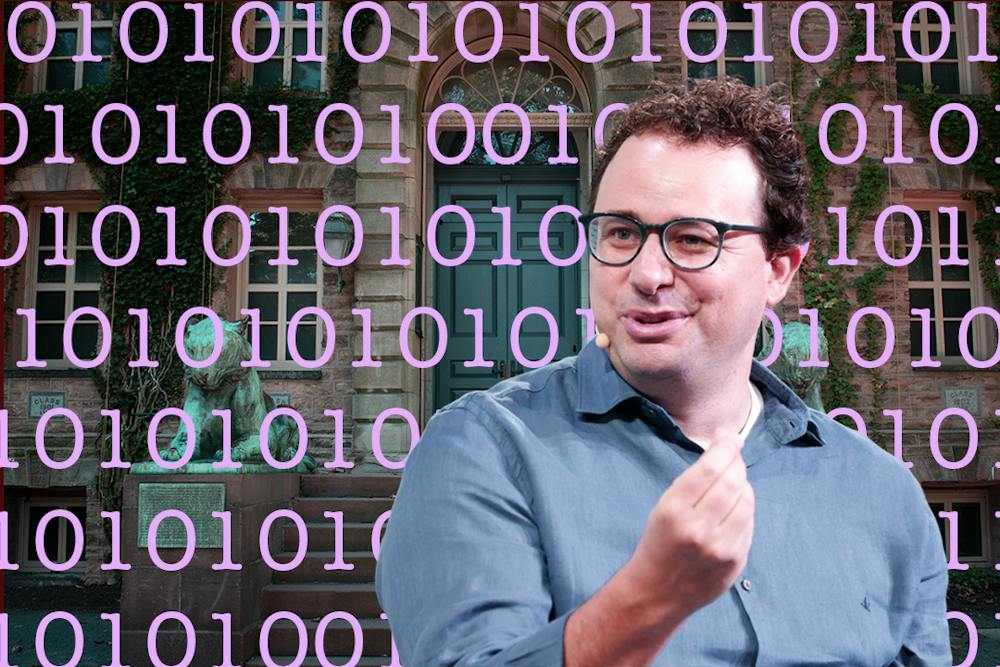
In the spring of 2007, a 24-year-old physics Ph.D. student named Dario Amodei GS ’11 sat across from neuroscience professor Michael Berry in his office in the basement of Guyot Hall and seriously entertained the possibility of pursuing biophysics research for the first time in his academic career. “I would like to thank Michael for introducing me to experimental physics and neuroscience, which have greatly expanded my intellectual horizons,” Amodei would later write in his 2011 doctoral dissertation.
The initial impression that Berry got from Amodei as they discussed potential projects “was that he was very, very sharp, but also very ambitious.”
“[Amodei] was interested in essentially thinking about technologies that could have a comprehensive impact to address scientific and technological problems,” Berry told The Daily Princetonian.
Two decades later, Amodei is working through precisely the same questions. As the CEO and co-founder of Anthropic, one of the world’s most valuable AI companies, Amodei sits at the center of a global AI boom that he believes can “cure most major diseases” and “usher in a renaissance of democracy and freedom.” But as governments and companies race to develop and harness AI technologies, Amodei has also called for slowing the pace of its development, making him the target of backlash from the highest levels of government.
Yet for all his newfound prominence, the tech mogul has rarely, if at all, spoken publicly about his time at Princeton. From 2006 to 2011, Amodei conducted research with colleagues in the physics and molecular biology departments, which culminated in a dissertation that examined how brains process data.
“He was just extraordinarily talented,” Berry, one of Amodei’s Ph.D. advisors, said. “I’d say definitely, the most talented graduate student I’ve advised while at Princeton.” Other researchers who worked with Amodei on campus echoed these sentiments, describing him as a diligent, intelligent student.
“At the time, he didn’t seem at all interested in lots of money or fame — he was interested in doing really good science on an ambitious scale and, I thought, ultimately using his abilities to try to cure diseases,” Berry said.
Physics professor William Bialek, who also advised Amodei, declined to comment. Amodei did not respond to multiple requests for comment.

Entering the second year of his Ph.D., Amodei joined Berry’s lab, which focused on sampling retinal cells in animals and examining how they transmit visual information. There, a main technical challenge was grouping and interpreting electrical signals in the retina after recording them, and the lab needed a device to precisely measure spikes for thousands of electrodes.
Amodei built the multi-electrode array himself. “It was, in the scheme of things, a pretty ambitious technology development project,” Berry said. “No one else in the lab was doing anything like that.”
That work eventually turned into a 2012 paper that postdoctoral researcher Olivier Marre worked on with Amodei, which examined techniques to record neural cells in the retina. “Dario spent a large part of his Ph.D. working in a cleanroom,” Marre recalled in a statement to the ‘Prince.’ “He was a smart, hard-working student — like many Ph.D. students I met during my time in Princeton.”
The rest of Amodei’s Ph.D. was mostly focused on finding a way to create small pipettes to more precisely measure electrical activity in cells. A patent for the technology listing Amodei, then-postdoctoral researcher Fred Soo, and Eve Schneider GS ’12 was filed in July of 2010, although it was later labeled as “Abandoned.” Soo could not be reached for comment, and Schneider did not respond to a request for comment. A paper on the technology was never published, though Berry noted that Amodei included “promising preliminary results” in his dissertation.
During his time on campus, Amodei was a Hertz Foundation Fellow. He was also awarded the National Defense Science and Engineering Graduate Fellowship and a Princeton Centennial Fellowship, which provides graduate students with one year of full financial support.
Beyond conducting his own research, Amodei was also a “mentor” in the lab, according to Nikhil Deshmukh GS ’15. “Dario and I exchanged ideas on how to better organize scientific research as an enterprise,” Deshmukh, who worked with Amodei from 2010 to 2013, wrote in a statement to the ‘Prince.’ “We also commiserated about how the current system is broken. But mostly, we focused on how to make pipettes.”

In 2014, Deshmukh was struggling to complete his dissertation, and Amodei wrote to the head of the graduate program advocating on his behalf, according to Deshmukh. As Amodei closed out his time at Princeton, he also showed Deshmukh how to use photolithography machines to create prototype pipettes.
“In all these projects, Dario spent much more time on hardware than on software, so I guess he was pretty far from any AI-related project at the time. But AI was not a trending topic back then,” Marre, now a researcher at the Vision Institute in France, wrote.
Much has changed since then for Amodei and AI. But those who knew him as a researcher at Princeton see great familiarity in the now-tech giant. “Dario’s mannerisms haven’t changed,” Deshmukh wrote. “What you see in interviews is how he carried himself in grad school.”
Upon earning his Ph.D. in Biophysics from Princeton in 2011, Amodei completed a postdoctoral fellowship at Stanford, where he researched cancer detection and mechanisms under Stanford professor Parag Mallick.
Though Amodei had little background in the cancer research Mallick was conducting, he “would spend weekends burning through every paper that had ever been published on a topic to come up to speed,” Mallick said in an interview with the ‘Prince.’ “That was a tribute to his ethos of approaching things with a very practical humility,” he said.
As Amodei’s time at Stanford approached a close in December 2014, he and Mallick weighed a wide range of potential avenues, from going into academia, to joining a research institute or a government lab, to starting a company. “Everything was on the table at that time,” Mallick said.
Around the same time, the earliest iterations of AI technologies were being birthed at Stanford and beyond. “[Amodei] was seeing from his friends and colleagues just how powerful these methods were, so I think that definitely laid the foundation for his future,” he said.
After working at Baidu and Google, Amodei joined OpenAI in 2016. Disputes over the company’s approach to AI safety and vision, however, eventually led him to resign and co-found Anthropic with a handful of former OpenAI employees in 2021.
Next month, Anthropic is set to stage a record-breaking initial public offering that could place the company’s value at $2 trillion and raise $100 billion. Last week, the company released its third Claude 5.5 model at a per-token cost 75 percent lower than Claude Haiku 4.5, another recent model.
“Dario is an incredibly principled person; [he has] that core drive to have a significant and positive impact on the world,” Mallick said. “I think what he’s doing now really brings together those elements.”
“In retrospect, it makes a lot of sense because he’s just extraordinarily talented,” Berry said, emphasizing Amodei’s interest in biomedical research aimed at curing diseases and using technology to address a broad range of problems. “I think it’s all kind of related to this interest I thought he already had by the time he first showed up in my office to talk to me about projects.”
Sena Chang is a staff Features writer and the associate News editor for the ‘Prince’ leading investigations. She is from Japan and South Korea, and she often covers local politics and student life. She can be reached at sena[at]dailyprincetonian.com.
Please send any corrections to corrections[at]dailyprincetonian.com.
Read More

Staff Picks: Football vs. Brown
Saad Akhtar, Alex Beverton-Smith, and Juha ImPrinceton football is set to take on Brown this weekend at home. The Daily Princetonian Sports section makes their picks for the game.
Princeton football is set to take on Brown this weekend at home. The Daily Princetonian Sports section makes their picks for the game.

Roundup: Marvel Jem Roth and Isaac Barsoum on their advocacy related to the Title IX process at Princeton, ‘hearing math,’ and proctors in the classrooms
Tendai Jobarteh, Devon Rudolph, and Danny ShingAn in-depth interview with Undergraduate Student Government treasurer Marvel Jem Roth ’28 and U-Council chair Isaac Barsoum ’28 on their advocacy related to the title IX process at Princeton, ‘hearing math,’ and proctors in the classrooms, ‘hearing math,’ and proctors in classrooms during the midterms.
An in-depth interview with Undergraduate Student Government treasurer Marvel Jem Roth ’28 and U-Council chair Isaac Barsoum ’28 on their advocacy related to the title IX process at Princeton, ‘hearing math,’ and proctors in the classrooms, ‘hearing math,’ and proctors in classrooms during the midterms.

Women’s rugby sees early success under new coaching staff
Devon RudolphPrinceton women’s rugby made several strides in their team with hopes to participate in the championship league next season.
Princeton women’s rugby made several strides in their team with hopes to participate in the championship league next season.