



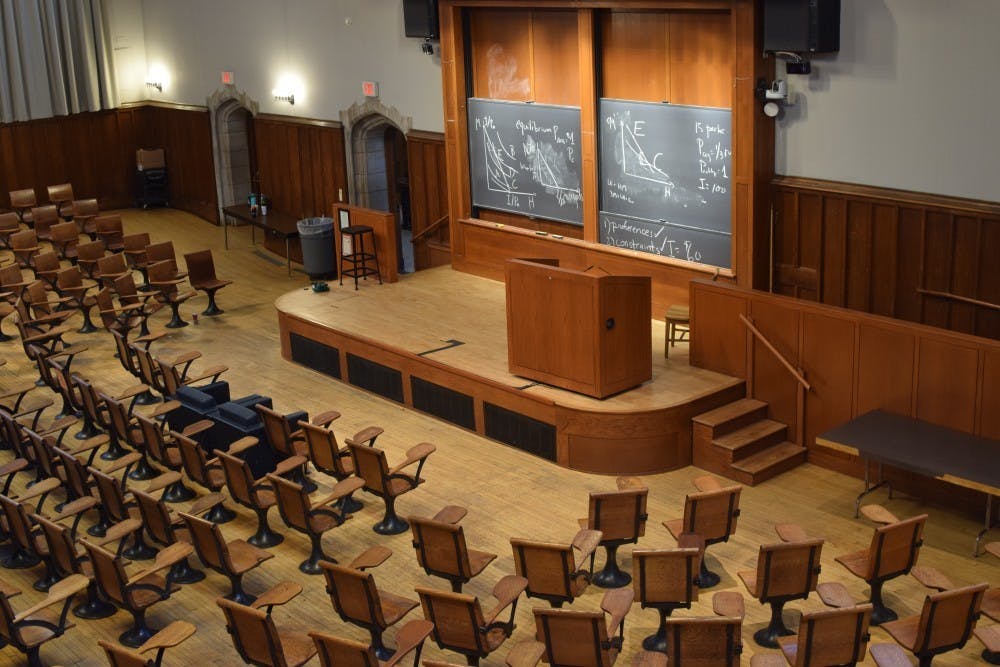
Generative AI might help some students draft papers, solve problem sets, and summarize readings, but technology can’t answer for a student when a professor suddenly calls on them in lecture.
Princeton faculty have relied on cold-calling for years to encourage student discussion and learning. For some professors, cold-calling has now become an invaluable tool of gauging student comprehension in a landscape where artificial intelligence is changing the way students learn.
“It is a good way to avoid having the professor/lecturer as the only voice in the room,” Visiting Lecturer in the School of Public and International Affairs Susan Marquis wrote in a statement to The Daily Princetonian. Marquis said she had been cold-calling for about 15 years.
Marquis teaches SPI 298: Introduction to Public Policy — Authority, Incentive, Persuasion. “[Cold-calling] is effective in jumpstarting a culture of active student conversation and engagement in a class,” she continued. “I generally find that once the course is underway, there is less cold-calling and more student-initiated discussion because students are used to talking in the classroom, whether large or small.”
For economics professor Sylvain Chassang, who implements cold-calling in ECO 300: Microeconomic Theory, it’s more about measuring student comprehension of the material. “It’s really for me to make sure that people understand what’s going on,” he said in an interview with the ‘Prince.’
According to Chassang, students are hesitant to disrupt large classes with questions, so cold-calling makes it easier for students to speak up when confused. “I try to make it easy for people to slow down the class,” he explained.
Both Marquis and Chassang described challenges with implementing the policy in instances of shy students.
“[The] key is keeping the tone kind and light-hearted, while being attentive to what students have to say. It’s not about judgment but about engagement with the material,” wrote Marquis.

If students look uncomfortable when called on in class, Chassang explained, he moves on to someone else to avoid increasing their stress level.
Professor Henry Shim, who teaches ECO 101: Introduction to Macroeconomics, relies on voluntary participation, citing the reservations students have. “You have — in my classes — hundreds of your peers, and you’re always nervous that you’re going to be judged or you get something wrong, and it’s a scary prospect,” he said.
Cold-calling is used outside of the social sciences as well. Lyman Page, who teaches PHY 104: General Physics II, calls on rows rather than particular students. “It’s just to find that balance between keeping the class engaged and thinking about what’s going on, and not terrifying anybody,” said Page.
Students in cold-calling classes reported varying feelings on the technique depending on how it was implemented. Gwennie Nellis ’29 experienced cold-calling in both math and physics classes, and says she had different experiences in both.
“I had never learned anything multivariable calculus before,” Nellis said. She continued, “That really stressed me out, and I switched out of [the course section] because it was very stressful to try and answer questions that I had never seen before,” she continued.
In contrast, Nellis described a positive experience with cold-calling in PHY 104. “The stakes were not as high — it felt like we were all learning. I think it really depends on how they implement it,” she said.

Bella Postel ’28, a student in SPI 298, described being more comfortable with the policy than she anticipated. “It sort of gets rid of the fear of having to speak in front of the class because everyone has to do it,” said Postel.
In an era defined by technological developments, professors emphasize the importance of classroom engagement and discussion in the process of learning, particularly in preparation for life after college.
Chassang also said that cold-calling is applicable to real life.
“[Cold calling is] defending ideas live to someone else, and that I think reflects the challenges of AI,” said Chassang. “It’s realistic in life. You are at a meeting, you are making a presentation. You’re going to have to defend it.”
“[In life after college,] you will be expected to do work with a [chatbot], but you’ll also be expected to own the product,” Chassang explained. “We’re sort of converging to ways to evaluate people that reflect these two forces.”
Because students can now confirm answers instantly with generative AI, Shim said that many have lost the ability to feel comfortable with uncertainty. “I think what we really lose when we have generative AI so easily accessible is we lose the feeling of not really knowing if we’re right because you get to check instantly,” said Shim.
“That moment that you as a student raise your hand in class and you’re saying something, there’s no guarantee that you’re correct,” Shim continued. “If we don’t build the tolerance and comfort with that in college, you never really get a chance to get used to it.”
Hannah Adams is a staff Features writer for the ‘Prince.’
Please send any corrections to corrections[at]dailyprincetonian.com.
Read More

Under 20 enrolled in first semester of TCNJ and Princeton cross-registration program
Rajbir ToorThe cross-registration program allows students at the two universities to take select courses at the other institution. Several TCNJ students who are taking classes at Princeton this semester shared their thoughts with The Daily Princetonian.
The cross-registration program allows students at the two universities to take select courses at the other institution. Several TCNJ students who are taking classes at Princeton this semester shared their thoughts with The Daily Princetonian.

Terhune Orchards navigates tough season as State Legislature considers relief
Walker VivianA cold freeze followed a heat wave in April, leading to major crop losses across New Jersey. A newly introduced state bill would bring $60 million in support to impacted farms, including Terhune Orchards near Princeton.
A cold freeze followed a heat wave in April, leading to major crop losses across New Jersey. A newly introduced state bill would bring $60 million in support to impacted farms, including Terhune Orchards near Princeton.

An ode to rainy days: How Community Action lifted my spirits
Kallysta KomlanContributing Writer for The Prospect Kallysta Komlan reflects on how she found community through Princeton's Community Action.
Contributing Writer for The Prospect Kallysta Komlan reflects on how she found community through Princeton's Community Action.