



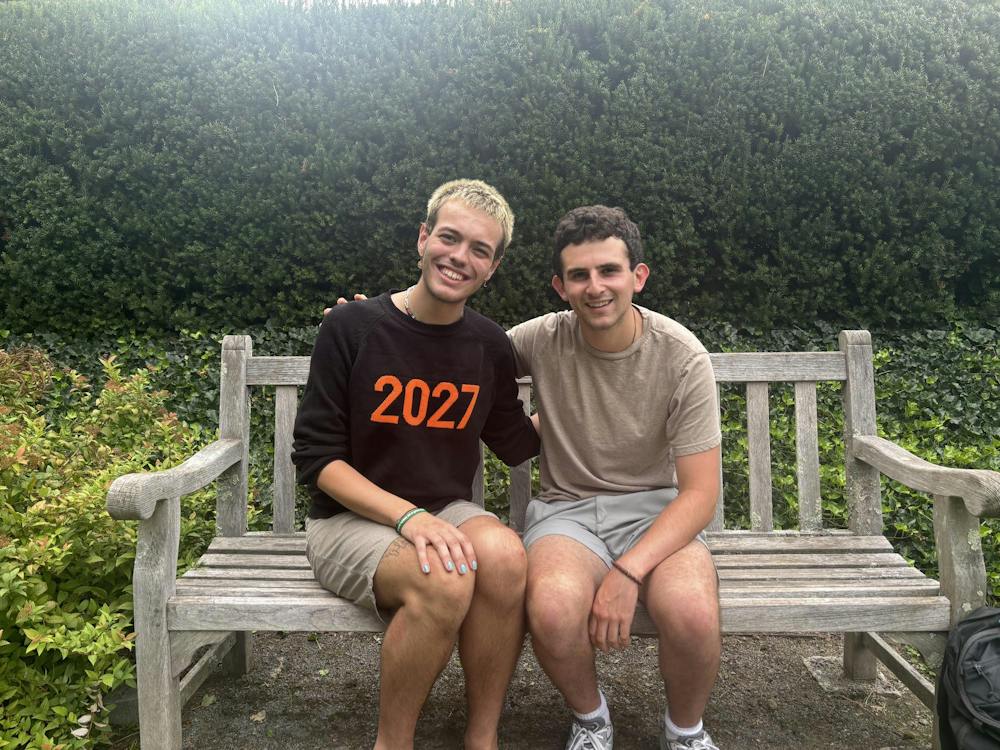
Jack Goodman ’27 and Jack Musser ’27, host and co-host for Season 15 of All-Nighter, Princeton’s student-run late-night talk show, stare out at the fragrant expanse of Prospect Garden from their wooden bench. For 57 seconds, they contemplate who their ideal special guest would be.
In All-Nighter’s 15-season history, the talk show has brought a plethora of special guests onto the Frist Theater stage. University President Christopher Eisgruber ’83 made an appearance and was thrown “the fastest bar mitzvah ever.” Cara McCollum ’15, Miss New Jersey 2013, came and acted in a Miss All-Nighter Competition. Irish poet, Pulitzer Prize winner, and creative writing professor emeritus Paul Muldoon engaged in a battle of punny wits. Goodman and Musser, who sat down with The Daily Princetonian to share their opinions on comedy, hadn’t yet considered who they would bring to the stage.
“Can we get Malala?” Musser asked.
Goodman agreed. “There was an article in The Sunday Times about Malala — it was actually kind of sad. It was about her PTSD being triggered by hitting a bong. I don’t know why that popped in my head.”
“Cause you want a bong,” Musser said.
Goodman and Musser fell back into their quiet, contemplative states.
“What about Mamdani?” Musser suggested.
Before Season 14 of All-Nighter came to a finale, former host Tyler Wilson ’26 and co-host Sophia Shepherd ’26 had to pass the torch to two successors. The selection process began with a self-tape video submission where candidates had to perform a list of pre-selected monologue jokes, write and act out two of their own monologue jokes, and read both roles of a pre-selected sketch. Afterward, the previous season’s Executive Committee, including Wilson and Shepherd, gathered at a dramatically long conference table in Green Hall and evaluated the submissions on a projector screen. Their favorites were invited for callbacks in Campus Club, among whom were Musser and Goodman, who tuned in virtually from Sweden.

Tyler Wilson was a senior Prospect writer and senior Humor writer for the ‘Prince.’
“A lot of the audition process has to do with chemistry,” Wilson explained. “It has to do with building a pairing that will work well together, both in their synergy as comedians, but also in the kind of dissonance they can bring when you put one personality up against another personality.”
The dilemma of the “Jack off” this semester, as Wilson and Shepherd phrased it, is that these are comedians with antithetical personalities. But it’s also what excited the previous season’s Executive Board most during the audition process.
Goodman hails from a “funny family” in Chicago and has always been a comedy buff, particularly for Saturday Night Live, The Lonely Island, John Mulaney, and Bo Burnham.
“My personality has been consistent my whole life, and I think the things that I have found funny have been the same my whole life,” Goodman said, who approaches comedy from the perspective of a writer and English major, “and the way I pursue them, or thought about them, that’s the only thing that I think of that’s changed over time.”
Goodman joined the All-Nighter writers’ room as the only first-year in a roomful of sharp-witted upperclass students armed with years of comedy sketch writing experience. The writers’ room originally intimidated Goodman, but he was able to get a sketch of his in the first episode of Season 12 – during his freshman year – and filled the position of head writer in his sophomore and junior years.

Wilson and Shepherd saw Goodman as offering the “straight man” approach in comedy, meaning the serious, sensible partner in a duo.
Goodman “is super, super smart, and his joke construction is pretty much perfect,” Wilson said. “He’s a real student of the craft. He worships at the altar of form and that’s really beautiful, especially when it’s put in collaboration with a comedian like Jack Musser.”
From the small village of Pomeroy, Ohio, Musser grew up singing in the church choir and thriving in the musical theater world. He always considered himself to be “situationally funny,” producing humor naturally through his disorganized and messy life.
“I’ve always been a little bit funny, a little bit off, but when you step into that and let people laugh with you instead of laughing at you, then it becomes humor that you can use as a tool,” Musser said. “I don’t really have as much of a grasp on, ‘I’ll put these words in this order, and that is a punchline, and boom, that’s gonna make the audience laugh.’ It’s more like I will just stretch out like my limbs until I find that connecting point.”
Musser entered Princeton’s comedy scene as a first-year through the Triangle Club, the student musical comedy group, and then through occasionally acting in All-Nighter sketches.
During callbacks in Campus Club, Goodman and Musser were never paired together by the Executive Board.
“We didn’t think it could be Jack and Jack,” Shepherd said. Their hesitation stemmed partly from the identical first names, and partly from the Executive Board’s favor for an opposite gender host and co-host dynamic, which had been the case for the previous two seasons. In the discussions after callbacks, however, sentiments shifted. “Someone said, ‘Wait, what if it was Jack and Jack?’ And I remember the room went silent for a second, and then we were like, ‘Whoa, that’s crazy! That’s a good idea!’” Shepherd continued.
Goodman and Musser appeared on stage together for the first time at the sold-out Reunions show where they never, not for a moment, shied away from the spotlight.
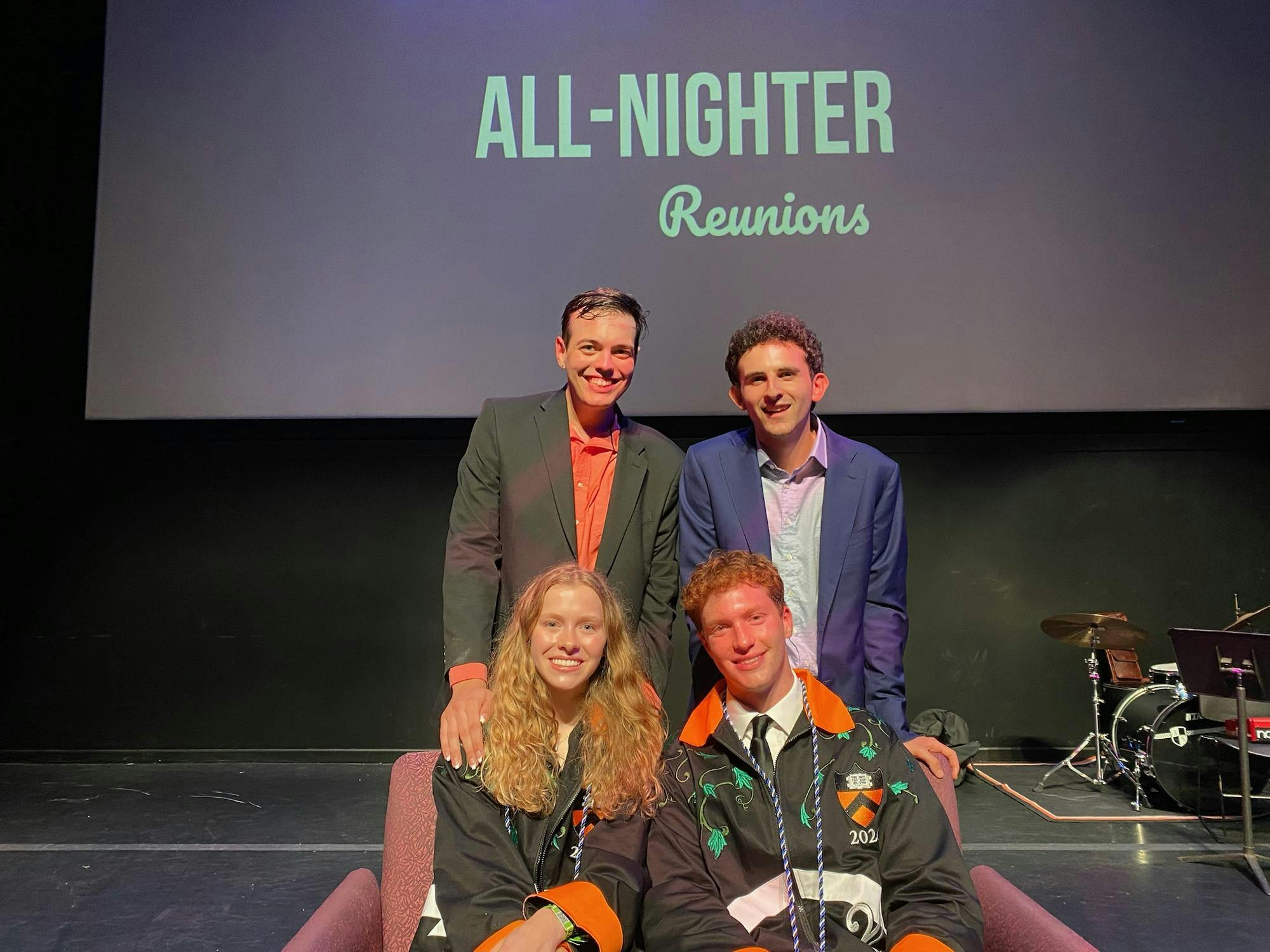
Jack Musser '27 (top left), Jack Goodman '28 (top right), Sophia Shepherd ’26 (bottom left), Tyler Wilson ’26 (bottom right) at the All-Nighter Reunions show in 2026.
Photo courtesy of Jack Musser
“It feels very good to be observed, and maybe that’s egotistical,” Musser said. “I put so much thought into how I approach these situations, the movements that I will do on stage, and how I will say things. When I can hear and feel that there are people seeing that and appreciating that, that feeds my soul.”
Goodman felt similarly. “Making people laugh is the best. And doing it at scale is cool. All-Nighter too is especially fun because it really does feel like you’re talking to your friends, but there’s like 350 of them.”
When students funnel into Frist Theater on a Friday night, they’re being greeted at the door, the house band is playing, the room is teeming with chatter, and everything feels put together. Pulling back the curtain on the production reveals far more chaos than the show lets on.
“We write up until, more or less, the moment the show starts,” Goodman said. “My sophomore year, there was a show — this was uniquely bad — but there was a show where I was writing jokes Friday afternoon that were on stage Friday night, and the host and co-host were learning their lines backstage during sketches, which is not normal, but so fun.”
An hour before audience members file in, cast members are running sound checks, the house band is warming up, dance groups are rehearsing, and sketches are being staged, often for the first time.
“I have a video from a couple years ago of one of my best friends in a hot dog costume on his knees screaming that his mom just died,” Goodman said. “It’s him, and the band is playing, and there’s a dance group dancing at the same time.”
All-Nighter might be a student group, but they’re grappling with the same questions as all industry professionals. In the social media age, society is exposed to a surplus of digital content at the swipe of a finger. All-Nighter is swimming in a comedy current in search of what topics there are left to joke about.
“I think some people make important comedy. I have never aspired to make important comedy, and I don’t think that I do. I write silly jokes,” Goodman said, referring to the work of political comedians such as Hasan Minhaj, Jon Stewart, and John Oliver who frequently comment on social, political, and economic issues.
“You can tell if something is punching down,” Goodman went on. “I don’t think there are hard rules, but you can feel if something just doesn’t sit right, and that’s sort of easy to avoid.”
Musser, a psychology major and aspiring therapist, strives to make people crack a smile or laugh in any way he can. “Sometimes just a simple laugh and just a cheap laugh is what we need to make it through the day.”
“I hate the sort of podcaster-comedian-bro shit of, ‘comedy is the last art form standing against the tide,’” Goodman said, pitching his voice low and macho. “I don’t think that comedy that doesn’t attempt that isn’t valuable. I’m wary of the self-aggrandizing thing in general.”
“That was a big word,” said Musser.
“I believe in you,” consoled Goodman. “Self-aggrandizing, like self-important. Taking yourself too seriously.”
“That was for everyone and for the readers as well.”
Musser and Goodman also have to consider the placement of and indulgence in profanity when composing sketch comedy.
“When we use [profanity] with taste, it lands so much more,” said Musser, believing that when swear words serve a purpose beyond filler, jokes feel more thoughtfully crafted.
“I think if you write a joke where the punchline is ‘fuck,’ probably it’s not a very good joke,” Goodman said. “But I do think that the way jokes are written should reflect the way people speak, and swearing is part of it.”
“Is it even funnier to say I love you than fuck you at this point? Because it’s less expected?” Musser asked.
Late-night American television has declined in profitability and viewership, and it has also come under fire from the Trump administration in recent months. “Jimmy Kimmel Live!” was suspended for six days in September 2025 after Kimmel made comments about Charlie Kirk’s assassination. Kimmel also took an interview with James Talarico, Democratic nominee for the Senate in Texas off-air after threats from the Federal Communications Commission.
“Yanking these [shows] off the air because they’re saying challenging things to hear is totally unethical,” Goodman said.
“We are so lucky to be hosting and co-hosting this show at a place where we know we can sort of say whatever we want on the stage, to a reasonable extent,” Musser said. “We can push [speech] a little further without that fear of what’s gonna happen to us because we know we’re gonna have All-Nighter and then next year we’ll be gone.”
All-Nighter has cultivated a social space on campus where faculty, students, and alumni can sit side by side and chuckle about the colorful idiosyncrasies of campus culture.
“I’m so stoked to be performing myself and, also, I’m so stoked to get to write for Jack [Musser] because he elevates everything you give him,” Goodman raved. “He has a physicality that I have seen in so few other performers. He can get a laugh wordlessly, walking on stage or off stage, which is so fucking hard to do.”
“I would say all the words about how beautifully you write, but I just don’t have the words to say them as well,” said Musser. “He’s just such a smart man, and there’s always something that takes me a little too long. I always know that [his writing] is good, and I can always trust him.”
Goodman and Musser break out into a fit of laughter.
Musser gushed, “Aw, Jack-Jack.”
The pair high-five.
“Or just one word. Jack,” Goodman suggested.
“But honestly, I really think language is limiting at this point to how we would describe our bond and union.”
“No labels. I won’t tell my girlfriend.”
“And I won’t tell her either … about … see, this is why he writes!”
Lola Horowitz is an assistant Features editor and staff Archivist for the ‘Prince.’
Please send any corrections to corrections[at]dailyprincetonian.com.
Read More
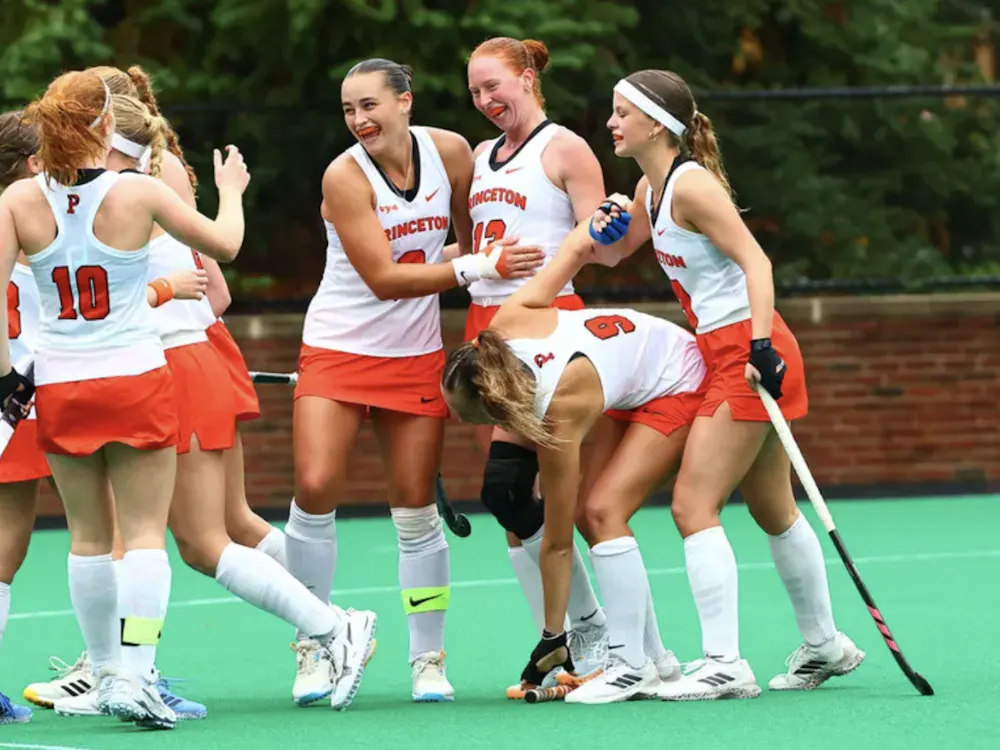
No. 10 field hockey sweeps the weekend: edges Yale 2-1, blanks Temple 3-0
Caden Hammond and Ari AhdiehNo. 10 Princeton field hockey snapped a three-game skid with wins over Yale and Temple.
No. 10 Princeton field hockey snapped a three-game skid with wins over Yale and Temple.

Women’s soccer scores twice late to stun Yale 2–1
Walker VivianPrinceton women’s soccer erased a late 1–0 deficit with two goals in seven minutes, defeating rival Yale 2–1 behind a brace from first-year forward Stella Monberg.
Princeton women’s soccer erased a late 1–0 deficit with two goals in six minutes, defeating rival Yale 2–1 behind a brace from first-year forward Stella Mounberg.

Staff Picks: Men’s Soccer vs. Hofstra
Emily Ganter, Juha Im, and Matthew YiPrinceton heads to Hofstra looking to build on its first Ivy League win of the season and avenge last year’s 1–0 loss to the Pride.
Princeton heads to Hofstra looking to build on its first Ivy League win of the season and avenge last year’s 1–0 loss to the Pride.