



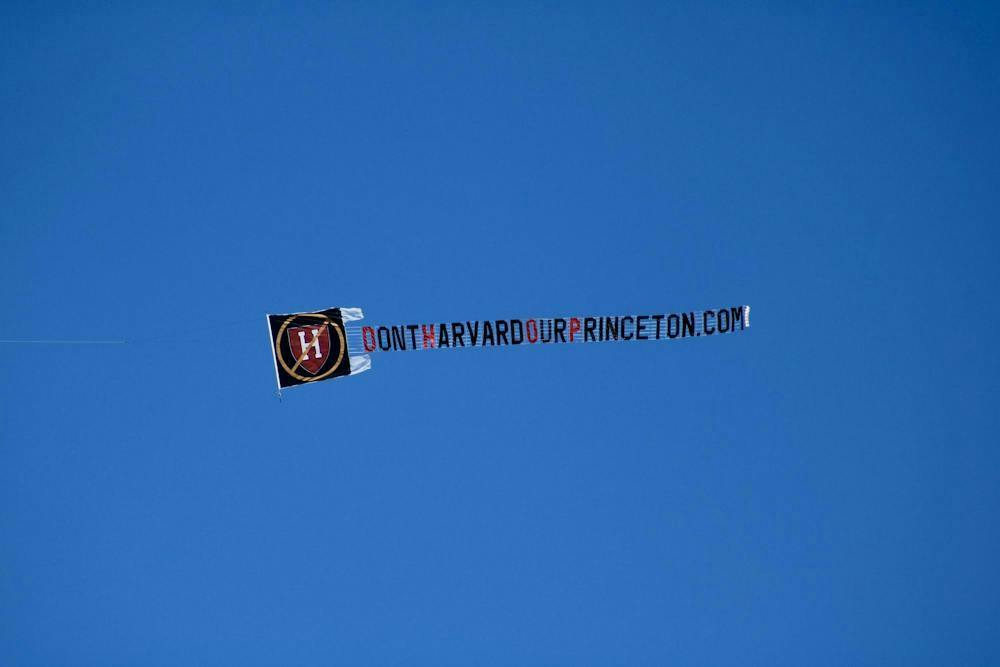
Last fall, Princeton administrators announced that beginning this academic year, no student living on campus would be allowed to not have a meal plan, and that all upperclass students would be required to purchase a $900 Block 32 University meal plan. Deemed an “existential crisis” for Princeton’s eating clubs and cooperatives, the proposal faced significant backlash from students and alumni alike, coalescing into the “Don’t Harvard Our Princeton” campaign led by the Graduate Interclub Council.
Through this advocacy campaign, Princetonians succeeded in preventing a full implementation of the plan, with administrators walking back a mandatory Block 32 plan purchase and electing to provide the swipes for free. The elimination of the independent status persisted, however. The Prospect Avenue polemics that led to this decision are not new, but rather the latest step in the Princeton tradition of opposition to University-instituted attempts at changes in student social life.
Over 100 years ago, Princeton President Woodrow Wilson, Class of 1879, proposed his “quad” plan, which similarly received intense criticism before ultimately succumbing to students’ demands. First published in June 1907 in Princeton Alumni Weekly as part of Wilson’s “Report on the Social Coordination of the University,” the quad plan stemmed from his distaste for the clubs’ independence and resultant disconnect from academic life. Wilson claimed that the clubs “divide all four classes into segments and sharply separate the classes as wholes” between the first and second halves of undergraduate education.
Beyond under- and upperclass division, Wilson disapproved of the clubs’ “organization [being] entirely outside university action,” such that they possessed “no organic connection whatever with anything academic.” Most of all, Wilson detested how, because “all social ambitions turn upon” the clubs, they absorbed “the attention and all the planning faculties” of Princeton’s undergraduates, to the point where undergraduates’ thoughts were “constantly fixed” on whether they would obtain entry to a club.
Drawing upon England’s college system, Wilson advocated for a residential college system akin to that of today, in which students would dine, live, and socialize together across class years, intended to affect the eating clubs’ “abolition or … absorption” into the new system as smaller residential quads. To this end, for Wilson, the majority of upperclassmen abstaining from the system would be “out of the question.”
Later that year, on Oct. 2, 1907, the ‘Prince’ published an anonymous editorial in response to Wilson’s plan. Noting that the proposed change “caused endless comment and criticism” among all associated with Princeton, it argued that “the social side [of the University] is peculiarly a possession of the students.” Moreover, it raised concern as to whether the plan’s proposed benefits “would thoroughly justify a change so radical that Princeton as it is to-day would cease to exist and another, a strange and unknown Princeton rise in its place.”
Not only students, but alumni, too, opposed Wilson’s plan. In the following issue of the PAW, Henry van Dyke, Class of 1873, shared his reflection that the clubs “had really participated in the intellectual quickening of the university during recent years.” Further underpinning his opposition to the plan, van Dyke predicted that the scheme would “produce first social confusion, and then social stratification.” After careful consideration, Adrian Joline, Class of 1870, penned, in a letter to PAW, that “the adoption of this plan will be the destruction of Princeton,” believing that the “great majority of alumni are against the scheme,” such that he had not encountered one unopposed to it.
Due to the “strong resistance from the eating clubs and alumni,” the Board of Trustees ultimately chose to not adopt Wilson’s plan. More specifically, Bill Paul ’70 noted that alumni “hit Wilson where he had no defense-in the pocketbook,” since the Trustees’ decision was motivated by “fear that alumni would withdraw their financial support for the university.”

Like that of 1907, last year’s proposal to modify dining options faced immense student and alumni backlash, which ultimately led to the University’s concession. The backlash materialized as an interclub “Don’t Harvard Our Princeton” campaign, a reference to controversy between Harvard and its “social finals clubs.” Described by Robert Cooper ’82, Chairman of the GICC and alumnus of Tiger Inn, as “the most serious threat faced by the Street in our 146-year history,” the campaign distributed custom T-shirts to eating club members and conducted a flyover of the Harvard-Princeton homecoming game. According to the GICC, the campaign’s success demonstrated “the power of our community when we stand together,” ensuring that “Princeton’s eating clubs and co-ops will continue to be the vibrant, student-led institutions that have defined the undergraduate experience for generations.”
Over a century has passed since Wilson proposed his quad plan, and Prospect Avenue remains a pillar of social engagement at Princeton, on account of student and alumni efforts to maintain its independence. In highlighting Princetonians’ enduring opposition to social changes instituted from above, backlash against Wilson’s plan and last year’s proposed change suggest divergent understandings of the Princeton community and experience. Together, these events indicate the benefit to be had in adopting bottom-up dialogue and communication when seeking to improve Princeton for all.
Vincent Sanfedele is a staff Archivist for the ‘Prince.’
Please send any corrections to corrections[at]dailyprincetonian.com.
Read More

Women’s volleyball sweeps Columbia, falls to Cornell in weekend conference slate
Emily Ganter and Lucas NorThe Tigers are now 2–1 in conference play, and will host Yale and Brown next weekend.
The Tigers are now 2–1 in conference play, and will host Yale and Brown next weekend.

New Indigenous mosaic unveiled in University Chapel
Lucy HarperThe University Chapel welcomed a new mosaic by Marianne Nicolson over the summer. The artwork, titled “Presence,” incorporates traditional Native American motifs.
The University Chapel welcomed a new mosaic by Marianne Nicolson over the summer. The artwork, titled “Presence,” incorporates traditional Native American motifs.

PSafe report shows decrease in liquor violations, includes new hazing data
Joshua KimPrinceton’s 2026 Security and Fire Safety Report showed that motor vehicle theft continued to be the most reported crime in Princeton. It also shows a continued decline in liquor law violations, and an increase in drug referrals since 2025.
Princeton’s 2026 Security and Fire Safety Report showed that motor vehicle theft continued to be the most reported crime in Princeton. It also shows a continued decline in liquor law violations, and an increase in drug referrals since 2025.