



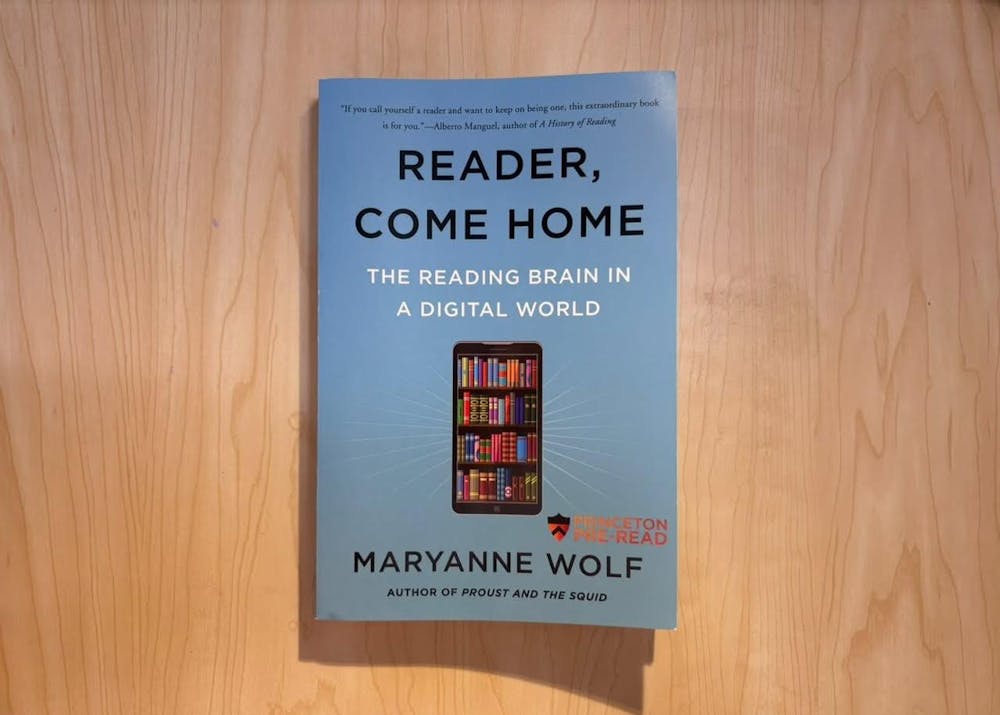
When I saw the title of the 2026 Pre-read, my first reaction was to groan. “Reader, Come Home: The Reading Brain in a Digital World” seemed like a reiteration of lectures I’ve already heard a hundred times. Here’s yet another book about the dangers of technology that would treat my generation like braindead, doomscrolling idiots who are sure to sell our souls to AI.
I admit that I had little intention of reading the book when it arrived: I felt that I had better things to do than read a book more likely to shame me than tell me anything new. I eventually read it — partly in need of something to do, partly out of the guilt of seeing it sit unread on my shelf every day. Ultimately, the book ended up being more enjoyable and thought-provoking than I expected.
However, “Reader, Come Home” is part of a larger conversation about technology and education that is too often repetitive, one-sided, and condescending towards young people. Students, then, become primed to tune out and reject these crucial conversations before they’ve even begun.
In the Pre-read, author Maryanne Wolf writes about the effects of digital media on our ways of reading. Accustomed to the fast-moving digital world, adults and children alike — and even Wolf herself — learn to read quickly and carelessly, losing the deep reading skills that are crucial to comprehension. As a solution, she proposes the concept of biliteracy, advocating that we teach the next generation to navigate both print and digital mediums with ease, and encourage them to more often choose deep reading over skimming.
I admit: As I found myself trying to skim through the very text telling me to read more deeply, Wolf’s observations seemed worryingly relevant, both for myself and for my peers. After I finished the book, I promised myself to begin defending my precious reading skills.
But however astute the Pre-read’s diagnosis of our cultural present, it was rendered ineffective — and discouragingly unappealing — by the environment and messaging in which it was introduced.
My conversations with fellow first-years revealed that many of them hadn’t read or finished the book. It would be easy to dismiss this as laziness, a symptom of the very phenomenon that Wolf describes: they are too used to digital reading to put in the necessary effort. But I don’t think that this is truly the case. My classmates weren’t innately unwilling to read the book; many mentioned being dissuaded before they even started — just as I was — because they have lost faith in older generations’ capacity to bring anything new to the table when it comes to technology.
Today, it is crucial to discuss the role of technology in higher education, whether in terms of academic honesty, the future of academia and the workforce, or any number of other domains.

I and other students in my year have heard endlessly from parents, teachers, and sensationalized headlines about the dangers of these technologies for as long as we’ve had them. But this often-narrow conversation leaves much to be desired.
This summer, while reflecting on the humanities class we took as part of Princeton’s Freshman Scholars Institute, our instructors repeatedly asked us what it was like to complete assignments without using AI, as if all of us constantly used AI in our prior classes. When it comes to the topic of technology in schools, the attitude trends toward guilty until proven innocent, teachers against students, lectures in lieu of discussion.
Even as the capacities of LLMs have grown exponentially and although every student has a unique academic and personal relationship with AI, every lecture I’ve received about AI seems to repeat the same vague, obvious information.
This trend of blaming our generation for anything and everything relating to technology isn’t new. Before AI became omnipresent, the great evil for Gen Z was social media. In both our personal and academic lives, we are cast either as hapless victims of technology who need to be saved from our own foolishness, or cheaters who’d rather lie than work. People blame us for a situation that is not of our own making; we just happen to be the first generation to grow up in the digital world created by those before us.
This is the real reason that most of my classmates never finished “Reader, Come Home.” Not because we don’t want to read or because we don’t think it’s important to talk about technology and reading, but because we are tired of discussions that lead nowhere and treat us like fools. That’s why many first-years believe that the Pre-read is about AI even though it was written years before LLMs became widely available; when we are given the same information over and over again, we eventually stop expecting anything new.
Some may call us passive when it comes to technology, but we don’t want to be. Talk with us, not at us. Instead of treating us like a monolith, let each of us dive deeply into something that’s relevant to our own interests. Let professors share their wisdom, but also hear our perspective as the people who are coming of age in this tumultuous time.

We need real conversations — ones where students and professors are not pitted against each other, but are able to build on each other’s strengths to envision a world where technology and learning can coexist. Maybe then, readers will truly come home.
Olivina Yang is a first-year contributing Opinion writer from Baltimore, Md. You can reach her at oyang[at]dailyprincetonian.com.
Read More
Who governs Princeton? Austerity and the need for democratization
Vera CandianiFaculty in all positions, staff, and students need to organize across the University around the costs and consequences of austerity, and demand elected representation with authority over how Princeton allocates resources and sets priorities.
Faculty in all positions, staff, and students need to organize across the University around the costs and consequences of austerity, and demand elected representation with authority over how Princeton allocates resources and sets priorities.

At a slight angle to the University
Jerry ZhuWhile our relationship with the University administration may not always be harmonious, our work ultimately serves to enhance the University’s core mission.
While our relationship with the University administration may not always be harmonious, our work ultimately serves to enhance the University’s core mission.

AI-resilient pedagogy must transcend the classroom
Nick ManetasAI-resilient pedagogy must address an educational environment in which merely teaching information has become less important than providing students avenues for self-directed inquiry.
AI-resilient pedagogy must address an educational environment in which merely teaching information has become less important than providing students avenues for self-directed inquiry.