



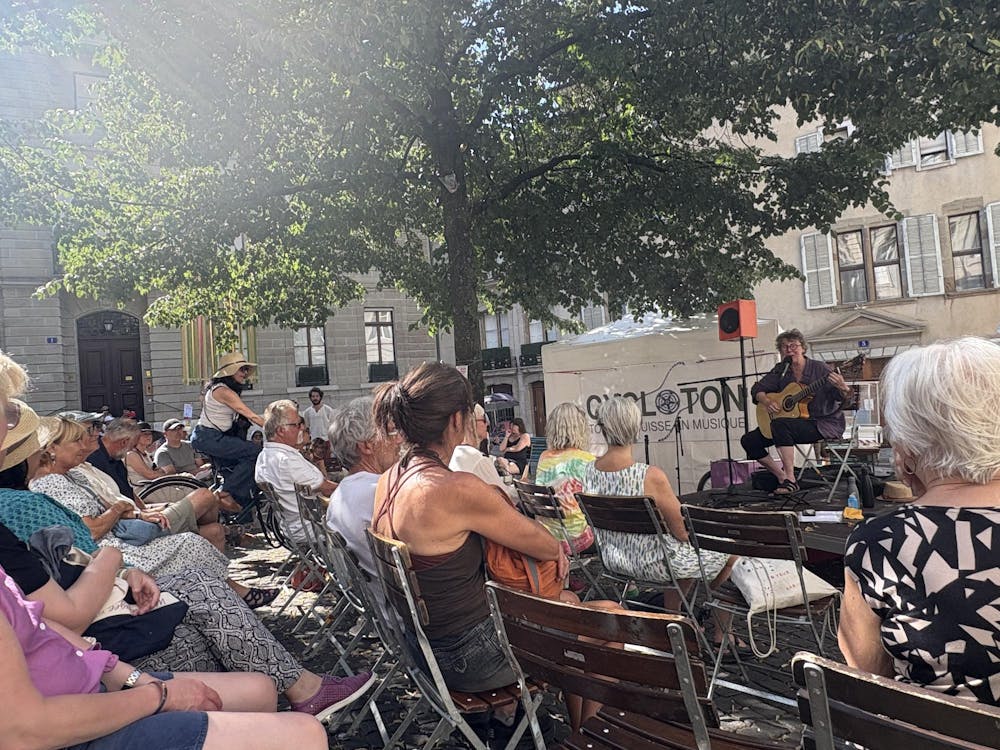
GENEVA — The city of Geneva is known around the world as the heart of international diplomacy. Yet beyond the carefully-executed relations of the United Nations exists an unfiltered blend of cultures and people that forms the soul of the city. While in Geneva this summer for a two-month internship through the Princeton Streicker Fellowship, I set out to experience the city’s vibrant cultural mosaic firsthand. At the 35th annual Fête de la Musique, I fell in love with my temporary city and the harmonic multiculturalism playing out in the city streets.
While my myriad internship tasks at the International Institute for Sustainable Development kept my hands full on weekdays, every weekend was a chance to travel around the beautiful region or explore Geneva. But travel can be as exhausting as it is exhilarating, and when my train from Lyon, France, finally pulled into the station on a Saturday evening early in my trip, I was more than ready to go home. In the midst of a European heat wave, I had decided, perhaps unwisely, to spend the day walking in the 37 degrees Celsius (99 F) heat while practicing my French. Despite my growing physical and mental fatigue, I had one more stop to make: Geneva’s 35th annual Fête de la Musique.
Over the next hour, Google Maps repeatedly failed to locate the festival. After nearly giving up, I finally decided to let my ears guide me. As I stepped into the heart of Geneva’s Old Town, passing open shop doors and old stone walls covered in moss, the festival unfolded before my eyes.
Consisting of near-constant unticketed performances across 34 venues scattered throughout the city, Geneva’s music festival is a three day affair. The festival began in 1992, when Alain Vaissade, then an administrative counselor for the Geneva canton, drew inspiration from the music festival model in neighboring France. From 6 p.m. on Friday to 9 p.m. on Sunday, musicians from every genre — classical, rock, jazz, opera, techno, choral, instrumental — play their hearts out, often into the wee hours of the morning.
Following the sounds of music, I crested a hill in the heart of Old Town and spotted a colorful sign marking one of the festival venues: I had finally made it. In a small Lutheran church with windows open to let in the evening breeze, a trio was concluding a classical string performance. I crept in just in time for the final piece, a meditative romantic melody. Perched on the church stairs and peering through the railing at the expressive performance below, I felt like a kid spying on a grand ball. When the ensemble finished, the room seemed to collectively hold its breath before bursting into rapturous applause.
The next performance was Ukrainian opera. For the next hour, pianist Iryna Martynova and two singers, soprano Nina Shelpiakova and tenor Sergey Zaritskyi from the National Opera of Odessa, serenaded us.
The performance, entirely in Ukrainian, taught me that great opera need not be understood, only felt. Though there were no subtitles to help me, Shelpiakova’s and Zaritskyi’s voices soared, and the passion of their love story, filled with both longing and adventure, was remarkably clear.
Following my elaborate printed festival guide, I next made my way to the Hôtel de Ville, a tall building of smooth, plastered stone with old wooden gates thrown wide to welcome audiences.

The building’s entrance opened to a giant stone courtyard which held a temporary stage. Here, balconies overlooking the courtyard lined each level of the building, and a turret peeked up from one corner, making the whole space feel like a castle’s royal courtyard. When I entered, people had already packed the space in front of the stage, prompting latecomers like me to curl up in window openings or climb the stairs to each of the balconies, higher and higher, until I was leaning over the railing of the top-floor balcony to see the stage below.
A soloist warmed up the crowd, weaving a smooth, piping melody as he strutted around the stage. In classic multilingual Geneva fashion, a boy next to me muttered to a friend in Italian, searching for the instrument’s English name. Pausing his own musings about the festival in French, his friend replied, “It’s an oboe.” (It was, in fact, a bassoon, but I’m not one to judge.)
Below, other musicians — playing bass, clarinet, percussion, sax, and others — joined the bassoonist on stage for a Brazilian jazz concert complete with octave-jumping solos, a playful stage presence, and songs in Portuguese, adding a fourth language to the mix.
On the way back to the tram, I wandered the streets, where children played late at night, while green and purple disco lights lit Old Town, highlighting the fusion of old and new.
Sunday passed in a blur as I enthusiastically dragged my friend from one venue to another: Turkish dancing in a park overlooking the rooftops of Old Town, English sea shanties and a cappella in an old cathedral, an ensemble sharing European and East African music with a Swiss flag hanging over the stage. By the end of the day, I realized that despite being in a Swiss-French city, I had not heard a single note of music in French.
While the festival came to a close seemingly as quickly as it started, to my delight, the international coexistence I had experienced extended to the city of Geneva itself. Geneva, I soon realized, is not just the U.N., nor a series of banks and high-end stores rising over the lake waterfront. It is 10 Middle Eastern restaurants in a row. It is nearby Carouge, Geneva’s Little Italy. It is flags of every nationality hung with pride on balconies and storefronts during the World Cup. It is the Sunday morning farmer’s market stalls hawking food from Brazil, India, and West Africa.

In Geneva, as in cities back home, I was once again reminded of the beautiful collage of music, art, and language that can only happen when cultures collide. At the Fête de la Musique, I saw the ultimate promise of these cultural collisions: a celebration of diversity through the unifying power of music. Swept away in the music with a crowd that couldn’t care less whether you were local or a brand-new tourist, I realized that I didn’t need to go to the U.N. to find international unity: it was already playing out in the U.N.’s backyard.
Annika Plunkett is a staff writer for The Prospect, associate Newsletter editor, and a Spanish translator. She can be reached at ap3616[at]princeton.edu.
Please send any corrections to corrections[at]dailyprincetonian.com.
Read More

New recipients of endowed professorships reflect on the importance of research amid higher education uncertainty
Luke GrippoPrinceton recently named 11 faculty members to endowed professorships, honoring their achievements in scholarship amid growing uncertainty in higher education.
Princeton recently named 11 faculty members to endowed professorships, honoring their achievements in scholarship amid growing uncertainty in higher education.

Princeton continues to back Harvard in lawsuit against federal government
Gray Collins and Giselle MorenoIn July, Princeton joined 35 other universities in backing Harvard in a lawsuit against federal research funding cuts, as higher education institutions continue to push back against the Trump administration’s funding restrictions.
In July, Princeton joined 35 other universities in backing Harvard in a lawsuit against federal research funding cuts, as higher education institutions continue to push back against the Trump administration’s funding restrictions.

New meal exchange system finalized, specific details still unclear
Grace Beckish, Riley Price, and Kimberly HutchinsonA new meal exchange platform led by the ICC and GICC will launch this fall to replace MealX, introducing changes to how students swap meals as additional details remain unclear.
A new meal exchange platform led by the ICC and GICC will launch this fall to replace MealX, introducing changes to how students swap meals as additional details remain unclear.