



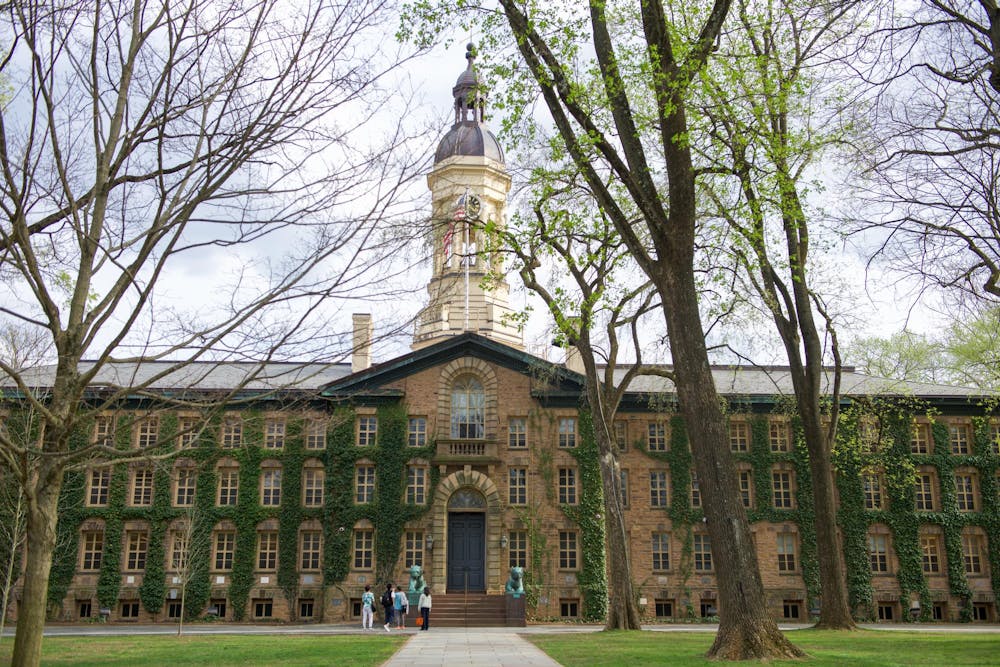
In the battle between Harvard and the federal government, Princeton is siding with Harvard.
On July 22, the University signed an amicus curiae brief supporting Harvard’s suit against multiple executive branch agencies over research funding cuts in a federal appeals court. The brief was joined by 35 other research universities and colleges, including the rest of the Ivy League.
The Trump administration has made widespread cuts to research funding at many institutions of higher education. In Harvard’s case, the government restricted $2.2 billion in funding, purportedly due to allegations of antisemitism on campus. At Princeton, about $210 million of federal research funding to the University was frozen last year amidst a reported antisemitism investigation, but as of last August, around half of these grants have been restored.
The 29-page filing argued that the grant cuts were unwarranted and threaten the position of the United States as the world’s leader in scientific discovery. It also highlighted numerous technological and pharmaceutical advances that have resulted from federally-funded research at universities in the decades since World War II.
In June of last year, Harvard sued multiple federal government departments in federal court in an attempt to regain its lost funding. Princeton and 23 other institutions filed a similar amicus brief in that case. The district court judge ruled that the federal government’s termination of those grants was unlawful, and the government appealed the ruling — leading to the current litigation.
“Draconian cuts to federal research funding endanger this longstanding, mutually beneficial relationship between institutions of higher learning and the American public—especially when funding is terminated or withheld for reasons wholly unrelated to the merits of funded research,” the brief stated.
When asked about the University’s stance on the lawsuit and why they signed the brief, University spokesperson Jennifer Morrill wrote to The Daily Princetonian, “The filing speaks for itself.”
The brief cited former Princeton chemistry professor Edward Taylor’s federally-supported exploration of butterfly wing pigment as an example of the unique advances made possible only by partnerships between higher academia and the government. Taylor’s research, which — according to the filing — would likely not have received private funding, concluded in a major breakthrough in lung cancer treatment.

“These cuts to research funding risk a future where the next pathbreaking innovation — whether it is a cure for cancer or Alzheimer’s, a military technology, or the next Internet — is discovered beyond our shores, if at all,” concluded the filing.
The amicus brief came on the same day as the American Association of University Professors (AAUP) released a report accusing the Trump administration of using federal funding as leverage to pressure universities into accepting demands about diversity, equity, and inclusion programs, class curricula, and institutional governance.
Several members of the AAUP committee focused on academic freedom pointed out that University President Christopher L. Eisgruber ’83 may have protected the University from more fervent attacks by being outspoken in defense of research and academic freedom.
In a column he wrote for The Atlantic in March 2025, Eisgruber wrote that the Trump administration’s attacks on Columbia University were “presenting the greatest threat to American universities since the Red Scare of the 1950s,” and that “every American should be concerned.”
Cornell professor Risa Lieberwitz, a member of the AAUP committee who drafted the report, said in an interview with the ‘Prince’ that Eisgruber’s outspokenness has left the University better insulated from federal government assaults than some of its peer institutions.
“Eisgruber made a name for himself in the popular press by saying that universities should not agree [to the Trump administration’s demands],” Lieberwitz said.

In an interview with the ‘Prince,’ when asked about the discrepancies between attacks faced by different schools, former chair of the AAUP Committee on Academic Freedom and Tenure Henry Reichman said that unlike other top research institutions, “Princeton does not have a medical school, and medical schools make universities vulnerable to [federal funding cuts] because they are so dependent on federal research grants.”
Harvard Medical School had over 350 grant contracts terminated, totalling around $230 million per year. Medical research at Columbia University was also threatened by the Trump administration, before Columbia agreed to pay $200 million to restore its slashed funding.
The University of Virginia and Brown University also ceded to some of the administration’s demands in exchange for continued government funding. As of last year, Eisgruber told the ‘Prince’ that no deal has been made between Princeton and the federal government.
The Harvard faculty chapter of the AAUP saw success in September when they won a case against the U.S. Department of Justice. The case, also brought by the wider AAUP and the United Auto Workers, claimed that “the termination of grant funding violated the 1st Amendment and federal statutes primarily because it was retaliation for — and an attempt to suppress — the protected speech of faculty and Harvard University and replace it with a governmental orthodoxy.”
The Association of American Universities, of which Eisgruber served as chair last year and vice chair the year before, joined numerous other higher education associations — including the College and University Professional Association for Human Resources and the American Council on Education — and First Amendment organizations, such as the Lawyers Defending American Democracy and the National Coalition Against Censorship, in filing amicus briefs in support of this AAUP case.
Gray Collins is the assistant News editor for the ‘Prince’ leading University administration coverage. He is from outside of Philadelphia and can be reached at graycollins[at]princeton.edu.
Giselle Moreno is a staff News writer who typically covers Town and University Affairs. She is from Dallas and can be reached at gm2076[at]princeton.edu.
Please send any corrections to corrections[at]dailyprincetonian.com.
Read More

Curious what the best burger on Nassau is? I went on a mission to find out
Eric MohoreaStaff writer for The Prospect Eric Mohorea visited three restaurants to decide what the best burger on Nassau Street is.

Princeton Council candidates meet in first contested general election in years
Oliver Wu and Mira BrockFor the first time in seven years, the Democratic candidates for Princeton Council will be challenged in the general election. The challenger is Antonio Merolli, a former orthopedic surgeon running as a Republican.
For the first time in seven years, the Democratic candidates for Princeton Council will be challenged in the general election. The challenger is Antonio Merolli, a former orthopedic surgeon running as a Republican.
Details on new ‘sexual climate’ subcommittee to be discussed, student survey to circulate amid Cornell case
Devon WilliamsThe new subcommittee will consist of undergraduate students, graduate students, faculty, and staff.
The new subcommittee will consist of undergraduate students, graduate students, faculty, and staff.