



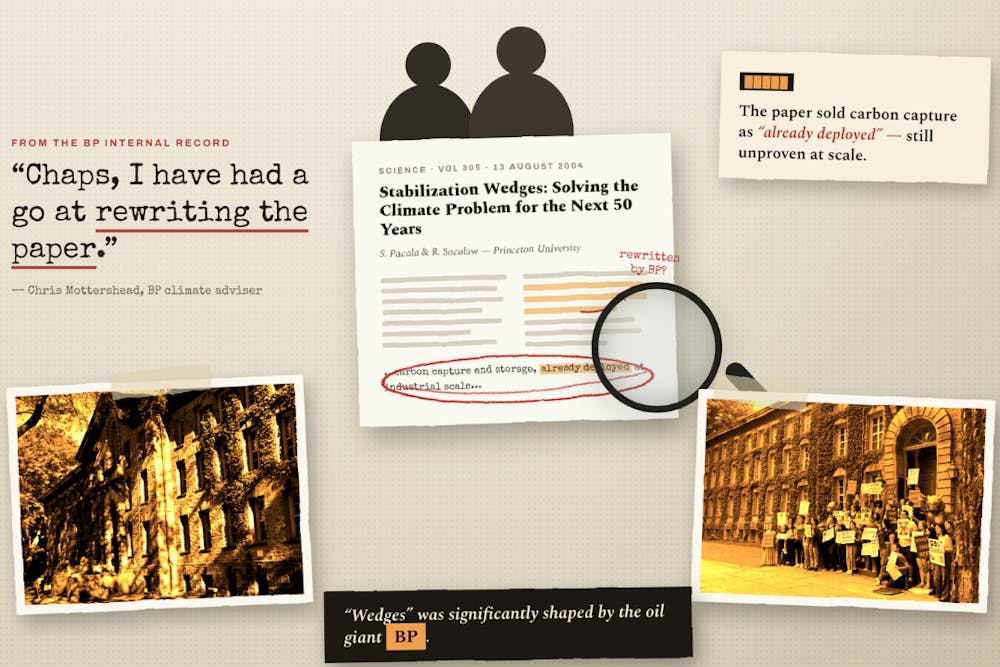
Oil executives from the fossil fuel company BP “significantly shaped” and sponsored a 2004 paper written by Princeton scientists that popularized carbon capture, according to a ProPublica and Drilled investigation published in late June. The papers’ authors, Robert Socolow and Stephen Pacala, denounced the investigation in a statement to The Daily Princetonian.
“We fully disagree with the ProPublica criticism and think it without merit and in error,” Socolow and Pacala wrote. They said that they expect to publish a formal response soon.
Multiple scientists at the University did not respond to requests for comment on the investigation. University spokespeople did not directly address questions from the ‘Prince’ about BP’s relationship with the two scientists.
ProPublica and Drilled’s investigation found that Socolow and Pacala “shared multiple drafts of their early paper with BP and got editorial feedback on those drafts,” author of the investigation Maddie Stone said in an interview with the ‘Prince.’ “It ran the gamut from high-level feedback on the tone and the style to really specific word choice suggestions.”
Socolow is an emeritus professor of mechanical and aerospace engineering, while Pacala is an emeritus professor of ecology and evolutionary biology. Both Socolow and Pacala remain appointed as post-retirement senior scholars at Princeton.
For years, BP’s ties to the University have been heavily scrutinized by student activists and politicians alike. While Princeton’s Board of Trustees voted in 2022 to dissociate from certain segments of the fossil fuel industry, the University has since changed course to allow for research funding from companies subject to dissociation. In June, the University also reversed its prior policy of not investing in any publicly-traded fossil fuel companies.
A 2024 investigation led by congressional Democrats argued BP highlighted research from its Princeton partnership to advance policies like carbon capture “without accountability for refusing to invest at scale.” A 2024 report led by climate activism group Sunrise Princeton also argued that the University continues “to invest in, profit from, and produce research that serves the interests of fossil fuel companies.”
From 2000 to 2025, BP sponsored the Carbon Mitigation Initiative (CMI), a Princeton-based research program currently directed by Pacala. Housed within the High Meadows Environmental Institute, CMI conducts independent research on alternative fuels and climate mitigation, among other topics related to a net-zero transition.

BP and CMI did not respond to multiple requests for comment.
Socolow and Pacala’s 2004 paper, titled “Stabilization Wedges: Solving the Climate Problem for the Next 50 Years with Current Technologies,” was published in Science magazine and mapped 15 different scenarios that would each hold annual carbon emissions at 2004 levels. The authors called each unit of avoided emissions a “wedge,” named for the triangular shape it formed on a graph.
Socolow and Pacala argued the goal was achievable using existing technologies, from expanding nuclear power to curbing deforestation, with measures to reduce emissions from continued fossil-fuel use. Cited more than 4,400 times, the term “Wedges” gained significant traction beyond academic circles, and was incorporated into policy papers, an Oscar-winning documentary, and was turned into a board game.
“In particular, [“Wedges”] gave a lot of credibility to this idea of carbon capture and storage, which is among the technologies that has really led to the perpetuation of fossil fuels rather than the phasing out of fossil fuels,” Jennie Stephens, a climate justice professor and activist at the National University of Ireland Maynooth, told the ‘Prince.’
BP’s alleged influence on the landmark climate paper, detailed through email exchanges, interviews, and other documents, left experts and community members unsurprised. Those interviewed by the ‘Prince’ condemned the degree of coordination uncovered between the company and the scientists, but said that it fit into a broader trend of corporate influence in academia.
“It’s totally, in my mind, unethical,” Mark Jacobson, a professor of civil and environmental engineering at Stanford, told the ‘Prince.’ Jacobson said there are circumstances in which close industry involvement is appropriate, such as when researchers are developing technology for a specific company. In those cases, he said, sharing drafts is “pretty standard.”

“But here, it’s not even that,” Jacobson said. “Here, they’re proposing what the solutions are [that] we should use for all of the climate, and it’s just a strange case,” he continued.
University spokesperson Michael Hotchkiss told the ‘Prince’ that the University does allow corporate sponsors a “limited prepublication review period” to ensure that confidential company information or potential patentability is not disclosed in a proposed publication.
A review prior to publication, Hotchkiss wrote, “is not a right of approval and does not permit sponsors to revise research findings or conclusions.”
The paper’s footnotes disclose funding for the CMI from BP and Ford in its “References and Notes” section. Socolow and Pacala told ProPublica and Drilled that BP did not have control over the scientific ideas in the paper.
But “the degree of collaboration was greater than what is suggested by the acknowledgements in the paper,” Stone said. In one email, Chris Mottershead, a climate adviser for BP at the time, wrote that he “had a go at rewriting the paper.” BP was unsuccessful in revising a version of the paper, the investigation found.
Even if BP had no direct influence over the paper, some argued that corporate funding can subtly shape academic research, blurring the line between independent scholarship and corporate sponsorship.
“It’s hard to distinguish those two things, especially in this case,” Stephens said. “[The paper] is about an industry-influenced agenda, but the whole paper is setting the agenda,” she continued.
Stone added that there is evidence from research sponsored by pharmaceutical and tobacco companies that corporate funding “biases research outcomes, even if the researchers are not aware of it.”
The University states that there is guidance in place to protect researchers from corporate influence or bias. According to Hotchkiss, the University provides “extensive guidance and information” to researchers about working with industry through workshops and presentations.
“What ProPublica and Drilled have reported on in this piece is just further confirmation of what we have known for a long time about this relationship between the Carbon Mitigation Initiative and BP, and other bad fossil fuel actors like Ford,” Isaac Barsoum ’28, an organizer with Sunrise Princeton, told the ‘Prince.’
Barsoum is an associate Opinion editor for the ‘Prince.’
“It’s not just ‘Wedges,’ in my opinion,” Lynne Archibald ’87, an organizer with Divest Princeton, told the ‘Prince.’ “It’s the more pervasive influence of fossil fuels on campus.”
Sena Chang is the associate News editor for the ‘Prince’ leading investigations. She is from Japan and South Korea, and she often covers local politics and student life. She can be reached at sena[at]dailyprincetonian.com.
Please send any corrections to corrections[at]dailyprincetonian.com.
Read More

Princeton endowment at all time high after 24 percent returns
Haeon Lee and Devonne PiccaverPrinceton’s endowment has reached an all-time high of $42.3 billion after a 23.7 percent investment gain for the 2026 fiscal year that ended June 30. This percentage increase marks the highest investment gain since 2021, which saw 46.9 percent returns driven by venture capital and private equity.
Princeton’s endowment has reached an all-time high of $42.3 billion after a 23.7 percent investment gain for the 2026 fiscal year that ended June 30. This percentage increase marks the highest investment gain since 2021, which saw 46.9 percent returns driven by venture capital and private equity.

Staff Picks: Football vs. Brown
Saad Akhtar, Alex Beverton-Smith, and Juha ImPrinceton football is set to take on Brown this weekend at home. The Daily Princetonian Sports section makes their picks for the game.
Princeton football is set to take on Brown this weekend at home. The Daily Princetonian Sports section makes their picks for the game.

Roundup: Marvel Jem Roth and Isaac Barsoum on their advocacy related to the Title IX process at Princeton, ‘hearing math,’ and proctors in the classrooms
Tendai Jobarteh, Devon Rudolph, and Danny ShingAn in-depth interview with Undergraduate Student Government treasurer Marvel Jem Roth ’28 and U-Council chair Isaac Barsoum ’28 on their advocacy related to the title IX process at Princeton, ‘hearing math,’ and proctors in the classrooms, ‘hearing math,’ and proctors in classrooms during the midterms.
An in-depth interview with Undergraduate Student Government treasurer Marvel Jem Roth ’28 and U-Council chair Isaac Barsoum ’28 on their advocacy related to the title IX process at Princeton, ‘hearing math,’ and proctors in the classrooms, ‘hearing math,’ and proctors in classrooms during the midterms.