



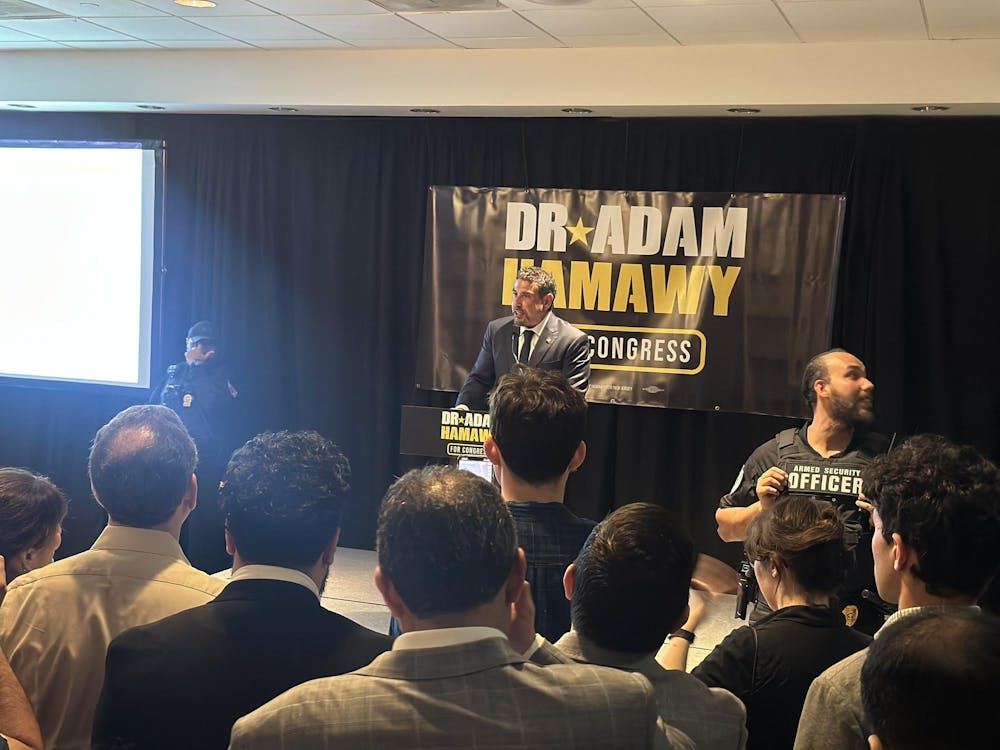
On Tuesday night, Adam Hamawy won the Democratic primary in New Jersey’s 12th congressional district for the U.S. House of Representatives. In the November general election, he is favored to defeat Gregg Mele, who ran unopposed in the Republican primary.
The district is considered to be a safe Democratic seat, and the number of registered Democrats is more than double that of registered Republicans. Princeton is located within the 12th district.
After his win, Hamawy sat down with The Daily Princetonian for an interview on Thursday.
Reflecting on his emotions post-victory, Hamawy said he was “feeling great” but “a little tired,” adding that the tiredness “has hit me over the last 48 hours, but the excitement is still there.”
In his victory speech at an election night party in Princeton attended by hundreds of supporters, Hamawy decried attacks on his candidacy, but said that his win showed that anti-Muslim attacks can no longer decide an election.
“My family was attacked, my values were questioned, and my patriotism was spat on,” Hamawy said during the speech. “There once was a time where this might have worked, when racist and anti-Muslim attacks would’ve turned an election. But tonight, we proved that this era of American politics is over,” he continued.
Hamawy positioned himself as one of the race’s most progressive candidates during the campaign. He repeatedly stated his support for progressive priorities, including abolishing U.S. Immigration and Customs Enforcement (ICE), ending all military aid and munitions sales to Israel, passing Medicare for All, and addressing economic inequality.
“Right from the start, I was labeled as an extremist in terms of my stance against genocide,” Hamawy told the ‘Prince,’ referring to Israel’s military activity in Gaza. “Then it grew from that to becoming a terrorist myself.”

Hamawy has faced criticism for his previous connections to Omar Abdel Rahman, an Egyptian cleric commonly known as the “Blind Sheikh.” Abdel Rahman was convicted of seditious conspiracy in 1995 after being found to have played a role in inspiring the 1993 World Trade Center bombing and other terror-related actions.
Hamawy spent time with the sheikh between 1991 and 1993, after he graduated from college and while he was in medical school. He later served as a witness for the defense in Abdel Rahman’s 1995 trial. Hamawy has criticized the sheikh’s past actions and comments during his campaign.
After graduating medical school in 1994, Hamawy spent about five weeks volunteering with the Chicago-based nonprofit Benevolence International Foundation in Bosnia. The organization was later investigated following the Sept. 11, 2001 attacks and found to have links to al-Qaeda.
Following his primary win, several House members have criticized his past affiliations, describing Hamawy as a risk to national security.
Speaker of the House Mike Johnson (R-La.) characterized Hamawy as “a Democrat linked to Al-Qaeda” in a social media post. “Not even ties to terrorists are too extreme for the modern day Democrat Party,” Johnson wrote.
Rep. Anna Paulina Luna (R-Fla.) called Hamawy a “national security risk” in an X post. “There is no way he can have a security clearance,” she wrote.

Democrat Rep. Jared Moskowitz (D-Fla.) has also expressed concerns about Hamawy and whether he should work on national security issues. Moskowitz has said that Hamawy is “clearly … not in line with our values.”
Hamawy attributed the criticism to his support of the Palestinian people.
“It’s a classic move that we see,” he told the ‘Prince.’ “If you attack Israel, then you must be a terrorist. If you’re a Muslim, you must be a terrorist.”
He pointed to Rep. Rashida Tlaib (D-Mich.) as an example, who was told by Rep. Max Miller (R-Ohio) that she “advocate[s] for terrorists on a daily basis” on the House floor on Wednesday. Miller also said that Tlaib “like[s] to hang out with” Hezbollah.
Hamawy has dismissed such concerns, pointing to his previous military service. “My patriotism is clear,” he said.
Hamawy previously served for eight years as an U.S. Army combat surgeon, and he has volunteered on medical humanitarian missions around the world, including in Gaza in 2024. He currently runs a private plastic surgery office in Princeton.
“To imply that just because I am Muslim, that I wouldn’t be loyal to my country is just absurd given my history,” Hamawy said. “Every time they bring these claims up, they don’t mention anything that I’ve actually really done and all my service.”
“This is coming from the party that supported the insurrectionists,” Hamawy added, referring to the Jan. 6, 2021 attack on the U.S. Capitol.
Despite his primary win, Hamawy said he will continue campaigning with “no changes” to his campaign strategy. Hamawy intends to continue holding town halls and attending “every single forum” he is invited to, with the goal of “getting to know a lot of the constituents in the district.” He added he “would not be opposed” to participating in a debate with Mele.
Hamawy, who is a first-time candidate, said that his victory signified that winning candidates could take “a very progressive approach, and not be worried about what the rest of the party is going to say, because this is about the people.”
He asserted that his campaign “got a lot of people that usually didn’t vote in the past.” He attributed the change to his focus on speaking to voters, rather than gaining support from local-level Democratic party branches.
Regarding lack of prior political experience, Hamawy said Congress needs more people who are not career politicians.
“What we need is people with experience in all walks of life, and that’s doctors and nurses and teachers and scientists,” he said. “That’s what we need in Congress, because that is a slice of America, and the House of Representatives is supposed to be people from the community and the problems that people face every day.”
Another part of Hamawy’s campaign strategy was mobilizing young voters. Two students at the University, Quentin Colón Roosevelt ’27 and Alex Norbrook ’26, headed the local Princeton branch of his campaign.
Hamawy described Colón Roosevelt and Norbrook as “a great resource” who contributed to the campaign’s success by “reaching out to other students, knocking on doors, and canvassing after school.”
Princeton students also volunteered for other candidates in the race, including Sue Altman, who had more than a dozen student volunteers, and Princeton neuroscience professor Sam Wang.
Although Hamawy led all the candidates in contributions from individual donors, no Princeton faculty member donated to his campaign as of May 13, the most recent campaign filing deadline. One University staff member in the Office of Finance and Treasury donated to Hamawy.
Hamawy urged students to get involved in politics — and to “at least get out and vote” — during the interview. He argued that political participation has significant impacts on the future of young people.
“People who say, ‘I don’t pay attention to [politics],’ or ‘It doesn’t affect me,’ I think, are in denial,” Hamawy said. “It affects the prices that you pay at the gas station, how the entire country functions, from your healthcare to your education.”
Ryan Buschman is a News contributor for the ‘Prince.’ He is from Haddonfield, N.J., and can be reached at rb8146[at]princeton.edu.
Please send any corrections to corrections[at]dailyprincetonian.com.
Read More

University restricts internship approvals for international students following new Trump administration guidance
Jonah Vimont and Meiya XiongFollowing new guidance from the U.S. Immigration and Customs Enforcement, the University indicated that Curricular Practical Training, a temporary work authorization that allows international students on F-1 visas to pursue off-campus internships, will likely be restricted for all undergraduate and most graduate students.
Following new guidance from the U.S. Immigration and Customs Enforcement, the University indicated that Curricular Practical Training, a temporary work authorization that allows international students on F-1 visas to pursue off-campus internships, will likely be restricted for all undergraduate and most graduate students.

N.J. Lt. Gov. Dale Caldwell ’82 reportedly being investigated for inappropriate behavior
Oliver Wu and Giselle MorenoNew Jersey Governor Mikie Sherrill has opened an internal investigation into Dale Caldwell ’82, New Jersey’s lieutenant governor and secretary of state, for alleged inappropriate behavior with women and possible ethics violations, the New Jersey Globe reported on Friday.
New Jersey Governor Mikie Sherrill has opened an internal investigation into Dale Caldwell ’82, New Jersey’s lieutenant governor and secretary of state, for alleged inappropriate behavior with women and possible ethics violations, the New Jersey Globe reported on Friday.
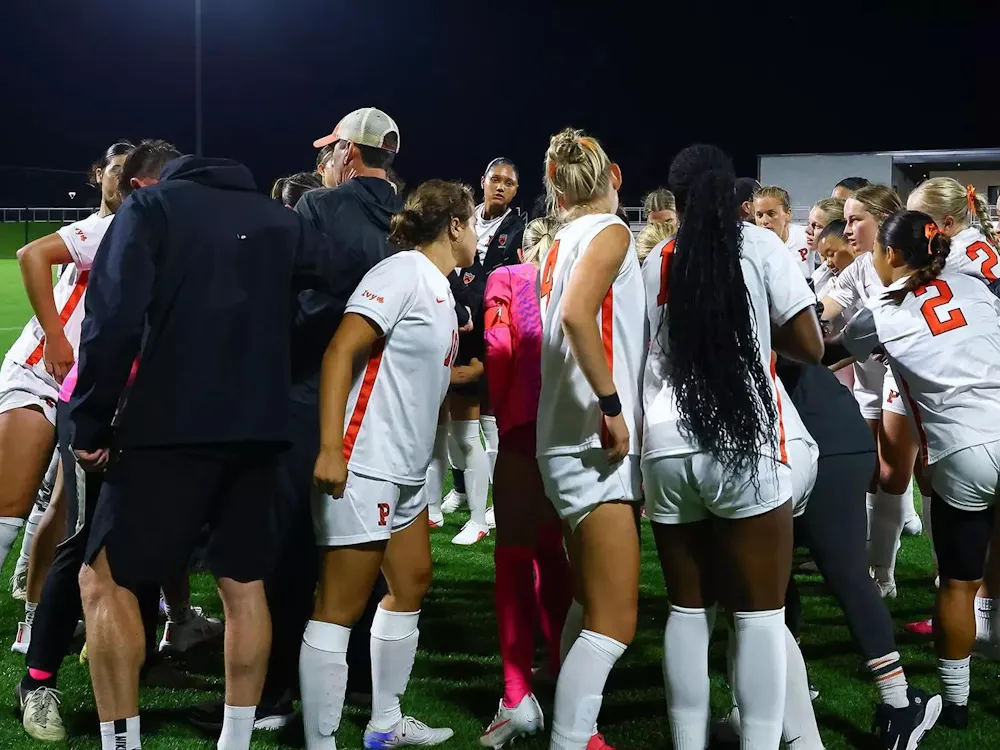
A B1G match-up: Women’s soccer falls to Ohio State
Siena SydenhamNo. 8 Ohio State proved to be a worthy opponent for the Tigers. Two goals in the first 10 minutes gave the Buckeyes momentum, and a second half surge in Princeton’s performance came too late and was not enough to combat the wide OSU lead.
No. 8 Ohio State proved to be a worthy opponent for the Tigers. Two goals in the first 10 minutes gave the Buckeyes momentum, and a second half surge in Princeton’s performance came too late and was not enough to combat the wide OSU lead.