



Hanging above a wooden supply cabinet piled with New Yorker magazines inside Joseph Henry House is an excerpt from the 1977 book “Coming into the Country” by John McPhee ’53, handwritten in black ink on a framed topographic map around the Yukon River of Alaska.
“‘But I’ll tell you the difference. The difference is that pile of bear sign back there, and the absence of trails, and…’ My thoughts race ahead of what I am trying to say,” he wrote, articulating the difference between Alaska and the eastern United States. “The difference is also in the winter silence, a silence that can be as wide as the country, and the dreamy, sifting slowness of the descent of the dry snow. If there were only twenty-five people in the state of New Jersey, they would then sense the paramount difference, which is in the unpeopled reach of this country. I may have liked places that are wild and been quickened all my days just by the sound of the world, but I see now I never knew what it could mean.”
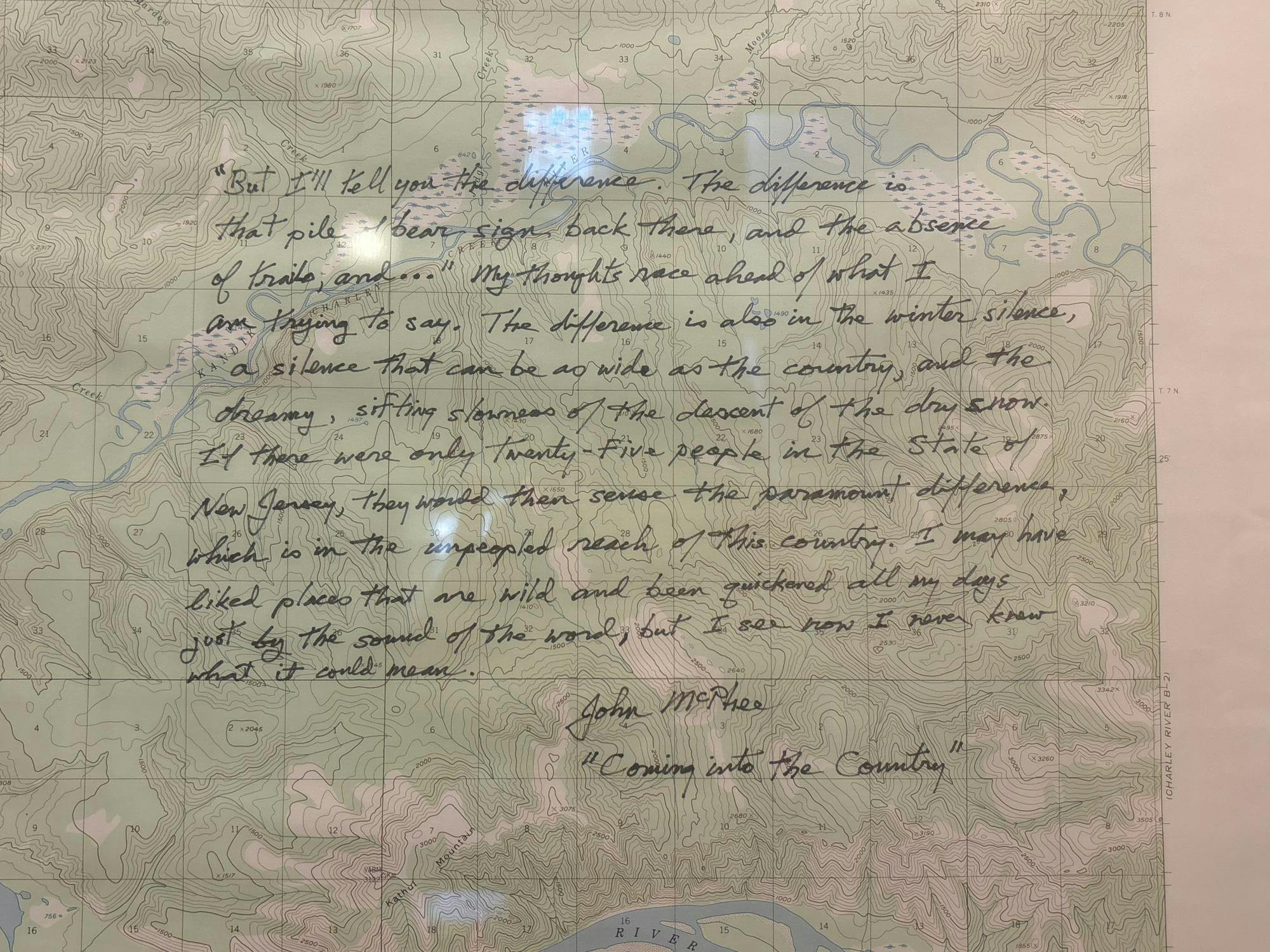
An excerpt from “Coming into the Country” by McPhee, which he handwrote in 2001.
Lola Horowitz / The Daily Princetonian
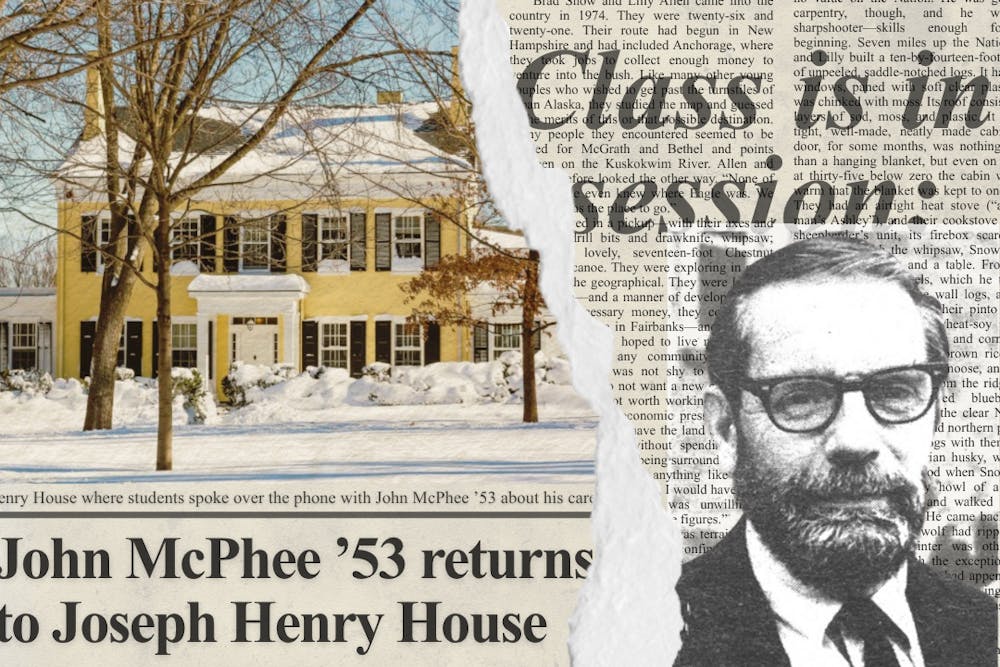
This commemoration of McPhee’s observed travel account of the landscape and wilderness of Alaska, which was first printed as a four-part narrative nonfiction series in The New Yorker’s summertime pages before being published as a book in December, flanks the ground-floor white doors to Room 16 wherein he last taught JRN 240: Creative Nonfiction in Spring 2020 to 16 sophomores. Six years later, on a cold, snowy Wednesday, Feb. 25, 13 students from the three-hour-long journalism seminar JRN 280: The Literature of Fact — Narrative Nonfiction taught by Director of the Program in Journalism Eliza Griswold ’95 are joined by McPhee, the guest speaker, over the phone. The subject of the day’s lesson was: What is a Lede?
For the past five weeks, the students had been researching and reporting for their literary reportages, ranging from stories on an all-girls, all-Muslim scout troop in Lawrenceville to an elderly man continuously denied parole after 50 years of incarceration. Every class, they parse longform essays and articles with the writer present, keeping in mind a particular element of narrative reporting such as crafting a lede, reconstructing scenes, and presenting complicated characters.
Griswold invited McPhee to be a guest speaker because “he’s the spiritual father of this program,” she said in an interview with The Daily Princetonian.
McPhee was born and raised in Princeton, the son of an athletic medical physician employed at McCosh Health Center, the location of University Health Services before they were relocated to Frist Health Center in 2025. An English major at Princeton, he occasionally wrote prose and poetry for the Nassau Literary Magazine, presently known as the Nassau Literary Review. Twenty-two years after graduating, he returned to campus in the spring of 1975 to succeed Larry L. King as the Ferris Professor of Journalism. His first class was HUM 406: “The Literature of Fact,” aptly the same name as Griswold’s course.
McPhee never had Griswold, a fellow English major, as a student during her schooldays because she says she felt too intimidated to take his course and spent most of her time at Princeton writing poetry. The first time McPhee recalls catching wind of Griswold was from her 2010 book, “The Tenth Parallel: Dispatches from the Fault Line Between Christianity and Islam,” about her intrepid journey 700 miles north of the equator to observe where Christianity and Islam collided on the ground. The two formally met when Griswold joined Princeton’s faculty as director of the Program in Journalism in the Fall 2024 semester.

McPhee, who won a Pulitzer Prize for General Nonfiction in 1999 for his book “Annals of the Former World,” has authored more than 30 books and contributed more than 100 pieces as a staff writer for The New Yorker since 1963. At 95, McPhee still surgically structures his writing and has an expressive writing style which are the product of decades worth of consistent effort and extensive reporting. It’s clear when reading his profiles that he doesn’t just study his subjects, but also spends time with them, immersing himself in their lives for months at a time and earning the interiority of his characters.
Seated at the mahogany-colored rectangular table inside Room 16, Lillian Paterson ’28, from Silver Springs, Md. and former contributing Opinion writer for the ‘Prince,’ wore a Kendrick Lamar Big Steppers Tour 2022 concert t-shirt and sipped a can of Sprite. She’d always had her eyes set on Princeton’s journalism minor but had recently been battling feelings of creative burnout. Patterson had been reporting on marijuana legalization in New Jersey for this class, which she said reinvigorated her passion for journalism.
Patterson posed the first question to McPhee. “You’ve obviously been around the block, the country. I’m wondering why you’ve stayed in Princeton for so long.”
After graduation, McPhee lived in New York for five years when he was just getting started as a writer, but he still felt drawn to Princeton. What brought him back to Princeton in 1962, as a father and writer for Time magazine, was the research access at Firestone Library. “I figured that if I was going to be able to do the work I hoped to do, that would be the best resource I knew about and was familiar with,” McPhee answered.
Upon moving back to Princeton, he paid for a house to be built on an unpaved road, surrounded by woods and overlooking a small meadow, in the northwest corner of Princeton Township. This house holds the memories of his children growing up and is where he lives to this day. McPhee was snowed in when he took the interview call.
“Theologists have words for this. Something that comes from somewhere else is allochthonous, and something that comes from where it was always is autochthonous,” McPhee said, claiming himself to be the latter. He might have flocked to New York for a brief time, where most writers inevitably migrate to, but he couldn’t stay away from Princeton for too long.

Livia Shneider ’28, from Manhattan, had never engaged with professional reporting beyond what she read in her high school newspaper. For this class, she chose to investigate the recent founding of a Turning Point USA chapter on Princeton’s campus. Half of her curly hair was done-up in an ornate pin, and she’d taken off her brown leather boots, which lay toppled beneath the table. “I was wondering if you could talk a little bit about your post-it system and how you structure and arrange your notes,” Shneider asked. “How do you choose between details that make it onto the post-it versus details that don't necessarily make it to the final story?”
When preparing to draft a profile, McPhee transfers his jotted down field notes and transcribes his tape recordings onto several 3-by-5-inch index cards. He shuffles the cards around on a table, visually searching for relationships, narratives, interesting juxtapositions, and natural transitions. McPhee believes that the best transitions have “no transition there. It just goes from A to B, and you don’t have to have a lot of velcro in between.”
In a black turtleneck, rising from her seat at the head of the table, Griswold strode toward the back of the room, rolled up the projection screen, and wrote left-handed on the blackboard: “Great transitions don’t have to be written. What is the authentic reason someone would turn the page?” Griswold set down the chalk and stood with her arms folded at the side of the blackboard, surveying the class from afar.
Shneider passed the phone to her right, where Lulu Mangriotis ’29 from Manhattan sat, in a red long sleeve with a notebook on her lap. Griswold returned to her post at the head of the table. The topic of Mangriotis’ longform was a high school pianist suffering burnout. She asked, “Did you ever feel, in your experience with immersion, that someone was ever catering their answers to what you wanted to hear or altering their actions around you? How did you try to shift that and try to create a new energy?”
Mangriotis is an assistant News editor for the ‘Prince.’
“When people are trying to dribble you like a basketball, you know it.” McPhee replied. He believes that a journalist’s best sources have no self-consciousness, ambition, or hidden agenda. McPhee prefers people who “just do their thing, because their thing is what I’ve come to watch them do.” He recalled that when he wrote “Annals of the Former World,” which combined four of his previous books on geology published between 1981 and 1993, he had never encountered the problem Mangriotis described.
The people he interviewed “sensed right away what I was trying to do, and they wanted to help. They wanted their science known on the level that I could produce,” he told her.
Mangriotis passed the phone to her right to Coco Cresswell ’26. Cresswell, from London, intends to become a journalist post-graduation. She was bundled in a white turtleneck, her hair tied in a bun, her computer closed in her lap. She’d been writing about slave labor in the Amazon rainforest for Griswold’s course.
Cresswell is a former contributing Opinion writer for the ‘Prince.’
“You’ve come up with so many different interesting structures,” Cresswell asked, including chronological structures and thematically-dominated structures that can incorporate flashbacks and flashforwards. “I was wondering how, when you’re reporting on a piece, you decide which specific one you would like to implement, and which one would be the most effective?”
“The material makes the structure,” McPhee answered, explaining that he never goes into an interview with a pre-planned structure in mind, instead scribbling down anything of mild interest to him. “I study it, transcribe it, keep working at it, looking at it, and gradually a structure forms.”
Griswold rose from her seat again to write another bullet point, chalk scratching on the blackboard: “The structure forms from the material.”
The next speaker was Mia Mann-Shafir ’27 from Princeton, who, like McPhee, is an alum of Princeton High School. For this course, she chose to report on a New York City supper club populated by women in their 20s. Mann-Shafir’s elbow was propped on the table, holding up her head with one hand. She wore a sunset gradient sweater and was armored with a standard blue Bic pen, ready to write. As a 22-year-old, she wondered how McPhee approached writing at that age.
“How [did you think] about writing then, and how [do] you think about it now?” she asked. “Are [there] any common traps that you think exist for aspiring writers?”
“I never had any other ambition,” McPhee said. As a young boy at the elementary school on 185 Nassau St., which now houses Princeton’s Visual Arts program, all he aspired to be was a writer. As young as eight, he experienced the harbingers of these desires: McPhee remembered being a sidelines mascot in an orange-and-black striped shirt for the University’s football team, standing on the field on a drizzly November day, wet and cold, and gazing up at the press box at the top of the stadium. A few boys were sheltered inside the press box, warm, and getting paid to type up accounts of the game. McPhee recalled wishing he was one of them.
At Princeton High School, McPhee was ineligible to write for the student newspaper because it fell outside of his course curriculum. Instead, he gained his writing experience from an English teacher, Olive McKee, who taught him for three consecutive years. In those three years, his class had to write three compositions a week, every week, and then recite the polished product to their peers. Kids stood in front of the classroom, orating while spitballs were propelled at them.
“This was my crucible as a writer,” McPhee fondly recalled.
Mann-Shafir slid the phone across the table to Miniya Malone ’29, from Baton Rouge, La. Malone drank a can of Diet Coke and wore a black long-sleeve top. Her black coat was slung over the back of her chair. Watching CNN every day on her home television since the age of eight had made her invested in the news. For Griswold’s course, she’d been writing about the sacrifices first generation low-income students make to attend prestigious universities such as Princeton.
“I was wondering, over the span of your life, from childhood to now, if you could talk about some changes that you’ve noticed in the art of nonfiction storytelling,” Malone asked.
“The biggest thing that has changed is the attitude of the academic world toward this form of writing,” McPhee answered. “It is given regard, nowadays, that it just never had before.” McPhee isn’t a stranger to words of discouragement from professors, from Princeton and beyond. During the 1980s, McPhee was invited to give a reading at the University of Utah, which was thereafter revoked when the professor who had originally invited him rang his telephone, apologizing for his colleagues who didn’t want a writer of nonfiction to speak to their students.
Paterson piped up again. She wanted to know how McPhee felt about his own reputation, such as having been crowned an “incomparable journalist” by the Library of America and a “master of his craft” by the Princeton Alumni Weekly. “You end when you can’t do anything better than you’ve done,” Paterson says, paraphrasing the final lines of his chapter on “Structure.” “Are you satisfied with where you’re at?”
“Blessedly, I feel good about it. It’s possible not to, for sure, and I just feel lucky that I’m not unhappy about anything. I did the best I could,” McPhee replied. “Somebody else might do better.”
Sitting beside Paterson, Pia Bhatia ’26, from New Delhi, wanted to know about McPhee’s revision process. “How do you go from writer to editor?”
“The editor in a writer, in a person, is a terribly important thing,” McPhee responded, but clarified that revision cannot happen too early in the process. “You got to get something on paper before you can decide that it needs adjustment,” he said. “Writing is revision.” His book title, “Draft No. 4: On the Writing Process,” recalls the writerly custom of iterative drafts that culminate in a final manuscript.
“How do you develop an inner editor?” Griswold wrote on the blackboard, which was now decorated with McPhee’s wisdom.
McPhee reflected further on the imperativeness of a writer’s inner editor in a recent interview with the ‘Prince.’ “I’ve always been extremely suspicious of anybody that told me they love to write. What you’re afraid of, as you’re writing, is put there by your critical faculty in your brain, which is judging, judging, judging what you’re doing. And if you didn’t have that component, your writing would be sloppy.”
“What is your reading diet like?” Bhatia asked.
At 95, McPhee suffers from glaucoma, which blurs his field of vision. He can no longer read physical books in his lap. “The world of recorded books is where I am reading,” he said. At the time of the class discussion, McPhee was reading “The Covenant of Water,” a 2023 book by Abraham Verghese.
Alyssa Lloyd ’26 from Riordan, Wash., asked the final student question of the afternoon. For Griswold’s course, Lloyd chose to report on the phenomenon of the “privileged poor,” lower-income students who attend elite institutions, through the lens of a Princeton senior. Eager to ask her question, she dragged her chair to the front of the room. “What did you write your senior thesis about?” she asked, and tacked on a second question. “What advice do you have for new 2026 grads, as we’re entering into the world in the workforce?”
Lloyd is a former assistant Features editor for the ‘Prince.’
McPhee was the second undergraduate at the University permitted by the Creative Writing Program to write a novel in lieu of an academic thesis. Entitled “Skimmer Burns,” McPhee wrote about a young man aging between 19 and 21 and paddling a canoe, inspired by his own adventures on lakes and rivers at Keewaydin, the summer camp he grew up in.
McPhee described “Skimmer Burns” as a well-structured but “manifestly unsuccessful” work of fiction and “an academic exercise [that] had no life in it.” But he did receive encouraging advice after turning in his thesis: one professor told him, “‘You have demonstrated that you could saddle a horse. Now go find a horse.’”
The conversation concluded with a reflection on the state of creative writing jobs. The Class of 2026 will be entering one of the grimmest labor markests since the COVID-19 pandemic. The pool of entry-level positions are shrinking, especially those in fields like journalism where artificial intelligence is outperforming humans in the speed of tasks like newsgathering, transcription, and fact-checking. McPhee told the aspiring writers not to be too choosy about jobs after graduation: They should accept whichever position allows them a sustained engagement with words; whatever they’ll learn in those jobs is “grist to the mill.”
“But have it in the back of your mind that someday you’re going to write a book,” he says, enunciating the last three words.
The students simultaneously uncapped their pens, gripped their pencils, and hunched over their notebooks to record McPhee’s inspiring words. In purple ink, Shneider wrote in her poppy-colored notebook: “You will write a book.”
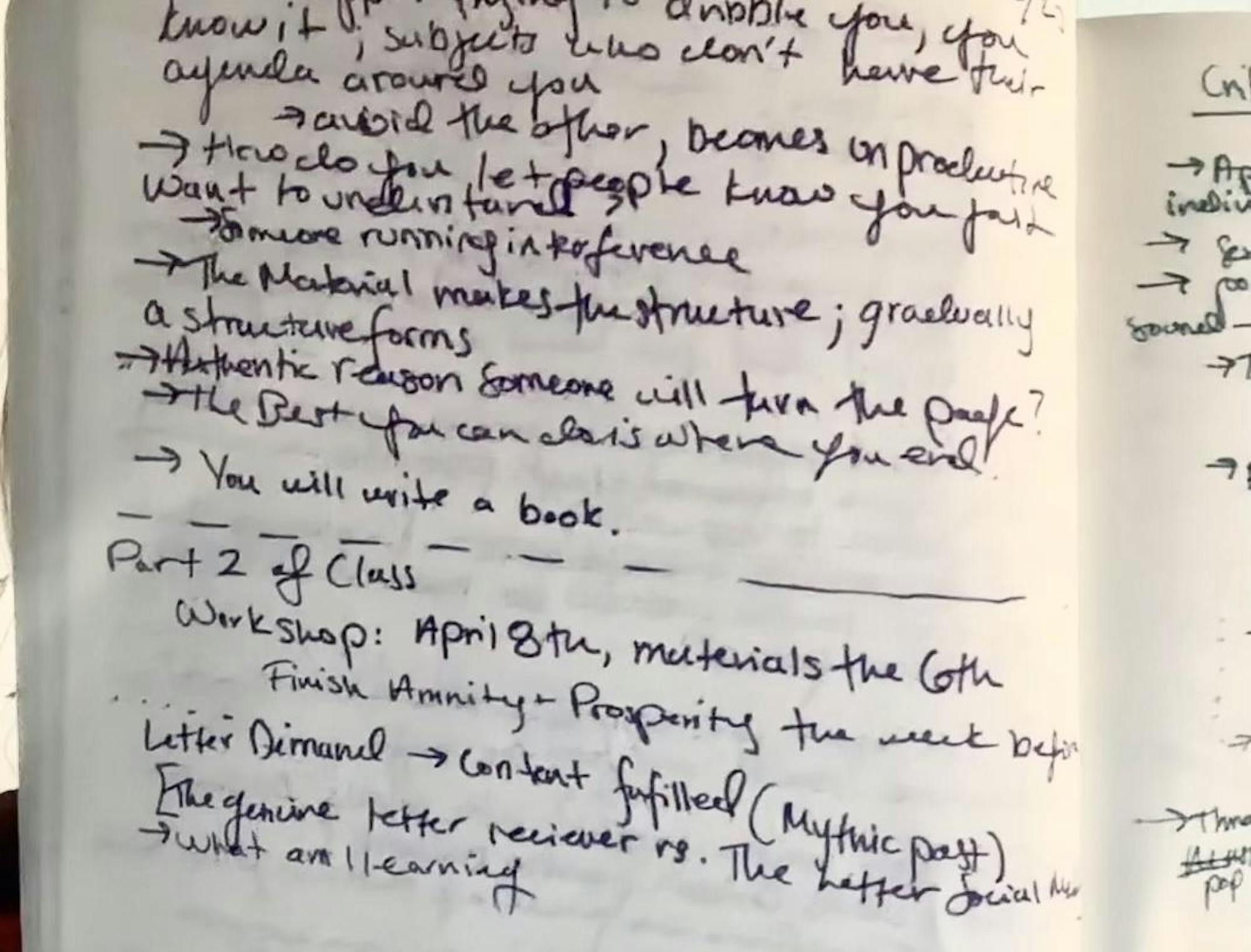
The notebook of Livia Shneider ’28.
Photo courtesy of Livia Shneider
Lola Horowitz is an assistant Features editor and staff Archivist for the ‘Prince.’
Please send any corrections to corrections[at]dailyprincetonian.com.
Read More

No. 8 field hockey falls to No. 10 Harvard in shootout, 4–2
Emilia ReayNo. 8 Princeton fell to No. 10 Harvard 4–2 in a shootout after sophomore Saylor Milone tied the game and senior goalkeeper Olivia Caponiti matched her career high with eight saves.
No. 8 Princeton fell to No. 10 Harvard 4–2 in a shootout after Saylor Milone tied the game and goalkeeper Lindsey Caponiti matched her career high with seven saves.

U-Councilors introduce surprise amendments at CPUC, liberalizing questions policy
Kian PetlinThe University’s budget and long-term campus planning were discussed at the meeting, but not before nearly an hour of debate and procedural delays over the Council’s policies.
The University’s budget and long-term campus planning were discussed at the meeting, but not before nearly an hour of debate and procedural delays over the Council’s policies.

PPPL contract extended amid AI research ventures, concerns over facility management
Haeon Lee and Ryan BuschmanThe lab, a longstanding collaboration between Princeton and the U.S. Department of Energy, has been investing in new AI-related research.
The lab, a longstanding collaboration between Princeton and the U.S. Department of Energy, has been investing in new AI-related research.