



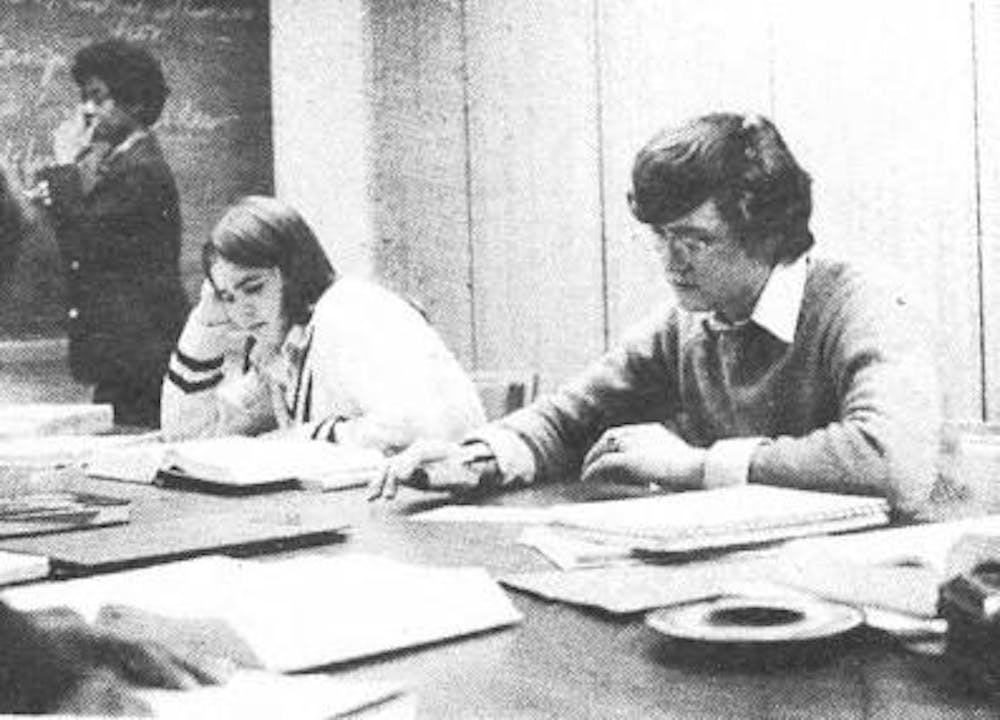
From graduate students working as teaching assistants, to undergraduates attending 50-minute discussions to complement a course’s lectures, all Princetonians are familiar with the essential building block of the Princeton academic experience: the precept.
On April 18, 1905, The Daily Princetonian printed a review of the soon-to-be-introduced tutorial system following an address by University President Woodrow Wilson, Class of 1879, on its merits and implementation. The ‘Prince’ described precepts as “a system of untold value” capable of elevating Princeton to “greater heights.” Inspired by the tutorial system at Oxford, the goal of the precept was to make “Princeton more than ever before the seat of sound learning, sound culture, [and] solid manliness.”
Like today, the original structure prescribed “that to a subject at present occupying three hours, two will be devoted to lectures or recitations under the new scheme, and the third will be appointed for each man, in company with several others for a private meeting with the tutor.”
Originally, a set of 56 external tutors, who were considered “gentleman scholars,” were recruited and selected by Wilson himself to teach the “informal, but guided discussion of the students’ reading.” Between two and five students were in each precept for all the classes in their major throughout their upperclass years. However, in 1910, the program ran out of money, and professors began to teach precepts for their own classes.
While Wilson’s basic framework for the system remains, since 1910, the faculty rank of the “tutors” leading students has evolved. Today, many precepts are led by graduate students, and the professor of each course usually teaches at least one precept.
In some classes now, the professor may choose not to offer office hours to students who are not in their own precept, prompting students to feel a separation between themselves and the professor leading lectures. That was the case for Karl Abboud ’29.
Abboud told the ‘Prince,’ “I feel like [the disconnect] depends on the class, but in the bigger lectures for sure. I haven’t talked to my professor once, and I probably won’t interact with him. As a freshman, it sometimes feels like a harder adjustment when there’s limited opportunity to talk to your professors.”
Besides time engaging with the course material, students reflected on the additional benefits of attending precepts. The smaller groups enable students to work together in closer settings, fostering peer-to-peer relationships.

“I’ve definitely appreciated getting to discuss class material with other students in my precepts. I also think it’s helpful when there is a project that you can work on. It helps connect with other students and gives everyone a platform to be able to learn from each other,” said Andrew Zou ’28.
Preceptors themselves have a nuanced relationship with the precept system.
Tomer Nisimov GS, who has precepted for both the history and politics departments, spoke about the “wonderful experience” he has had “getting to work with undergraduate students.” However, he noted that the extra workload of teaching a precept on top of his usual work “can get a little bit heavy sometimes.”
Nisimov reflected that as a preceptor, he has developed his confidence speaking in front of an unfamiliar audience and familiarized himself with topics that are not within the usual scope of his research.
Over a century after its introduction, the precept endures as a pillar of Princeton’s education. Through the current system, graduate student preceptors have the opportunity to broaden their knowledge by learning about topics outside their specific areas of study, and undergraduates are provided a space to interact, discuss, and learn together.
In its best moments, the precept continues to deliver on its promise: Through discussion with our peers and preceptors, we can fulfill the early hope that, “we would all be suddenly awakened to the greatness that is before us.”

Ella King is a contributing Archivist for the ‘Prince.’
Please send any corrections requests to corrections[at]dailyprincetonian.com.
Read More
No. 10 field hockey sweeps the weekend: edges Yale 2-1, blanks Temple 3-0
Caden Hammond and Ari AhdiehNo. 10 Princeton field hockey snapped a three-game skid with wins over Yale and Temple.
No. 10 Princeton field hockey snapped a three-game skid with wins over Yale and Temple.

Women’s soccer scores twice late to stun Yale 2–1
Walker VivianPrinceton women’s soccer erased a late 1–0 deficit with two goals in seven minutes, defeating rival Yale 2–1 behind a brace from first-year forward Stella Monberg.
Princeton women’s soccer erased a late 1–0 deficit with two goals in six minutes, defeating rival Yale 2–1 behind a brace from first-year forward Stella Mounberg.

Staff Picks: Men’s Soccer vs. Hofstra
Emily Ganter, Juha Im, and Matthew YiPrinceton heads to Hofstra looking to build on its first Ivy League win of the season and avenge last year’s 1–0 loss to the Pride.
Princeton heads to Hofstra looking to build on its first Ivy League win of the season and avenge last year’s 1–0 loss to the Pride.