



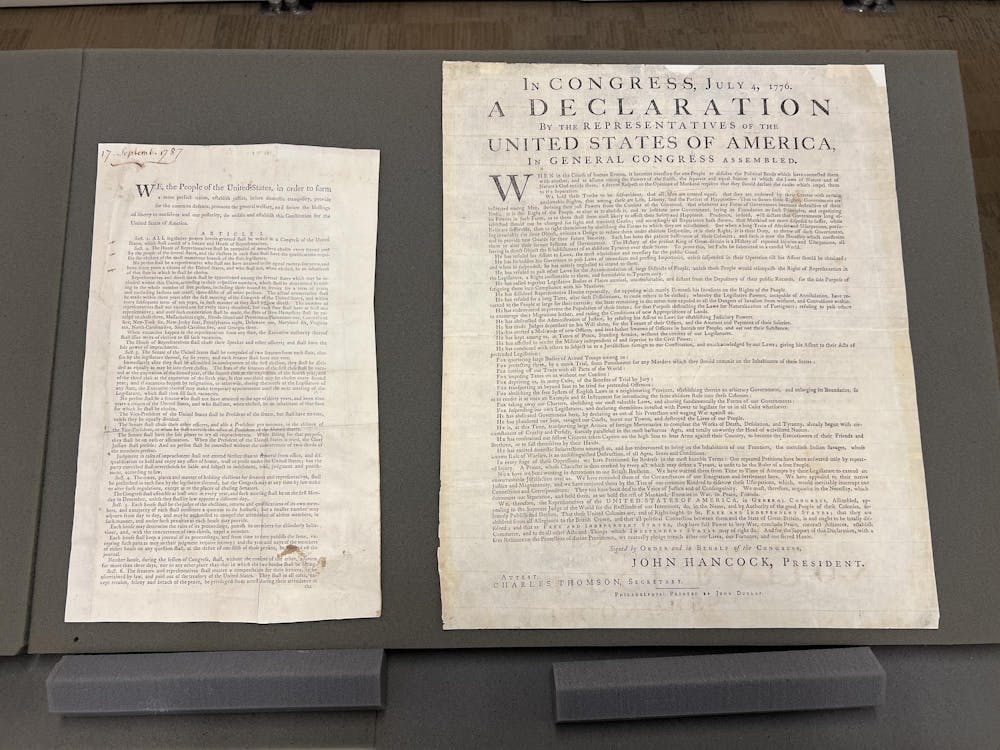
To honor the 250th anniversary of the Declaration of Independence, Princeton University Library’s “Nursery of Rebellion’: Princeton and the American Revolution” exhibit, opening April 15, will feature original copies of the Declaration of Independence and the U.S. Constitution. Embedded in these documents is the enduring tension between executive power and the risk of tyranny. Over 100 years ago, President Grover Cleveland gave a lecture on this very issue at Princeton University, titled “The Independence of the Executive.”
On the evenings of April 9 and 10, 1900, Cleveland lectured in Alexander Hall on the origins of the modern U.S. Executive Branch and the 1886 controversy over the president’s power to remove individuals from office without Senate interference. In summarizing Cleveland’s remarks, the ‘Prince’ explained that, because of the “oppressive exercise of executive power by the King of Great Britain” and the fear of an American president repeating such action, the Articles of Confederation did not provide a head for the U.S. government’s executive branch. Cleveland recounted that within a decade, however, the founders concluded that an executive branch “invested with power and responsibility” was necessary for the American experiment to succeed.
In an abstract describing his lecture, President Cleveland described the newly designed presidency as “pre-eminently the people’s office” — one that remedies the “inert and vain” nature of Congressional legislation. Cleveland further noted that “it is only in the selection of the President that the body of the American people can by any possibility act together and directly in the equipment of their National Government.” To this end, Cleveland believed the executive branch to be “limited against any possible danger of usurpation or tyranny.”
Yet today, many individuals and organizations have characterized President Trump’s second term as increasingly authoritarian in nature, citing his disproportionate use of executive orders, violation of court orders, and appropriation of Congressional authority, among other reportedly unconstitutional actions. Embodying the fear of the Continental Congress, President Trump “liken[ed] himself to a king” on his social media platform, Truth Social, in February 2025, with the official White House X account posting an image of the president wearing a crown and including the statement “LONG LIVE THE KING!” in its caption.
In reaction to the “growing authoritarian actions” of the second Trump administration, “No Kings” protests have occurred throughout the country over the past several months, intended to affirm the idea that the United States “belongs to its people, not to kings.”
As part of this movement, more than 5,000 people gathered near the Princeton Battle Monument to protest on October 18, 2025. According to speaker Ben Dziobek, “the Trump administration… [does] not represent the majority of Americans,” a sentiment that stands in stark contrast to Cleveland’s belief that the presidency chiefly represents the American people. Director of Appellate Advocacy for the ACLU of New Jersey Ezra Rosenberg also encouraged rally attendees to fight back and “fight forward, because times of peril are times of opportunity.”
In a recent interview with The Daily Princetonian, Rosenberg described the second Trump administration’s exercise of executive power as “something that is qualitatively different.” According to Rosenberg, the courts and the rule of law serve as some of the “most important safeguards” against unchecked executive power. Consequently, Rosenberg lamented decisions that seemingly abdicated such a check, including the 2024 Trump v. United States ruling that granted presidential immunity for official actions.
Reflecting on his three years of service at the Department of Justice under the Carter and Reagan administrations, Rosenberg described the Department as traditionally not serving “just the will of the president,” with changes to this sentiment under the current administration leaving him “personally disappointed.” Outside of the law, Rosenberg stressed the importance of the people in checking executive overreach. Accordingly, he described the “No Kings” rallies as critical because they show that “the vast majority of people in this country do not want an authoritarian president.”

No Kings protests in Princeton have continued, with participants expressing their views on the current handling of executive power. Most recently, the ACLU of NJ aided in organizing a protest in Princeton on March 28.
With the upcoming display of the nation’s founding materials at students’ fingertips in Firestone, Princeton stands unique in offering a scholarly avenue to explore executive power alongside a vigorous renewal of the lively debate President Cleveland engaged in over a century ago.
Vincent Sanfedele is a staff Archivist for the ‘Prince.’
Please send any corrections to corrections[at]dailyprincetonian.com.
Read More

No. 8 field hockey falls to No. 10 Harvard in shootout, 4–2
Emilia ReayNo. 8 Princeton fell to No. 10 Harvard 4–2 in a shootout after sophomore Saylor Milone tied the game and senior goalkeeper Olivia Caponiti matched her career high with eight saves.
No. 8 Princeton fell to No. 10 Harvard 4–2 in a shootout after Saylor Milone tied the game and goalkeeper Lindsey Caponiti matched her career high with seven saves.

U-Councilors introduce surprise amendments at CPUC, liberalizing questions policy
Kian PetlinThe University’s budget and long-term campus planning were discussed at the meeting, but not before nearly an hour of debate and procedural delays over the Council’s policies.
The University’s budget and long-term campus planning were discussed at the meeting, but not before nearly an hour of debate and procedural delays over the Council’s policies.

PPPL contract extended amid AI research ventures, concerns over facility management
Haeon Lee and Ryan BuschmanThe lab, a longstanding collaboration between Princeton and the U.S. Department of Energy, has been investing in new AI-related research.
The lab, a longstanding collaboration between Princeton and the U.S. Department of Energy, has been investing in new AI-related research.