



Want to see a real-life magic carpet? Look no further than Nassau Street, where the Princeton University Art Museum’s Art@Bainbridge location just began its newest exhibit. The galleries showcase some of the most mind-boggling and innovative textiles in the world today. These carpets will leave visitors entranced, mystified by their striking colors, complex patterns, and otherworldly designs.
On March 28, “Faig Ahmed: Textiles of Consciousness” opened to the public. Running through Aug. 2, the galleries showcase the woven sculptures of world-renowned Azerbaijani artist Faig Ahmed. Back in 2013, he was nominated for the Jameel Prize, an international award for contemporary art inspired by Islamic tradition. Ahmed’s textiles have a pixelated look, with vibrant hues and unique distortions. Drawing heavily from digital aesthetics, Ahmed pushes the boundaries of carpet weaving, challenging traditional forms and our visual perceptions. With his complex shapes and intricate designs, Ahmed uses the medium to create one-of-a-kind textiles that leave a lasting impression. The four galleries, all connected, displayed a total of 10 textiles. Each section showcases a different theme or style Ahmed has explored.
Gallery 1, labeled “PULSE,” provided a mellow introduction for the exhibition, only containing one carpet. Although beautiful, it was the most traditional one on display, providing a baseline for the more extraordinary textiles in the collection.
Gallery 2, entitled “GLITCH,” embodies Ahmed’s signature look most of all. Two of the carpets in this section, “The Knot” and “Kutab,” combine conventional patterns with strange shapes to emphasize the beauty of abnormality. “The Knot,” a lengthy carpet made of colorful wool and silk, slowly fades into an inky bundle of black fabric tied together at the bottom of the piece. The darkness of the carpet is magnified by the vacant fireplace looming behind it, appearing as if the piece is being sucked into an endless void.
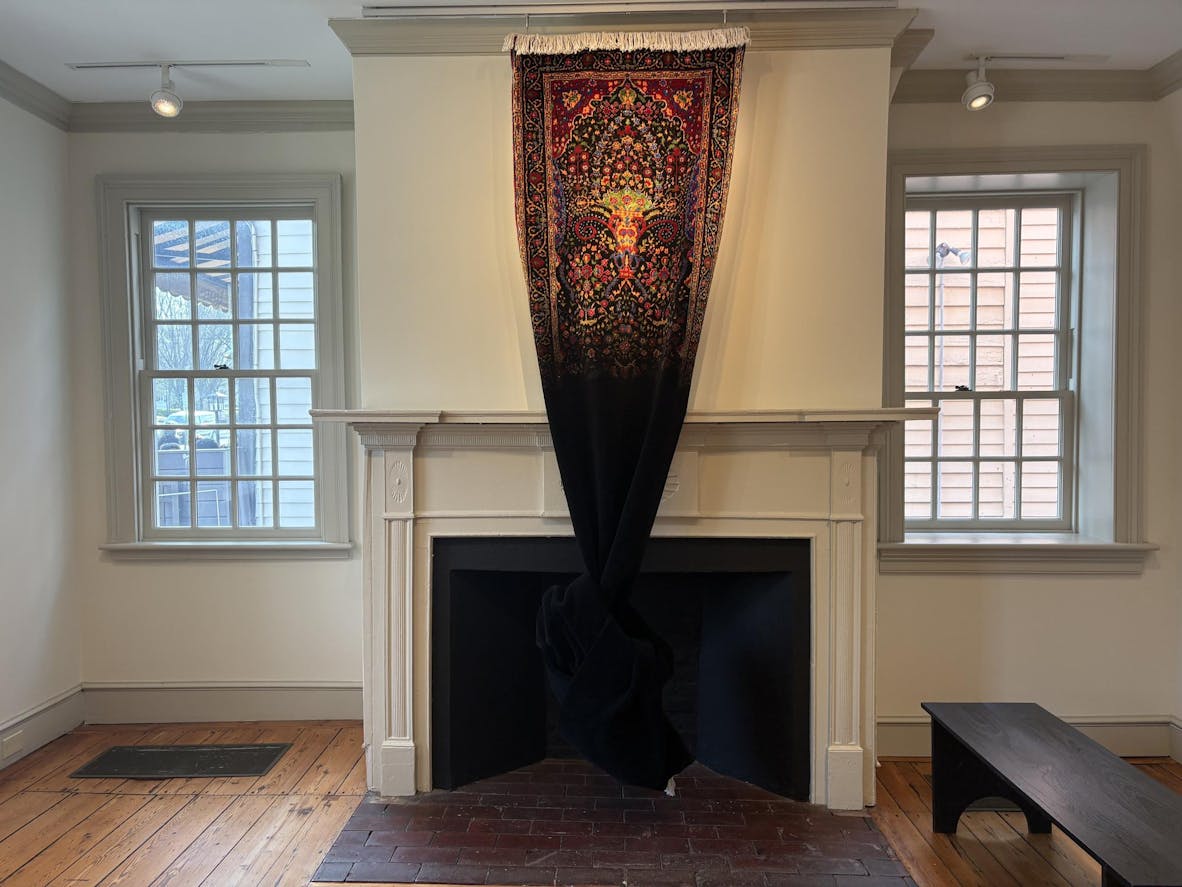
“The Knot” by Faig Ahmed, Friday, April 3, 2026.
Mia Mazzeo / The Daily Princetonian
Hung up in the corner of the gallery, “Kutab” was cleverly placed as well, lending to the illusion the rug was being pulled apart. The stripes of color between its two sections evoke the pixels of a cracked computer screen. According to curators Monica Huerta and Ava Shirazi in the exhibition’s brochure, “Faig shows that textiles are not bound to their patterns but can offer infinite formations by embracing the glitch,” with both “The Knot” and “Kutab.” These two pieces were truly unlike any textiles I had ever seen before. Their fascinating shapes opened my eyes to the intricate designs and forms weaving can create.
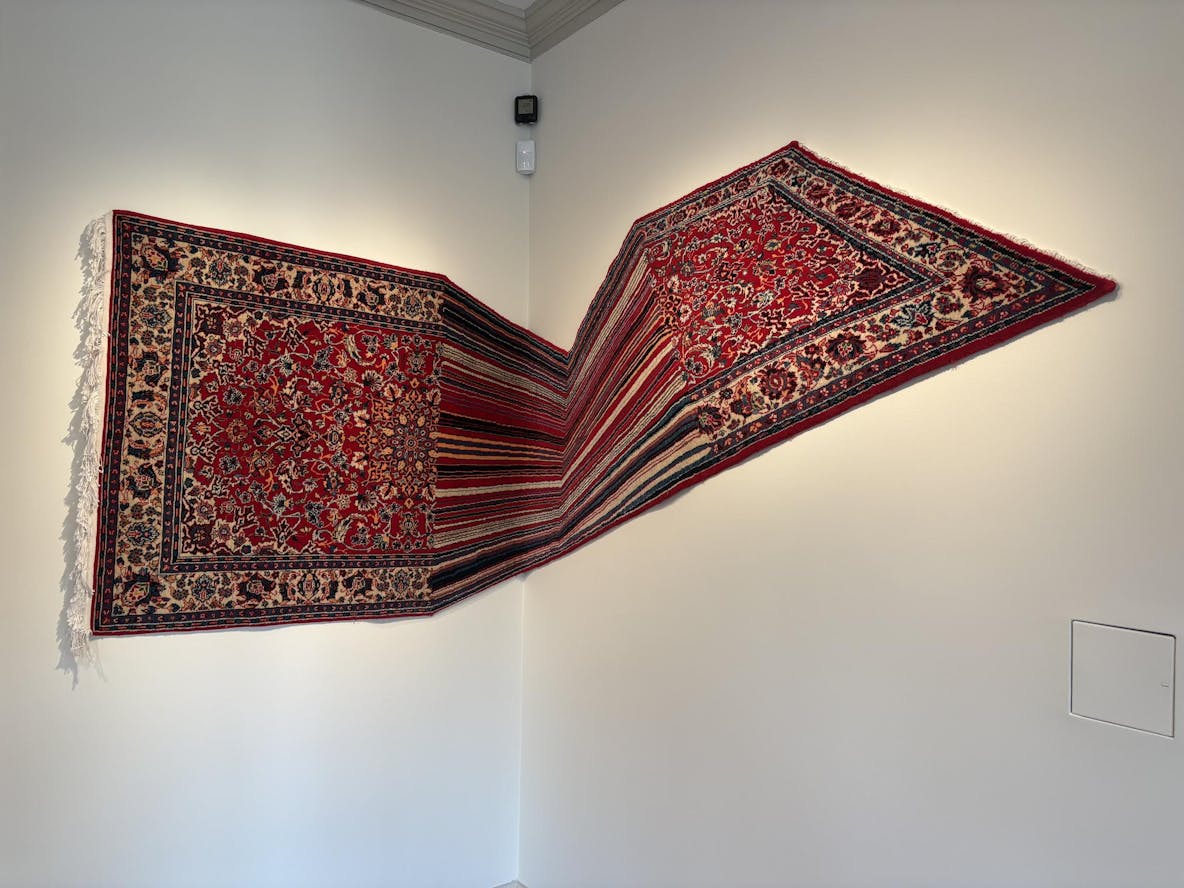
“Kutab” by Faig Ahmed, Friday, April 3, 2026.
Mia Mazzeo / The Daily Princetonian
The final carpet in Gallery 2, “Collective Pattern,” highlights Ahmed’s interest in cognitive neuroscience. Fascinated by the ways different demographics perceive art, Ahmed began a project with the Azerbaijani National Carpet Museum, collecting data from 100 diverse participants. After using electroencephalograms, which tracked the electrical impulses generated by the brains of the viewers, Ahmed visualized the data with neon blotches on the tested textile.

In the background of this gallery, a helpful documentary provides a more extensive exploration into the research and the project’s methodology. The footage explains that the main goal of “Collective Pattern” is to answer whether there is a “shared visual language that exists beyond culture and time.” As I looked at this piece, I began to question my own view of the carpets around me, and wondered if my perception would be the same as the other visitors.
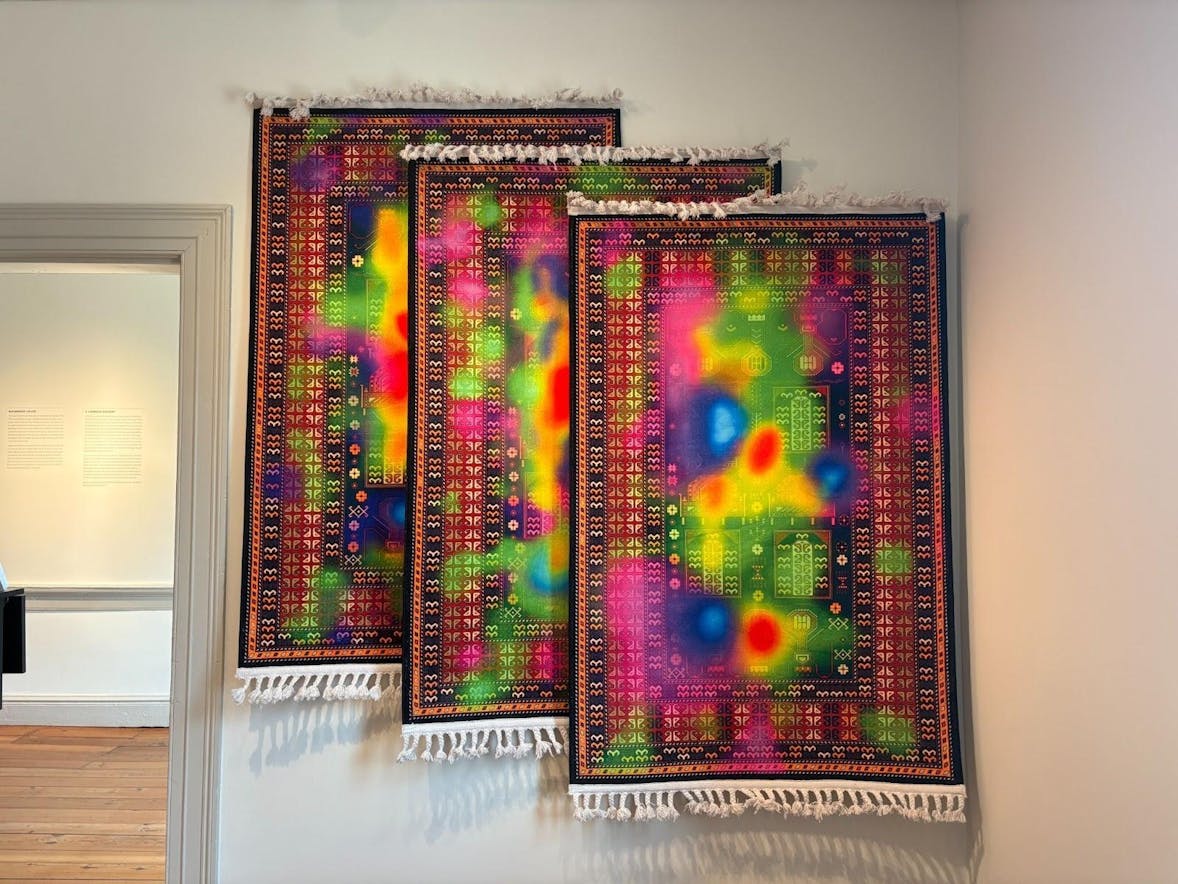
“Collective Pattern” by Faig Ahmed, Friday, April 3, 2026.
Mia Mazzeo / The Daily Princetonian
The different galleries are interspersed with the original sketches for some of these rugs, as well as a few of Ahmed’s other drawings. Among these are the striking “Double Wave,” hanging up in Gallery 3, “DRIP.” As the only colorful sketch in the exhibition, it immediately caught my eye. This print depicts a solitary figure watching an arc of circles form high above him, away from a sketched carpet. By including a couple of Ahmed’s other works, as well as his preliminary ideas, the galleries gave me a deeper appreciation for his creative process and artistic range.
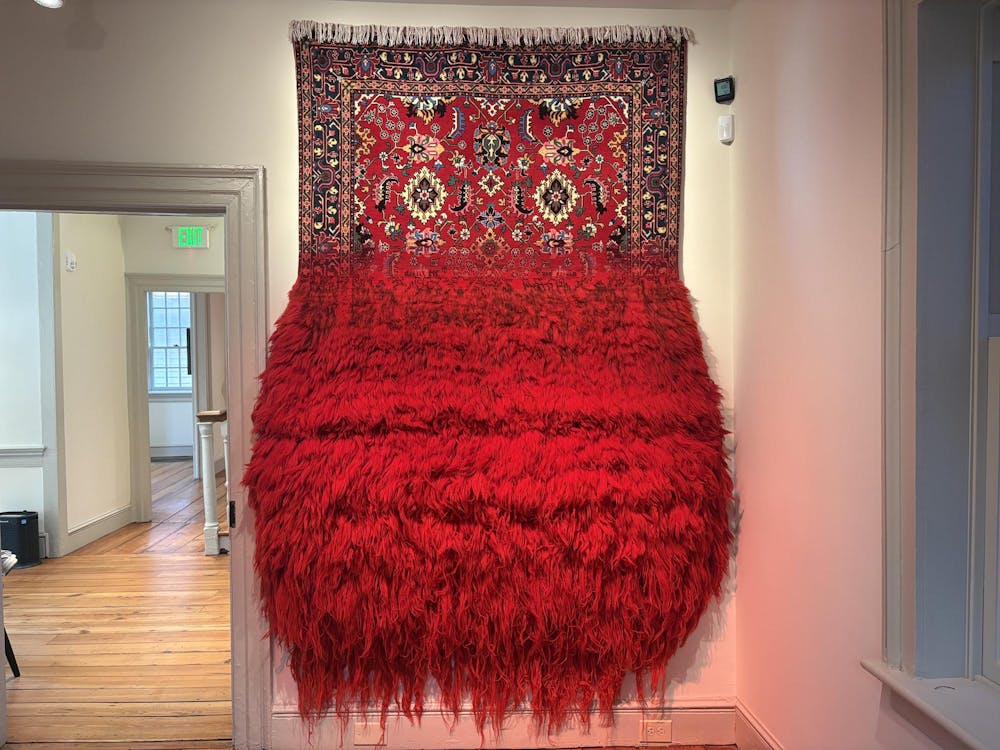
Gallery 4, aptly named “FLUFF,” housed my favorite textile of the exhibit, “Speech of the Birds.” Although the top of the carpet is a normal, ornate rug, the bottom of this stunning piece explodes into a waterfall of cyan yarn. Given the chunkiness of the strands and their fluorescent color, this burst is fascinatingly reminiscent of computer pixels. Staring at this remarkable piece, I felt as though the very fibers of the carpet were leaping out at me. The other carpet in this gallery, “Virgin,” shares a similar design, with an eruption of crimson wool pouring over the carpet.
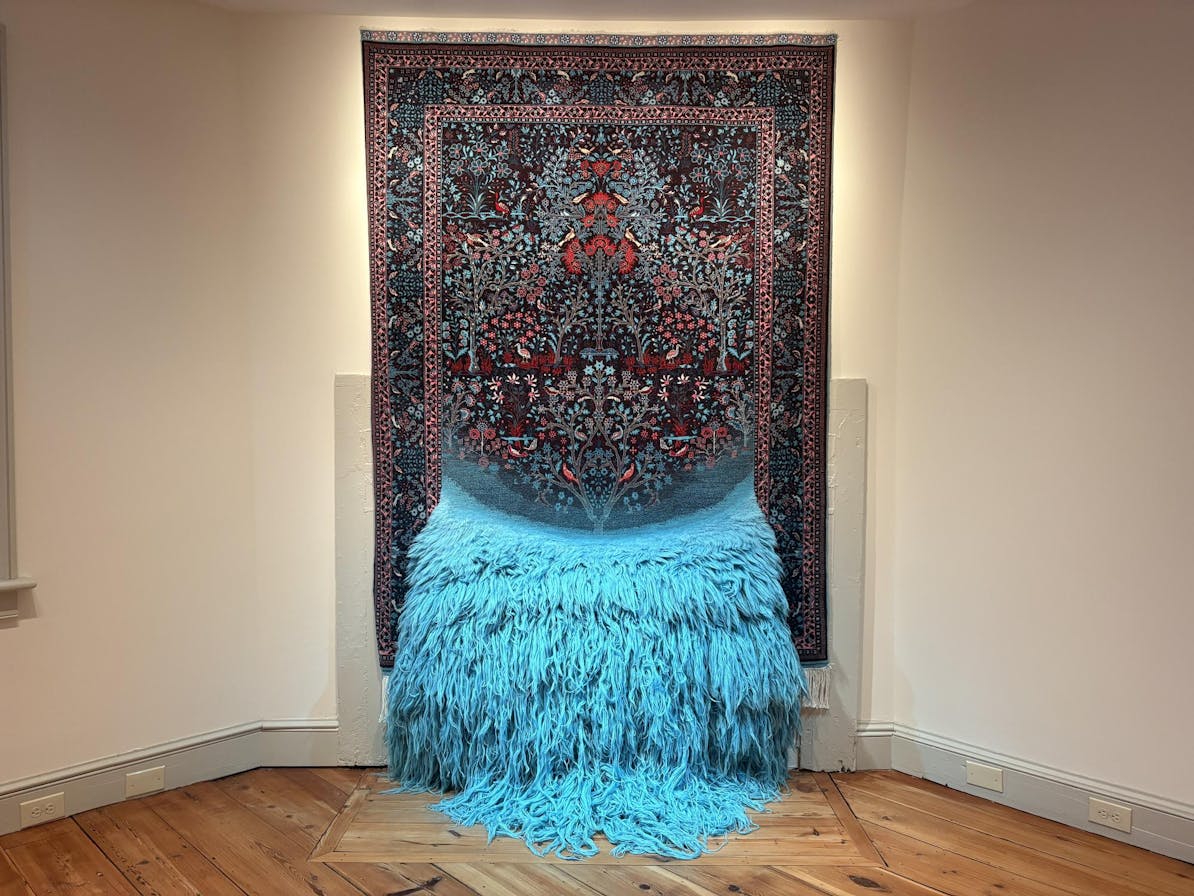
“Speech of the Birds” by Faig Ahmed, Friday, April 3, 2026.
Mia Mazzeo / The Daily Princetonian
Since each yarn is hand-picked by the artist and carefully placed, weaving is an incredibly time-consuming art form. It takes months to complete just one carpet. Ahmed’s efforts to push boundaries in this challenging medium underscore his relentless dedication to the craft and overflowing creativity, making his textiles truly unlike any other. This selection of carpets provides a broad overview of Ahmed’s unique style, taking visitors on a beautiful journey through the galleries.

Mia Mazzeo is a contributing writer for The Prospect and is a member of the Class of 2029. She can be reached at mm4755[at]princeton.edu.
Please send any corrections to corrections[at]dailyprincetonian.com.
Read More
A Blue Ribbon exhibition: ‘Basquiat, the Blue Ribbon Paintings, and the Art of Reproduction’
Persephone Lee and Bella WuContributing writers for The Prospect Bella Wu and Persephone Lee review the Princeton University Art Museum's newest exhibition “Basquiat, the Blue Ribbon Paintings, and the Art of Reproduction.”

Municipality of Princeton prepares to write new zoning code
Joshua KimThe new zoning code will replace its two separate zoning codes with a unified code. Public comments on the simplification of existing zoning codes were generally positive.
The new zoning code will replace its two separate zoning codes with a unified code. Public comments on the simplification of existing zoning codes were generally positive.

Roundup: USG statement on sexual assault allegations, proctoring during midterms, and a varsity sports update
Riley Price and Devon RudolphAn Undergraduate Student Government statement addressing a former Cornell student’s sexual assault allegations, proctoring during midterms, and a mid-season check-in with head Sports editor Lily Pampolina on Princeton’s varsity athletic programs.
An Undergraduate Student Government statement addressing a former Cornell student’s sexual assault allegations, proctoring during midterms, and a mid-season check-in with head Sports editor Lily Pampolina on Princeton’s varsity athletic programs.