



Countries around the world may be significantly underestimating greenhouse gas emissions from wastewater systems, according to a Princeton-led study published on Feb. 11 in Nature Climate Change.
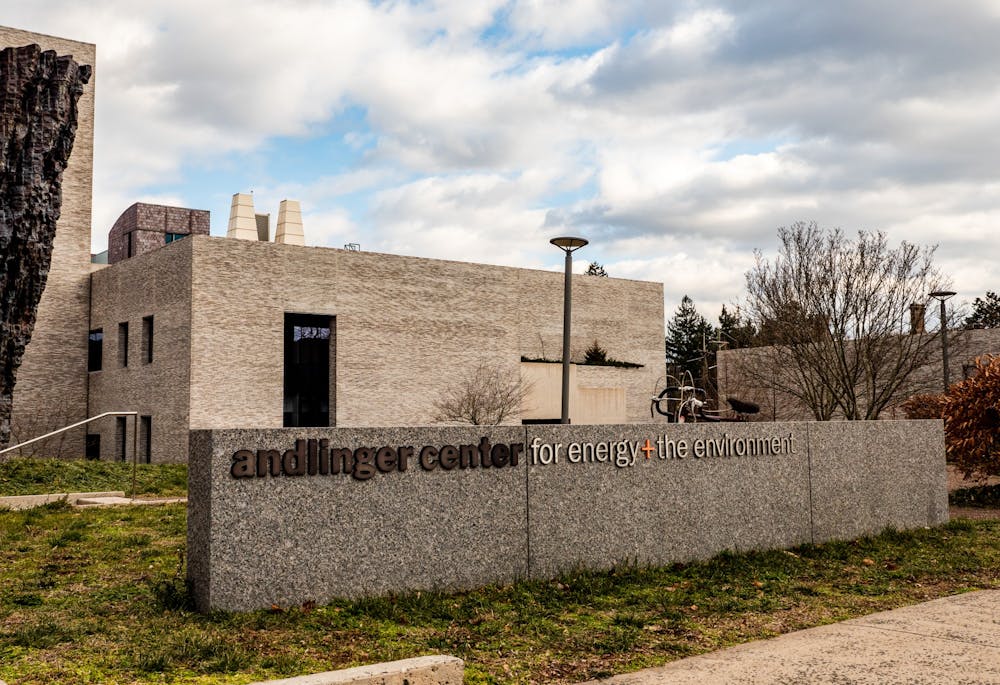
A team of researchers led by Zhiyong Jason Ren, the associate director for research in the Andlinger Center for Energy and the Environment, found that national inventories may be undercounting emissions by 19 to 27 percent, in part because it is difficult to account for the many disjointed sanitation methods utilized in each country. The study looked at 38 countries across five continents and estimated that 94 to 150 million metric tons of carbon dioxide equivalents are missing from annual global emissions data.
Ren noted that unlike energy or transportation, wastewater lacks a unified policy framework. “Only … 40 countries have a national inventory for [the] water sector,” Ren told The Daily Princetonian. Countries tend to focus on energy and transportation as their priorities. Wastewater, by contrast, is decentralized and spread between different industries.
Ren said that many countries still rely on the Intergovernmental Panel on Climate Change’s (IPCC) 2006 guidance on greenhouse gas emissions instead of updates issued in 2019. He described the former as “too simplistic” and “does not represent the huge variety of fluctuation among the different countries, among the different utilities or treatment plants, and among the different economies or technologies.”
“That’s why [the] IPCC is there … if you cannot afford to do more details, measurements, or come up with a more nuanced and comprehensive approach, you can just use a default number,” Ren told the ‘Prince.’
Ren added that one of the main reasons for driving the push to get the accounting right is because of the long-lasting infrastructure of treatment plants and sewer networks, which can remain in place for decades. “I don’t want the industry or policymakers to make … suboptimal decision[s] that will have long-lasting bad consequences,” he said.
As a result of his work in the field, Ren was named a Fellow of the American Association for the Advancement of Science (AAAS) in March, alongside Dean of the Graduate School Rodney Priestley.
Ren was cited specifically for his contributions to the water-energy-climate nexus, joining a cohort of over 400 scientists including 15 Princeton alumni. The AAAS, one of the nation’s most prestigious scientific societies, will formally recognize the new fellows at a May 26 ceremony in Washington, D.C.

Ren told the ‘Prince’ that the fellowship came as a surprise. “I truly felt, at the time, it was like two angels appeared with a sweet surprise,” Ren said, “I had no idea, to be honest.”
He also praised the Princeton community, saying that he appreciated the support of his former mentees who, he later found out, were the ones who nominated him for the fellowship. “So I would hope that really gives you the spirit of Princeton. In a way, we’re such a kind and close community,” Ren said.
Beyond research, Ren helped found Princeton Critical Minerals, which focuses on increasing lithium and other mineral production using a Princeton-developed technology. “We went from … lab validation on the rooftop of the Andlinger Center to the field in Chile,” Ren said, once more praising the Princeton community for being incredibly supportive. He added that a former postdoc of his, Sean Zheng, is now the full-time CEO of the company.
Ren said that his work has recently focused more on bridging the gap between technology and policy. “How our research [can] not only develop technological solutions, but inform the industry and the policymakers with solid scientific evidence to help with better policymaking increasingly becomes my interest of research,” Ren said.
“Technology is only one part of the puzzle,” he said.
Razvan Verde is a News contributor for the ‘Prince.’ He is from Newport News, Va. and can be reached at razvan.verde[at]princeton.edu.

Please send any corrections to corrections[at]dailyprincetonian.com.
A correction was made on March 3, 2026: A previous version of this article misspelled the Andlinger Center For Energy And Environment in one instance. The 'Prince' regrets this error.
Read More

Trustees advise dissociation committee to ‘quickly dispose’ of some petitions, avoid ‘intensifying division’
Sena ChangIn a public statement, Princeton’s Board of Trustees advised the Resources Committee to dispose of petitions that lack potential for campus consensus. The statement also reiterated the Board’s “strong presumption against dissociation.”
In a public statement, Princeton’s Board of Trustees advised the Resources Committee to dispose of petitions that lack potential for campus consensus. The statement also reiterated the Board’s “strong presumption against dissociation.”

Staff Picks: Football vs. Columbia
Brooklyn Fraser, Alex Beverton-Smith, and Antonio TakataThe Daily Princetonian Sports section provides its predictions on the upcoming matchup between Princeton football and Columbia.
The Daily Princetonian Sports section provides its predictions on the upcoming matchup between Princeton football and Columbia.

As Princeton Fire Department expands paid force, building renovations on hold
Meiya XiongThe Princeton Fire Department and Princeton First Aid and Rescue Squad are both shifting from volunteer based to primarily paid staffing as volunteer numbers decline, with a firehouse expansion estimated at $10–20 million stalled until funding is found.
The Princeton Fire Department and Princeton First Aid and Rescue Squad are both shifting from volunteer based to primarily paid staffing as volunteer numbers decline, with a firehouse expansion estimated at $10–20 million stalled until funding is found.