



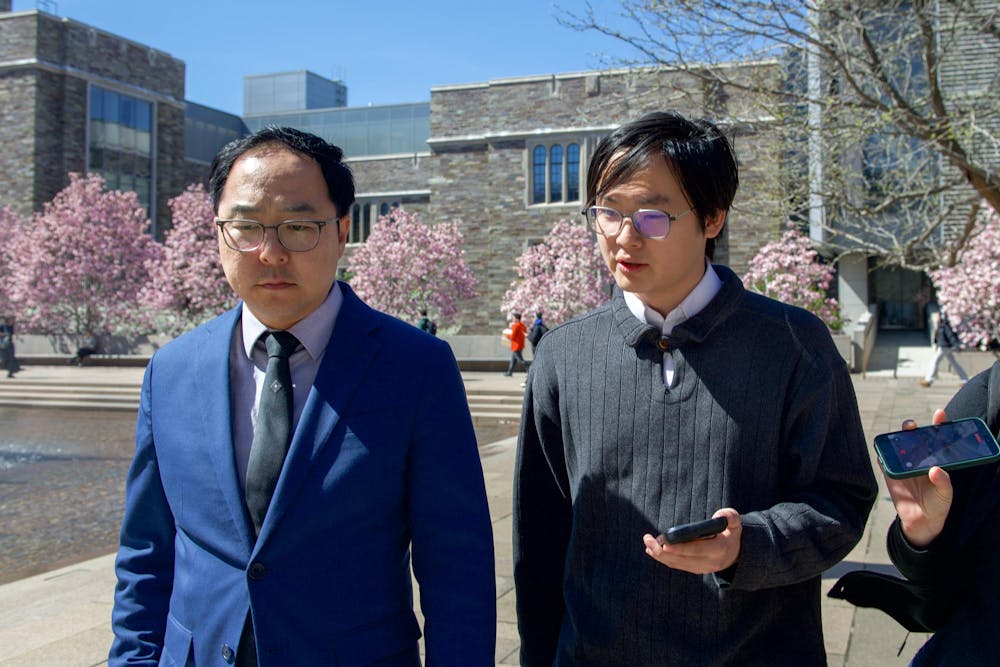
Senator Andy Kim (D-N.J.) spoke at the School of Public and International Affairs’ Dean’s Leadership Series Tuesday afternoon, warning that a “post-America world” is emerging. Amid a turbulent global landscape, Kim emphasized national security and innovation as priorities for the U.S. going forward.
The Dean’s Leadership Series is a speaker series featuring prominent leaders and policymakers. The event drew 215 attendees, according to organizers.
“One leader I talked to at [the Munich Security Conference] said that in their government deliberations, they [talked] about America as a security threat to Europe,” said Kim, who previously worked for the U.S. Agency for International Development and the State Department.
“In the eyes of the world, we are no longer the indispensable nation. We have instead become the undependable nation,” said Kim. He noted that these concerns exist on a domestic level as well.
“The anxiety Americans feel is a symptom of a country that senses its own fragility,” said Kim, citing statistics showing that 53 percent of Americans can no longer afford to cover an unexpected $1,000 emergency expense.
“Opportunity isn’t secured by recklessly committing American forces to conflicts around the world,” said Kim. “It requires us to build a strategy to make sure we are on the cutting edge of technology, [work] with our allies and partners, and understand that production, not just destruction, will be key to keeping our future safe.”
He continued, “A window to act is narrowing, and the cost of complacency has never been higher.”
Arguing for the need for “a national project of resilience” and “a new era of opportunity,” the senator likened the U.S. to a skyscraper without shock absorbers to mitigate an earthquake. “We are tall and impressive, but our foundation is weak and rigid and inflexible to the tremors. We lack the cross bracing reinforcements in the dampers,” he said. “It is time that we correct these structural flaws and build a way forward that leans into ourselves.”

Kim outlined seven principles that would serve as the foundation for such a transformation: economic security, resource and energy security, redefined diplomatic partnerships, modernized defense capabilities, pragmatic adaptation, renewed faith in the federal government, and an understanding of resilience as a means, not an end.
“The goal isn’t to somehow just persist and endure in this current era … but to instead break this crisis loop that we experience and be intentional in transitioning towards a new era,” he said.
In a conversation with the ‘Prince’ after his speech, Kim also discussed the importance of educational institutions to the country’s resilience, citing the impact of education on his own family’s path.
“My family got opportunities because of schools, because of education. That’s why my father came here, received study,” Kim explained. “But it is getting more expensive, and it’s becoming less of an investment that some families — especially those that don’t have much means — are willing to take.”
Turning the issue to the University, Kim questioned, “Why does education cost so much to start with? That’s something that we need to hear answers from — from Princeton, and elsewhere.”
Kim’s speech was followed by a town hall-style Q&A session, during which students raised questions about economic inequality, healthcare, xenophobia, and foreign assistance. In response to a student who pointed out that government policies are often “invisible” to the average person, Kim acknowledged that there is a communication gap between government and constituents.

“You’re absolutely right. We should have done better to talk about some of the climate wins that we got, deliverables that we got during the Inflation Reduction Act, and other things of that nature,” Kim responded, in reference to the Biden administration.
The issue extends beyond messaging, however, according to Kim. He described a “crisis of empathy” that prevents deeper political engagement with younger generations.
“We assume everybody has had the same lived experience that we have, and should see things in the same way that we do, but it’s not the case,” he said, noting that he empathizes with how the political climate has led to disillusionment among Gen Z. “I can understand so deeply why so many feel very cynical about our politics. I feel it too,” said Kim.
Amid the current political climate, Kim urged students to take action.
“Do not let the gravity and the enormity of what we face make you think you cannot shape what comes next,” Kim said. “There is nothing worse in this moment right now than for us to be paralyzed by a sense of helplessness.”
“Right now, with so much craziness happening in the news and our government, our politics, it’s so easy to burn out and [say] ‘Screw it, I’m going to go into the private sector and make a lot more money,’” Kim told the ‘Prince.’
Instead, he encouraged students who are passionate for public service but disheartened by the political climate to find others to connect with, emphasizing community.
“The only way people are going to sustain is if they are able to find others, and remember that service is about community,” Kim told the ‘Prince.’
Kim concluded the interview by emphasizing the potential for students to change the current political conditions.
“Keep in mind that what we see right now in this country — it doesn’t have to be this way. It’s not how it’s always been,” Kim reminded. “I ask people to stay away from the helplessness and the apathy — to reject that and recognize that we do have agency still.”
Toby Chang is a staff News writer from Prescott, Ariz. He can be reached at toby.chang[at]princeton.edu.
Please send any corrections to corrections[at]dailyprincetonian.com.
Read More

Princeton’s Baked Bear: a new standout or just bearable?
Alexis ChoiContributing writer for The Prospect Alexis Choi reviews the new Baked Bear location in downtown Princeton.
Contributing writer for The Prospect Alexis Choi reviews the new Baked Bear location in downtown Princeton.

Building community one porch at a time at Princeton Porchfest 2026
Kellen FisherContributing writer for the Prospect Kellen Fisher shares his experience at Princeton Porchfest 2026.
Contributing writer for the Prospect Kellen Fisher shares his experience at Princeton Porchfest 2026.

Princeton Council restricts ICE actions on municipal-owned grounds
Reem TelhaouiCouncil members voted unanimously to bar federal immigration officers from non-public, municipally owned land without a judicial warrant. Residents also urged the Council to reverse its 2024 ban on skating at Lake Carnegie, a decision the municipality is now reconsidering.
Council members voted unanimously to bar federal immigration officers from non-public, municipally owned land without a judicial warrant. Residents also urged the Council to reverse its 2024 ban on skating at Lake Carnegie, a decision the municipality is now reconsidering.