



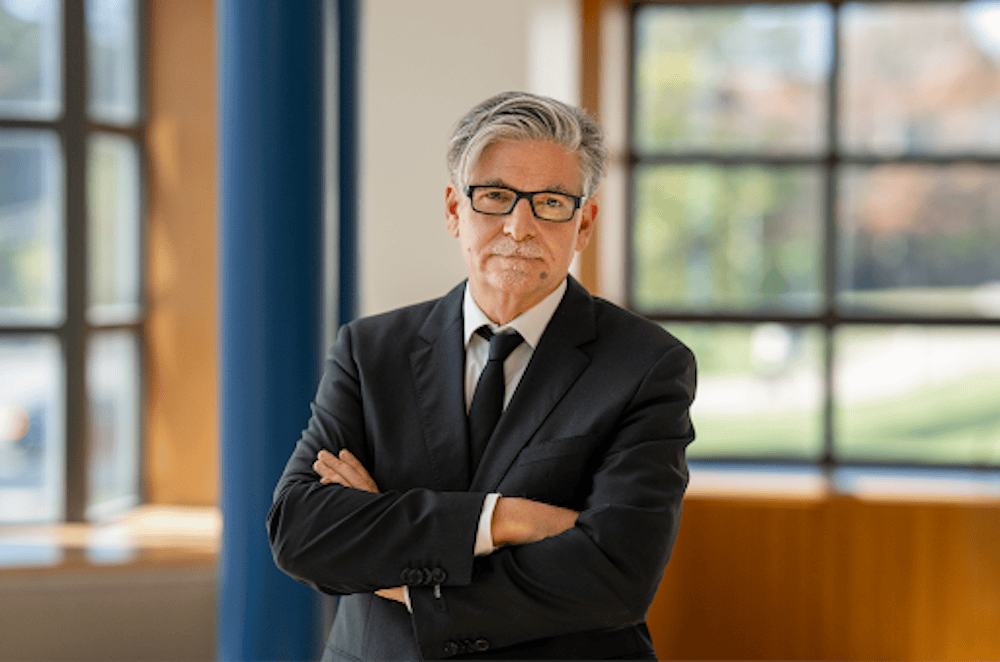
Jan-Werner Müller, renowned scholar of democratic theory and the history of political thought, was named Class of 1943 University Professor of Politics. Professor Müller is the founding director for the Academic Freedom Initiative and Forum for the History of Political Thought, which bring scholars together to examine academic freedom and the development of political ideas, respectively. Princeton endows 25 University professorships, which are the highest honor for faculty at the University.
Müller has also published widely on contemporary politics in major outlets, including international newspapers and magazines, such as “Project Syndicate,” “The Guardian,” “The London Review of Books,” and “Foreign Policy,” where he has written on populism, the rise of autocracies, and the relationship between theory and political systems. Müller, who has taught at Princeton since 2005, reflected on the honor in an interview with The Daily Princetonian.
As one of the University’s largest departments, the Department of Politics includes nearly 60 faculty, 150 undergraduate students, and 140 graduate students. Müller praised the department’s multifaceted intellectual environment, which he argued facilitates the study of his specialization, political theory. “It’s a large department, which also means that one can have lots of different conversations with different colleagues,” he said.
“We have a relatively large group devoted to political theory … there is no fragmentation or division in the way that, quite frankly, at some other universities, you have real kind of intellectual hostility,” he said.
Müller also stressed political theory’s continued relevance in politics departments today. “We use concepts like liberty, democracy, equality all the time … they all have a history,” he said. “It’s important to understand how we got to the point where we are.”
Regarding the broader University community, Müller expressed concern about student reluctance to engage in political debate on campus. “Even if you’re not interested in politics, politics is interested in you,” he said.
While Müller believes disagreement is central to political theory, he observed that many students might feel too socially constrained to articulate their views because of potential retaliation from peers.
He added that students need “resources to back up [their] arguments… [and] argue in a way that doesn’t feel knee jerk, or get personal immediately.”

Müller also reflected on the place of political theory within the discipline more broadly, noting that its relevance is increasingly questioned in favor of more immediately policy-oriented approaches. “If you look at the country as a whole, political theory really has suffered in many places because it’s not seen as that relevant in political science departments,” he said. “There are many voices who would say we don’t need courses on Plato and so on; we just need to do something much more practical.”
“We sometimes rediscover important thoughts, important theories,” he said. “And if all that ended, we would basically cut ourselves off from a certain kind of understanding, from a certain set of traditions.”
Müller connected this work to present-day threats facing democracy and higher education, including the Trump administration’s attacks on American universities, which he has consistently criticized in the media. “Democracies have been under attack in many parts of the globe,” he said, noting that “that has often involved an attack on universities and academic freedom as well.”
Müller also highlighted his work with the Academic Freedom Initiative, which aims to respond to these external pressures.
The Academic Freedom Initiative organizes events to explore the concepts of academic freedom, including its history around the world and experiences from those who have been involved in “concretely defending it,” according to its mission statement.
Müller emphasized that the concept is often misunderstood. “Far too often academic freedom gets conflated with free speech,” he said. “They’re not the same thing. They’re both important, but we’re not doing ourselves a favor … if we don’t see the distinction between the two.”

The next event at the Academic Freedom Initiative, “Academic Freedom: From Professional Norm to First Amendment Right” will take place on April 23 in Wallace Hall. The event features speaker David M. Rabban, distinguished teaching professor from The University of Texas at Austin School of Law.
In statements to the ‘Prince,’ Müller’s students consistently pointed to Müller’s ability to engage and challenge students. Abigail Leibowitz ’26, an advisee of Müller, praised him for his knowledge in “vast areas of political theory” and his commitment to “helping his advisees and students gain sound footing in these academic areas and contribute their own voice.”
Leibowitz is a former senior News writer for the ‘Prince.’
Andrew Pedersen ’28 emphasized that Müller creates “an open dialogue environment” while also pushing students to “strengthen, refine, and sometimes rethink” their perspectives. Similarly, Charlotte Kaya ’27 wrote that Müller’s ability to balance “seriousness and levity” creates “a class community” where students feel comfortable engaging with difficult material.
In Spring 2026, Müller taught two courses, ECS (European Cultural Studies) 338: Fascism — Politics and Culture, and POL 309: Politics and Religion.
Louisa Gheorghita ’26 said that ECS 338 taught her to view fascism as “not only … a political ideology, but also as a cultural movement and counter-revolution,” spanning architecture, art, and everyday life into analysis.
Gheorghita is a former staff photographer for the ‘Prince.’
Spyros Papapetros, associate professor of architecture, explained that “[Müller’s] committed teaching for ECS helps us bridge historical analysis with a rigorous investigation of political and cultural debates in the present.”
Papapetros emphasized Müller’s unique role in the ECS program’s intellectual life, particularly as it marked its 50th anniversary this year.
Papapetros pointed to Müller’s seminars on Architecture and Democracy, as well as his contributions to the course ECS 301: Rethinking European Culture in the Present, where Papapetros has examined “the role of grand scale monumental architecture in recent populist regimes” and “the history and present-day legacy of the idea of ‘Christian Democracy’ in central Europe.”
“By underlining similarities as well as differences between European and contemporary cultural politics in America,” Papapetros added, “he also helps us examine Europe beyond its geographic borders and reassess its role on the global stage.”
Looking ahead, Müller noted his ongoing research interests, including “the relationship between architecture and politics,” which he has incorporated into his teaching. Questions about “what kind of buildings should be created in democracy” and “how [they] can reflect our value commitments” shape his research and teaching. His previous research has explored how physical spaces, from Princeton’s campus buildings to global landmarks, reflect and shape political values.
In the fall, Müller will be teaching the graduate-level course POL 570: Free Speech, Free Assembly, Academic Freedom, extending his work in the Academic Freedom Initiative to discuss the underpinnings of free speech in legal contexts in the U.S. and Europe.
Aitana Camponovo is a staff News writer for the ‘Prince.’ She is from Washington, D.C. and can be reached at aitana[at]princeton.edu.
Please send any corrections to corrections[at]dailyprincetonian.com.
Read More

Trustees advise dissociation committee to ‘quickly dispose’ of some petitions, avoid ‘intensifying division’
Sena ChangIn a public statement, Princeton’s Board of Trustees advised the Resources Committee to dispose of petitions that lack potential for campus consensus. The statement also reiterated the Board’s “strong presumption against dissociation.”
In a public statement, Princeton’s Board of Trustees advised the Resources Committee to dispose of petitions that lack potential for campus consensus. The statement also reiterated the Board’s “strong presumption against dissociation.”

Staff Picks: Football vs. Columbia
Brooklyn Fraser, Alex Beverton-Smith, and Antonio TakataThe Daily Princetonian Sports section provides its predictions on the upcoming matchup between Princeton football and Columbia.
The Daily Princetonian Sports section provides its predictions on the upcoming matchup between Princeton football and Columbia.

As Princeton Fire Department expands paid force, building renovations on hold
Meiya XiongThe Princeton Fire Department and Princeton First Aid and Rescue Squad are both shifting from volunteer based to primarily paid staffing as volunteer numbers decline, with a firehouse expansion estimated at $10–20 million stalled until funding is found.
The Princeton Fire Department and Princeton First Aid and Rescue Squad are both shifting from volunteer based to primarily paid staffing as volunteer numbers decline, with a firehouse expansion estimated at $10–20 million stalled until funding is found.