



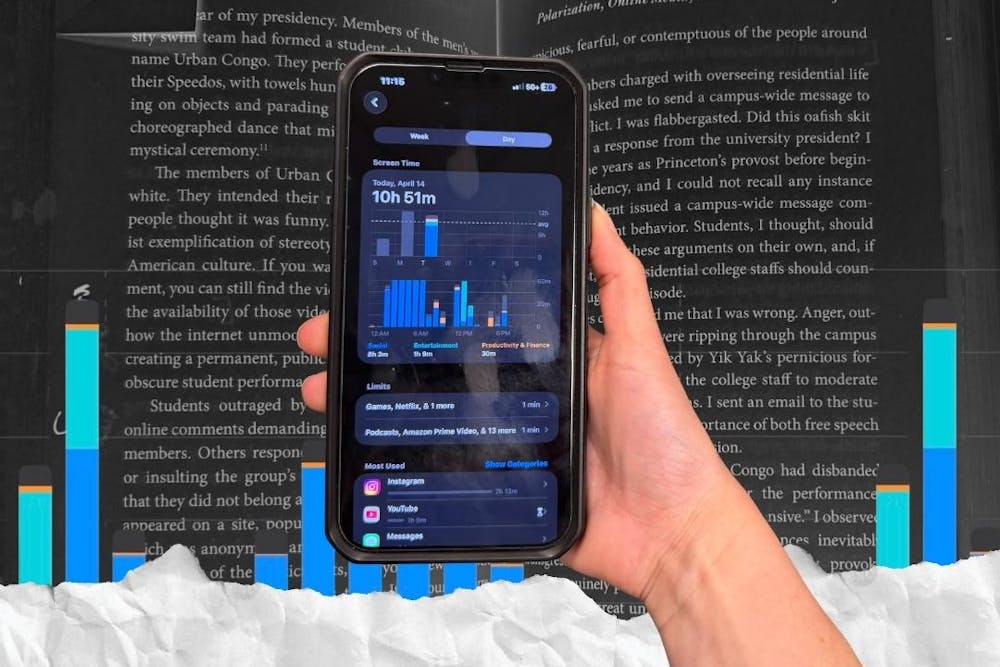
“I definitely feel like my mind is wandering a little bit more compared to freshman year,” Angie Ling ’26 said, reflecting on her decreasing attention span and the compulsive need to scroll. “With all the short form content, like Tiktok and Instagram Reels, etc. I think that’s definitely had an impact on me … That’s affected my ability to consume long-form content.”
“Damn,” she continued. “Kind of sad, reflecting on that.”
Since 2020, approximately half of incoming students reported spending five or more hours on their phone per day, according to The Daily Princetonian’s Frosh Survey. As short-form content has proliferated and increasingly dominated young people’s media appetites, much attention has been placed on how this has impacted college students’ abilities to focus, learn, and read.
In conversations with the ‘Prince,’ students and professors at Princeton reflected on how constant exposure to technology has decreased attention spans and increased levels of distraction in academic settings. In recent years, faculty members have begun to experiment with new policies around technology and different methods of teaching, such as taking more breaks during class — and many students saw the policies produce positive changes in their lives. However, debates over cutting down on assigned readings or whether or not to ban technology still persist.
“I definitely think universities should experiment with all kinds of different policies to make more and more of the university a tech-free zone,” politics professor Gregory Conti said. Distraction due to technology, he continued, is an “existential threat to the University.”
The relentless scroll
In classrooms across Princeton’s campus, laptops are a constant presence, with artificial light and the tapping of keyboards filling each room. In settings like these, the urge to check notifications and scroll on social media can be difficult for students to resist.
Sarah Hu ’27, a Peer Academic Advisor (PAA), watches all her recorded lectures and videos at two-times speed. “My attention span is definitely very cooked,” she admitted. “And that’s what the short-form content is designed to do: make your brain like that, which is really terrible.”
It’s easy for students — even those who take handwritten notes or attempt to pay attention — to get distracted when their peers are off task.
“Many computer screens are doing so many things at one time,” Nadia Makuc ’26, chair emerita of the Honor Committee, said. “Even if I’m listening, I can’t fully pay attention, right? Because it’s like, ‘Oh, someone’s playing 2048, and someone’s shopping for handbags.’”
Economics professor Ulrich Müller views distraction as a “negative externality,” where the initial actions of several distracted students leads to later learning losses for others.
Distracted students “signal to the other students that this is not interesting,” Müller said.

While distraction during lectures has been an issue for decades, recent technological advances have exacerbated the problem. With the advent of artificial intelligence, many students don’t bother taking notes during class. Instead, they record lectures or flick through summary slides posted on Canvas to make AI-generated transcripts, notes and flashcards.
“What I’ve seen a lot of people doing is plugging those notes [from Canvas] directly into ChatGPT and saying, ‘Please explain this as if you are a four year old,’” Luke Chatham ’27, a Peer Representative, said. Peer Representatives provide support for students who are accused of Honor Code violations or have cases before the Honor Committee or Committee on Discipline.
Geosciences professor Christopher Griffin makes a point not to post lecture slides. In his own experience as a student and teaching assistant, Griffin came to believe that posting class slides effectively discourages students from actively listening and taking notes. Griffin also does not use a textbook, and his course content is difficult to find online, so students “kind of have to pay attention.”
“If you’re in an 80-minute lecture, this thing,” Griffin said, holding up his phone, “comes out. We think, ‘what’s going on on Instagram?’”
For Makuc, distraction in class can be attributed to what she believes is the increasingly utilitarian framework with which students view higher education — that higher education is intended for students to find employment, rather than learning for the sake of learning.
“I feel like people are more likely to be flipping between online shopping in lecture than if they were at their internship in the summer and they’re at a meeting with their boss,” Makuc said.
“The mission — why we’re here — of academic excellence is just one of the things among social and international experiences, securing jobs, and participating in clubs, and it’s lost some of its respect,” Makuc added.
Offloading reading loads
The same issues that lead to distraction inside the classroom also translate to distraction outside of it. Reading for an extended period of time has become mentally taxing, students noted, though some say that they eventually finish their assignments and homework — it just takes longer now than it used to.
Conti has noticed significant changes in students’ ability to read and digest lengthy texts. He says they have more difficulty summarizing the main ideas of a text compared even to eight years ago, when he began teaching as a professor.
“It’s harder for students to read a sustained amount of difficult text,” Conti said. “[The average student] used to find it easier to recapitulate what they’ve read in their own words, even if it was something quite difficult. Already in my time you see that more and more students struggle to do that … because it’s harder for them to pay attention when they read with all the distractions they have.”
“There is no continued 40-minute focus. It’s really, really rare and quite hard,” Hu said. “But I also don’t think it’s been debilitating for my ability to do work; I just get on with it.”
Many have embraced the art of skimming readings, or strategically reading just the introduction and conclusion to get the best gist of a paper.
“I do this thing where if it’s under 20 pages, I do read the whole thing. If it gets more than that, I’m just like, ‘let me get the main point,’” Colin Hepner ’29 said.
“For assignments, there’s really no incentive not to take the shortcut and just look things up for instances where it’s not built into the assignment to do deeper thinking,” Makuc said.
Whether or not this has affected scholarly integrity is unclear. Chatham believes that students’ distraction in class translates to a higher inclination to be academically dishonest in assignments and exams. A proposal to proctor all examinations is currently being considered by two faculty committees. If passed by a majority faculty vote, it would end the University’s traditionally unproctored examination system, which has been in place since 1893.
“I tend to believe that people are now more inclined to violate some form of the Honor Code because they’re paying less attention in class,” Chatham said. “There’s a lot of pressure academically to perform, and with people’s attention spans decreasing, they’re understanding things a lot later, which means they’re cramming the nights before exams.”
However, Attending Peer Representative and Co-Chair of Peer Representatives Seryn Kim ’27 said that “it is a bit of an assumption that attention span or access to technology is the primary driver of academic misconduct accusations.”
Kim explained that the reasons behind Honor Code violations are “multi-factored.” The most common reasons, she said, included time limits, seating, and the way students write and turn in assessments, rather than using unauthorized aids.
Experimenting with no-technology policies
Faculty are actively discussing technology policies, although no consensus seems to have been reached. Undergraduate Student Government (USG) Academics Committee Chair Isaac Bernstein ’28, who often engages in discussions with faculty members, said that “there’s not necessarily a policy that we believe would be the best fit for passing towards students.”
Bernstein is a former staff News writer for the ‘Prince.’
Some faculty members have implemented no-technology policies in their classes.
Professor of Politics and International Affairs Frances E. Lee used to simply suggest that students put their devices away during her lectures — a policy which she now acknowledges had no effect — but this year, she outright banned technology during her lectures. Instead, she handed out notebooks to every student in her class POL324: Congressional Politics, telling them to take physical notes instead.
“I’m not authoritarian in my approach, but I do try to establish a classroom norm where we’ll be looking at each other, and do[ing] more active engagement rather than looking at a screen,” Lee said. “Students [now] do seem to be more engaged. I have regarded the experiment as a success in my classroom.”
After more than 20 years of teaching ECO202: Statistics and Data Analysis for Economics, Müller introduced a similar policy forbidding students from taking out their laptops and phones during lectures. Students in his class are also given a small grade bonus for attending lectures, and Müller enforces his technology policy by removing this bonus for any students caught using a device. He still allows students to annotate on iPads, however.
“Of course, you can also browse the internet or buy socks using your iPad,” Müller said. “There’s sort of an understanding that people don’t do that. I don’t know if that is always successful, but that’s the compromise that I’m currently running with.”
Students said they generally appreciated the engagement that comes with a technology-free class.
“When there’s no phones in the class or the precept, it’s caused me to make friends,” Hepner said.
“I had started to have a more positive experience in classes where it was handwritten notes only,” Ling added.
However, some students still prefer being given an option as to whether or not they want to use technology. “Banning technology [entirely in courses] is not a solution, and it’s not helpful for a lot of the students that prefer taking notes on electronic [devices],” Bernstein said.
Müller is ultimately hopeful about student responses to restrictive technology policies. He has not encountered much resistance with his own laptop and phone bans.
“I’ve never gotten really much pushback on any of these things,” Müller said. “So it’s not as if I feel I’m really putting myself out there by having these policies.”
Changing course content and pedagogy
While some faculty members have implemented strict no-technology policies, others have been more adaptive.
Bernstein said some of his professors have incorporated more videos in their classes in order to respond to the way some students now learn most effectively.
“A lot of them are open to using that technology as well, which is a really exciting innovation,” Bernstein said. “I think the faculty, just like the students, are continuing to adapt and help make sure that their content is absorbed in the most effective ways possible.”
Many professors are incorporating small changes in their teaching pedagogies.
“I try to incorporate more shifts of gears,” Lee said. “We’ll talk about a topic for a while, and then I signal a change. I spruced up my slides to make them more interesting. I will take pauses and do a little discussion, or at least ask a rhetorical question and take a pause.”
In past years, students had approached Müller and told him they had trouble focusing during the 80-minute-long class. For this reason, he now introduces new content in a 50-minute lecture block, then gives students a short break before beginning a 25-minute period of exercises and other activities, seeking greater student engagement.
The lengths of assigned readings have also come under fire. Makuc recalled a class she took in which a professor “totally just cut the syllabus from what it used to be.” This professor made sure to keep a strict grading standard, but “changed the content by lowering the reading,” Makuc said.
Changes in the lengths of assigned reading may appear extreme, but some instructors at other institutions have also adopted the practice. The Harvard Crimson reported that many instructors in the humanities and social sciences at Harvard have had to trim or entirely cut readings due to student complaints.
Conti, however, strongly opposes reducing reading load, especially for his graduate-level courses. As someone that teaches political theory, Conti said that reading theory in full is necessary for students to truly grapple with its ideas. Likewise, he explained that AI summaries are counterproductive to student learning, as they replace student engagement with generic answers and reduce the nuances of texts.
Long reading is “the only way to actually know anything,” Conti said. Part of the learning process is “going through a whole process of trying to figure out how some problem makes sense to you,” he said.
“One thing I worry about is students [asking ChatGPT], ‘Rousseau says X, and he also says Y, but these don’t seem to fit. What’s the answer?’ And ChatGPT will tell you some way to make them consistent. But why? How do you know that’s right? Maybe they’re not consistent. There’s no substitute for doing your own thinking,” he continued.
Changing habits, changing mindsets
While University policy can shift and faculty can experiment with their teaching strategies, students acknowledged that any solutions are ultimately dependent on their own behavior. Hepner summed up the problem with the idiom, “You can lead a horse to water, but you can’t make it drink.”
“The University can take you to the water with the strictness about technology, but then you inevitably have to make a conscious effort,” Hepner said.
Most students don’t see a clear way out of the attention span crisis. But some see small reprieves. Ling’s simple solution involves forcing herself to read more books. Beyond these smaller habits, students expressed that more lasting change may require a shift in the cultural mindset.
“We’re here to get an education, and it’s really important to have the patience and integrity and care to go through long readings or to watch very long documentaries,” Kim said. “And I’ve definitely noticed that your brain, once it gets primed to just expect reel after reel after reel, has to sort of reset and decide, ‘Alright, you just need to lock in and do this.’”
“Just kind of reminding ourselves that we as humans have that ability to create and not just to consume — I feel like that is important,” Ling said.
Nikki Han is the head Features editor for the ‘Prince.’
Chris Braun is a Features contributor for the ‘Prince.’
Please send any corrections to corrections[at]dailyprincetonian.com.
Editor’s note: A quote from Bernstein was updated to clarify that he does not believe an outright banning of all technology in courses is a solution, instead of specifically in the classroom.