



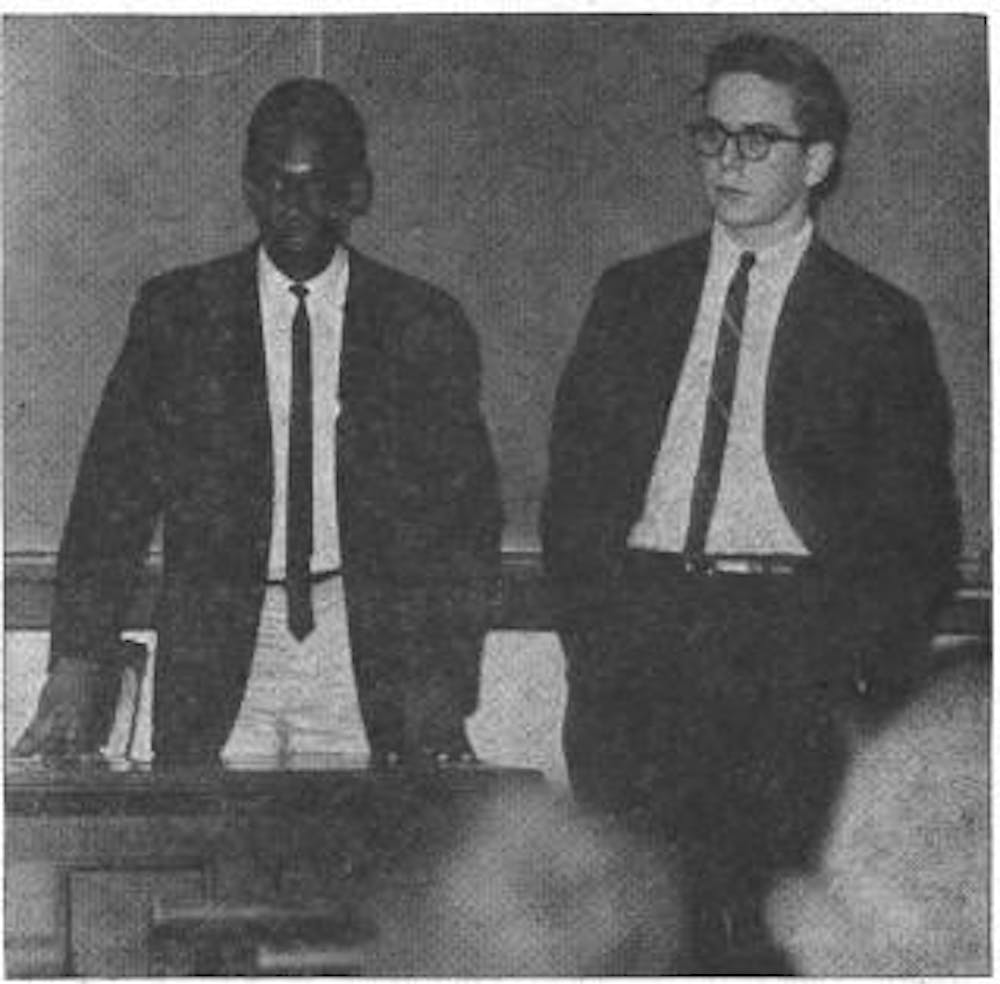
On March 10, 1964, Whig-Clio hosted a debate on the merits of racial mental superiority. Two days later, the Council for Racial Reconciliation was created with Marschall I. Smith ’66 serving as president, before resigning less than a day later. The group’s purpose, according to Smith, was to assert that “informed people can favor continued racial segregation.”
The group was supported by one prominent alumnus, Carleton Putnam Class of 1924, who wrote the pro-segregation book “Race and Reason: A Yankee View,” arguing that there were genetic inequalities between races. Under Smith’s leadership, the group originally planned to sell said book at the campus center. The group was prevented on the grounds that the University “did not permit any student agency to conduct sales in the Student Center.” Smith also attempted to bring Congressional attention to Smith’s resignation, arguing it was under the “implicit order” of Smith’s Naval Reserve Officers’ Training Corps officer.
Vice President Martin L. Gray Jr. ’66 then took over as president. In his new position, Gray told the ‘Prince’ the Council was supposed to “present the southern viewpoint” on segregation. Furthermore, Gray stated that “because the whole civil rights movement has become so embroiled with emotion that there are automatic hostile reactions to the presentation of the other side of the question.” Gray explicitly outlined his belief in Caucasian superiority and opposition to social equality to the ‘Prince.’
On March 24, 1964, the ‘Prince’ reported that the Council would likely “have to wait at least two weeks more” in order to receive official standing from the University. Assistant Dean of Students James B. Laughlin ’52 argued that there seemed to be “little real substance,” explaining the University was waiting to issue approval until the Council had demonstrated there was adequate student interest. Gray noted that between 15 and 20 undergraduates were interested.
Nevertheless, the Faculty Committee on Undergraduate Life granted the Council approval as an extracurricular organization on March 24. Assistant Dean of the College William Lippincott ’41 stated that the club had been contingently approved if ample participation could later be proven. However, as Dean Lippincott noted, “The approval of the existence of any organization does not necessarily imply that the university endorses the views of that organization.”
At the Council’s first meeting on April 9, pro-integration students staged “the political coup of the year.” The meeting was originally called to meet the “stipulation that the Council show ‘sufficient’ membership before being granted an extra-curricular charter.” Protesting the group’s mission, anti-segregationists flooded the meeting and forced an election of officers according to the parliamentary procedures that led to Gray’s assumption of the presidency.
With over 100 integrationists in attendance, Black student Robert F. Engs ’65 was elected vice president, with protesters noting that an integrationist viewpoint was also a “Southern [viewpoint].” Gray responded saying, “I can only find one point of view here, and it’s damn well expressed too.”
Five days later, the ‘Prince’ reported that Gray was considering resigning to create another pro-segregation group, even though he asserted pro-integration students had “urged him to continue the group and present both points of view on the race issue.”

In October, Gray and Engs, as de facto presidents of the pro- and anti-segregation sides respectively, decided to disband the Council for Racial Reconciliation. Engs stated that he was “more than happy” to let the organization die and to protect his fellow anti-segregationists from ever being seen to associate with a segregationist group. He went on to tell the ‘Prince’ that their activities succeeded in making segregationists look “ridiculous.”
Gray, in contrast, stated that his group had at least succeeded in calling attention to the existence of segregationist views on campus, but that it produced “no practical result.”
From its first meeting, the Council for Racial Reconciliation faced pushback from the very students it attempted to exclude. At a time of intense political and social tension both on and off campus, the Council was shut down, not by the administration, but by the students themselves.
MC McCoy is a staff Archivist, staff photographer, and senior Puzzles constructor for the ‘Prince.’
Please send any corrections requests to corrections[at]dailyprincetonian.com.
Read More

High Meadows Environmental Institute hosts Summer of Learning Symposium
Mia ChenThe High Meadows Environmental Institute’s Summer of Learning Symposium showcased research by 122 undergraduate interns, who worked with faculty across 13 countries and 10 U.S. states on projects ranging from hydrogen electrolysis to forever chemicals.
The High Meadows Environmental Institute’s Summer of Learning Symposium showcased research by 122 undergraduate interns, who worked with faculty across 13 countries and 10 U.S. states on projects ranging from hydrogen electrolysis to forever chemicals.

USG shifts winter elections to before Thanksgiving, debates limiting slates in contentious meeting
Claire DingThe Undergraduate Student Government moved its winter elections before Thanksgiving break but voted down a proposal to ban slates for non-executive offices.
The Undergraduate Student Government moved its winter elections before Thanksgiving break but voted down a proposal to ban slates for non-executive offices.

If you give a tiger a cookie: celebrating 50 years of Murray-Dodge Café
Mia MazzeoAssistant Editor for The Prospect Mia Mazzeo celebrates and reflects on the significance of Murray-Dodge Café's 50th Anniversary.
Assistant Editor for The Prospect Mia Mazzeo celebrates and reflects on the significance of Murray-Dodge Café's 50th Anniversary.