



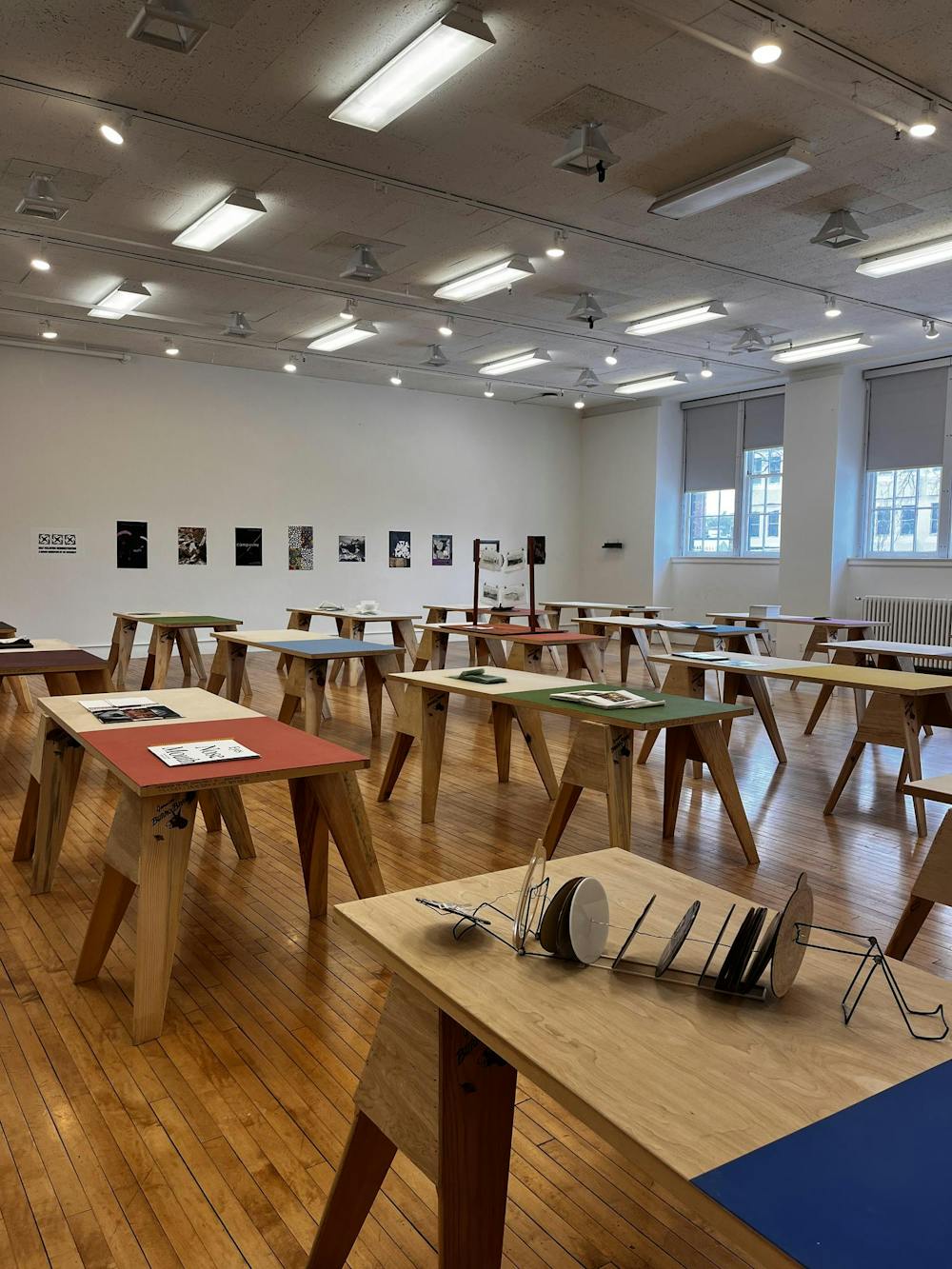
Tucked away in Nassau Street’s Hagan Gallery, the 2026 Visual Arts Book & Poster Show quietly unfolded. From Feb. 16 through March 13, the space has transformed into something both intimate and expansive: a room of 16 desks, “books,” and a gallery of posters lining the walls.
I first noticed the amount of color throughout the exhibit. The wooden desks were arranged in rows, each half-painted in a different hue: one side bare wood, the other dipped in saturated shades of blues, greens, yellows, reds, like colorful tiles scattered across the floor. The faint scent of paint lingered in the air, mingling with something woody and dry. There weren’t any excessive decorations, and the layout was neat and orderly.
A junior project rested on each desk. Simply calling them “books” feels insufficient — each varied in size, medium, texture, and intention. Some resembled more traditional volumes with bound spines and uniform pages. Others unfolded, accordion-like, across the desk. One appeared to be sculptural, with layer upon layer of thick paper cut into vaguely conch-like shapes; another even had pages made of a green gel-like material that stuck together slightly as I turned the pages.
Some works were particularly striking. On a red-painted desk near the entrance sat a spiral-bound volume titled “Eyes Nose Mouth,” created by Logan McNabb ’27. At first glance, each page presents the same composition: a large frontal portrait of a male face, rendered boldly and without distraction. But as you turn the pages, the image shifts subtly. The brushstrokes grow fainter. The shading loosens, then thins. Features start to blur at the edges. The repetition becomes a slow unraveling. You find yourself wondering how far this disintegration will go, how much the face can fall away before it ceases to be itself, until it gives way to another portrait altogether.
Beside it on the same table, there is a second version of this book, transformed through a simple but ingenious intervention: each page was cut into three horizontal sections, dividing the eyes, nose, and mouth. Viewers could flip each section separately, assembling hybrid faces from different features. The piece oscillates between coherence and fragmentation, inviting the viewer to participate in the act of constructing and recombining identity.
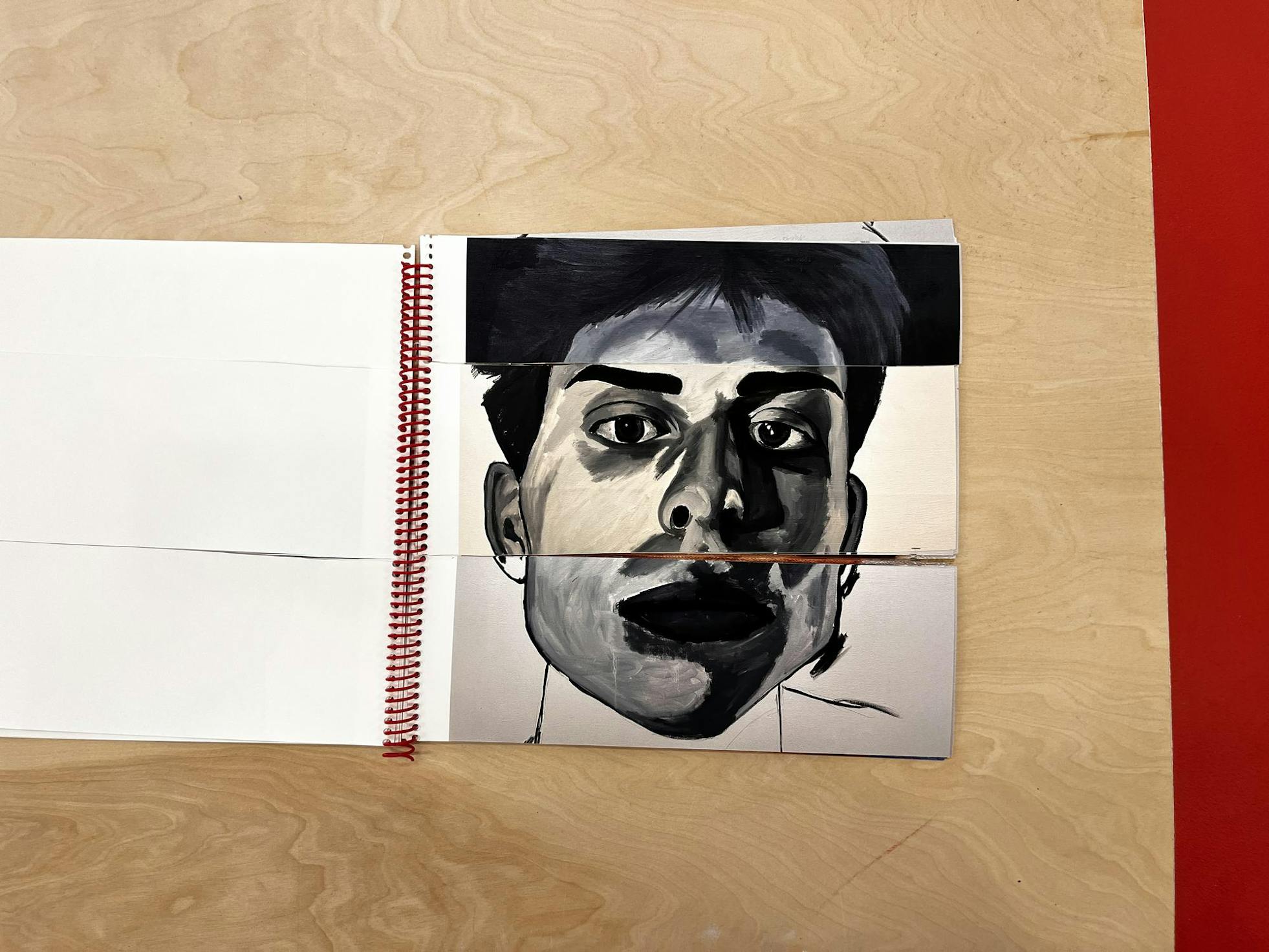
"Eyes Nose Mouth" by Logan McNabb '27.
Alexis Choi / The Daily Princetonian
A few desks away sat “Commuter Student,” a photography portfolio by Kenneth Simmons ’27 that offered a different kind of intimacy. The book unfolded as a visual journey, from blurred images of empty New York subway stations to vibrant candid shots of New Yorkers crocheting or reading on park benches. The photos captured snippets of the path to and fro from Princeton to Brooklyn, the camera lingering on gestures and spaces that might otherwise go unnoticed. On one page, Simmons writes, “As a Black man, a nontraditional student, and a veteran,” he created the project as “an attempt to explore how space, identity, and mobility shape my perspective as a photographer.” Upon reading this statement, the preceding images were reframed: what at first appears purely observational becomes a type of self-portraiture by other means. The commute isn’t just a route but a way of perception shaped by movement across social and geographic boundaries.
The posters, lining the right and left walls, belong to the seniors’ thesis projects. Where the books felt inward and tactile, the posters asserted themselves outwardly. Large-scale, graphic, bold in typography and image, they functioned as both announcement and distillation — a visual thesis statement rendered in ink and layout.

Particularly eye-catching was a piece on the leftmost wall, of unknown artist and title. It was a cascade of tea bags, arranged in perfectly level rows. The tea bags’ strings extended upward, and each tag read in small letters variations of “SILICA GEL; THROW AWAY DO NOT EAT DESICCANT SILICA.” The unconventional medium of tea bags was distinctive; visually, there was something breathtaking about them against the pure white wall. Spanning both walls, the posters created a visual corridor framing the quieter intimacy of the desks.
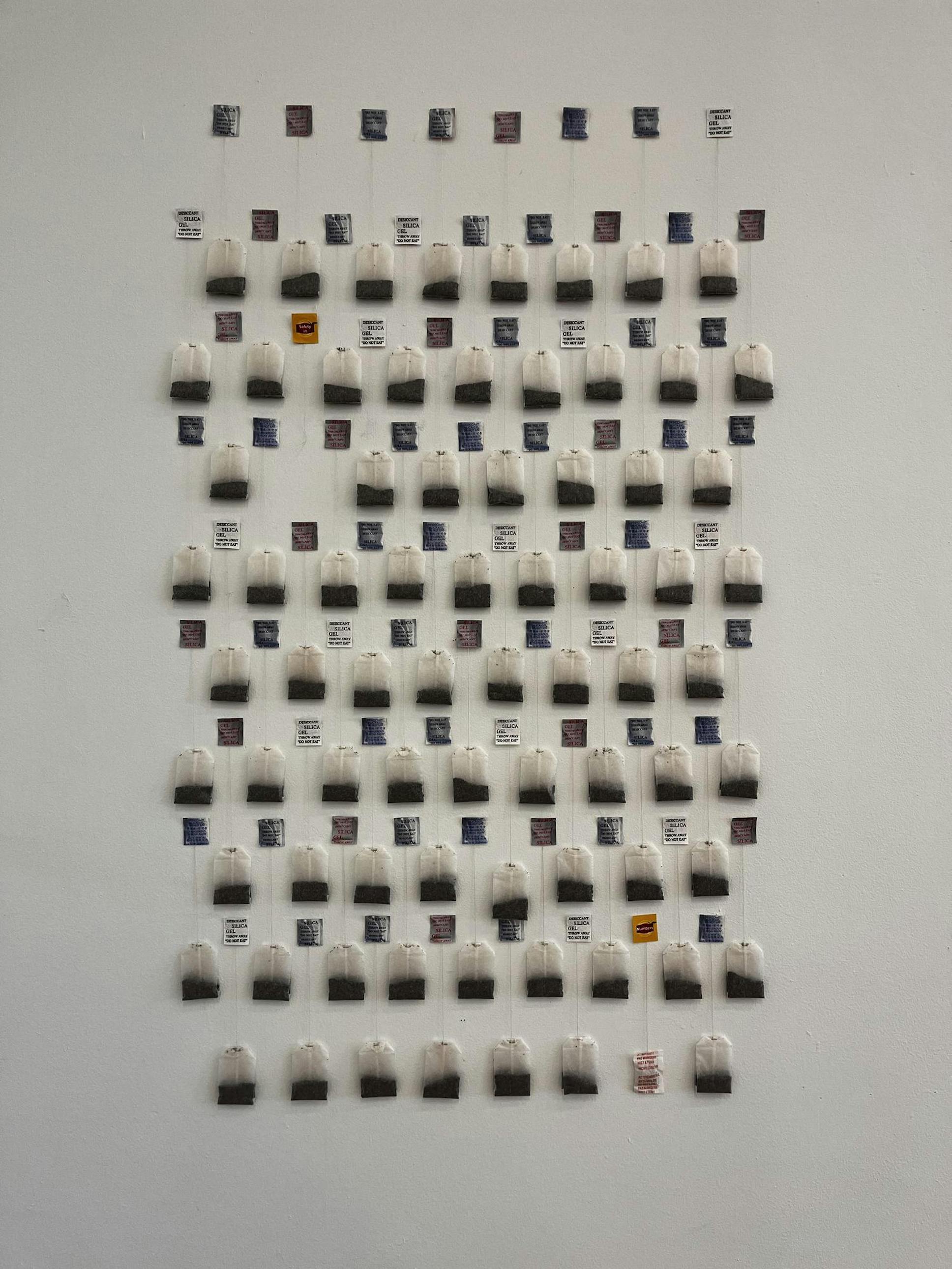
Untitled work by unknown artist.
Alexis Choi / The Daily Princetonian
Unfortunately, regardless of the dazzling quality of the exhibition, it is easy to miss. Upon entering the Lewis Center for the Arts at 185 Nassau Street, I meandered around the building in search of signage that might signal the exact location. Finally, after asking a student for directions, I arrived at Hagan Gallery. I was also disappointed to see that several of the works didn’t appear to display the artist’s name or even a title, and that there weren’t any labels or caption cards for each piece, preventing me from getting to know the context behind each artwork.
Throughout my viewing, I was alone in the room; there was no music, no crowd — though, to be fair, I had made my visit on a random Monday afternoon. All I could hear were the light echoes of my footsteps as I wound around the tables, the quiet rustle of paper. Although I was alone, the exhibition was surprisingly interactive. Each book invites you to lean in. You have to stand close. You have to turn the pages yourself. Unlike paintings mounted high on walls, these works demanded physical participation. They felt meant to be handled — carefully, deliberately — and in that handling, the viewer almost seemed to become part of the piece.
There is something radical about an exhibition devoted entirely to books and posters — formats often considered functional, or even utilitarian. Here, they are elevated, stretched, and deconstructed in ways beyond my imagination. Books and sculptures become sculpture, archive, diary, and experiment.
Yet what lingers most is not spectacle, but atmosphere. The room felt contemplative. The desks — half-painted, half-bare, one for each book — seemed emblematic of the moment these artists occupied: not yet fully finished, still in process, and straddling the raw material and the polished surface.

The show does not overwhelm the senses; emotion and ideas build as you leaf through each story. Each table offers a different world. I left not dazzled, but thoughtful — aware of how many forms a “book” can take, how much someone can be captured in a single painted sheet.
The 2026 VIS Book & Poster Show runs through March 13 at Hagan Gallery, 185 Nassau St. It is open weekdays from 9 a.m. to 6 p.m. and is free and open to the public. It may be a bit difficult to find. But once inside, the room holds you — in color, in paper, in silence — longer than you’d expect.
Alexis Choi is a contributing writer for The Prospect and a member of the Class of 2029. She can be reached at ac7729[at]princeton.edu.
Please send any corrections to corrections[at]dailyprincetonian.com.
Read More

Princeton University Orchestra and men’s ultimate frisbee team named in University’s latest hazing report
Andrew ArthurTwelve students in the Princeton University Orchestra and Men's Ultimate Frisbee team were found responsible for hazing violations in the University's latest Campus Hazing Transparency Report. Sanctions ranged from Dean's warnings to disciplinary probation.
Twelve students in the Princeton University Orchestra and Men's Ultimate Frisbee team were found responsible for hazing violations in the University's latest Campus Hazing Transparency Report. Sanctions ranged from Dean's warnings to disciplinary probation.

Murray-Dodge Café celebrates 50th Anniversary, drawing over 260 students
Hifza KaleemOn Wednesday, Murray Dodge Cafe celebrated its 50th anniversary, drawing more than 260 students to celebrate with free cookies and merchandise.
On Wednesday, Murray Dodge Cafe celebrated its 50th anniversary, drawing more than 260 students to celebrate with free cookies and merchandise.
Students share mixed reactions as mandated officer and treasurer trainings return to in-person format
David EstradaThe University's student organization officers and treasurers returned to mandatory in-person training this fall after years of online sessions. Student reactions found parts of the training redundant or tedious, though most agreed the sessions were important.
The University's student organization officers and treasurers returned to mandatory in-person training this fall after years of online sessions. Student reactions found parts of the training redundant or tedious, though most agreed the sessions were important.