



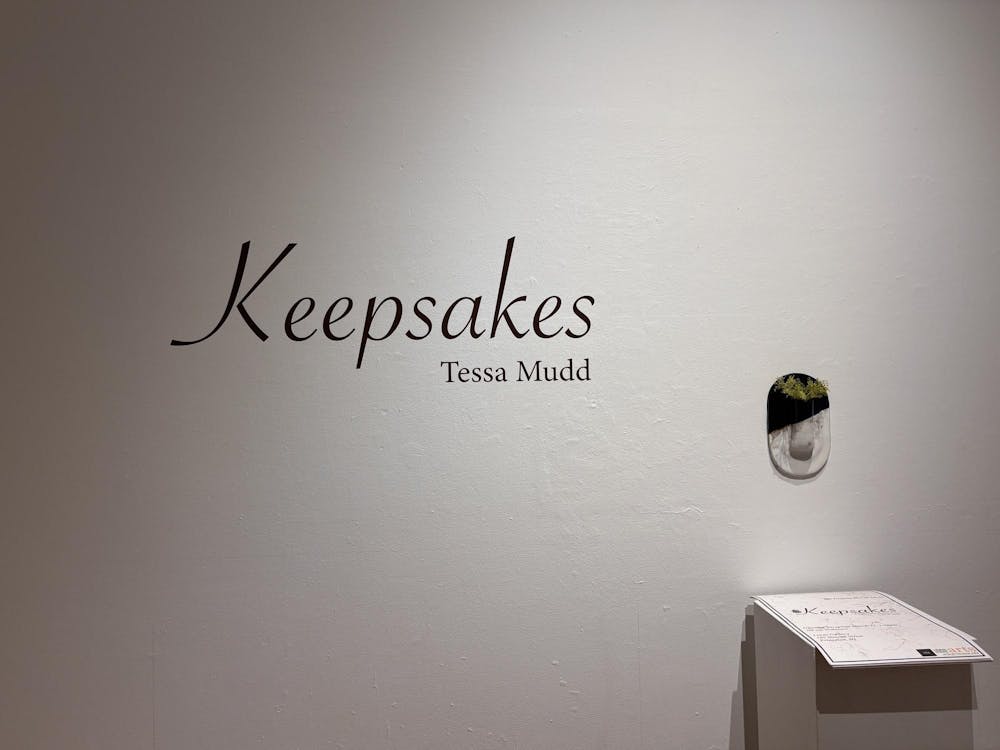
The room revealed itself slowly, inviting careful retrospection. Located just beyond the entrance of the exhibition, a floor mat and pair of dress shoes rested solemnly, silently imploring viewers to step in. An expansive wall laid ahead; save for its latter half’s delicate, floral wallpaper, it was sprinkled with colorful framed artwork, miniature display shelves topped with decorative trinkets, and trailing green vines. As my footsteps echoed through the hollow gallery, I couldn’t help but notice how the intimate atmosphere complemented the wistful, homely nature of the display.
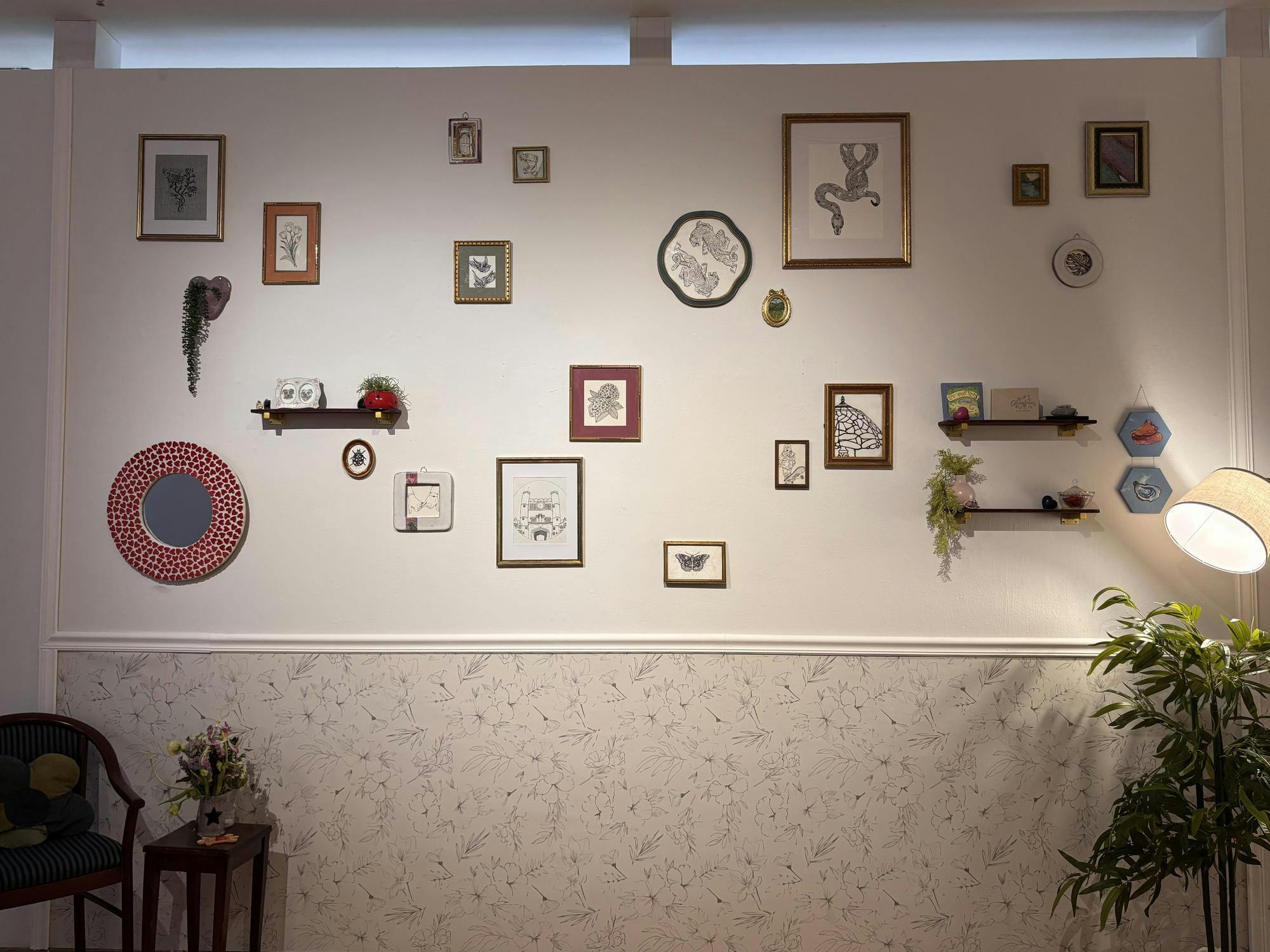
A gallery wall of framed art, hanging shelves, and indoor plants, Wednesday, March 25, 2026.
Kaichen Chou / The Daily Princetonian
From March 16–27, “Keepsakes” by Tessa Mudd ’26 was featured in Lucas Gallery at 185 Nassau St., where often-overlooked everyday artifacts and childhood memorabilia took center stage. From a children’s book titled “Eat Your Peas” to a glass dish stowing away nuggets of Dove chocolate, this space was a wholesome embodiment of what makes a house a home — cozy, yet faintly somber when unoccupied.
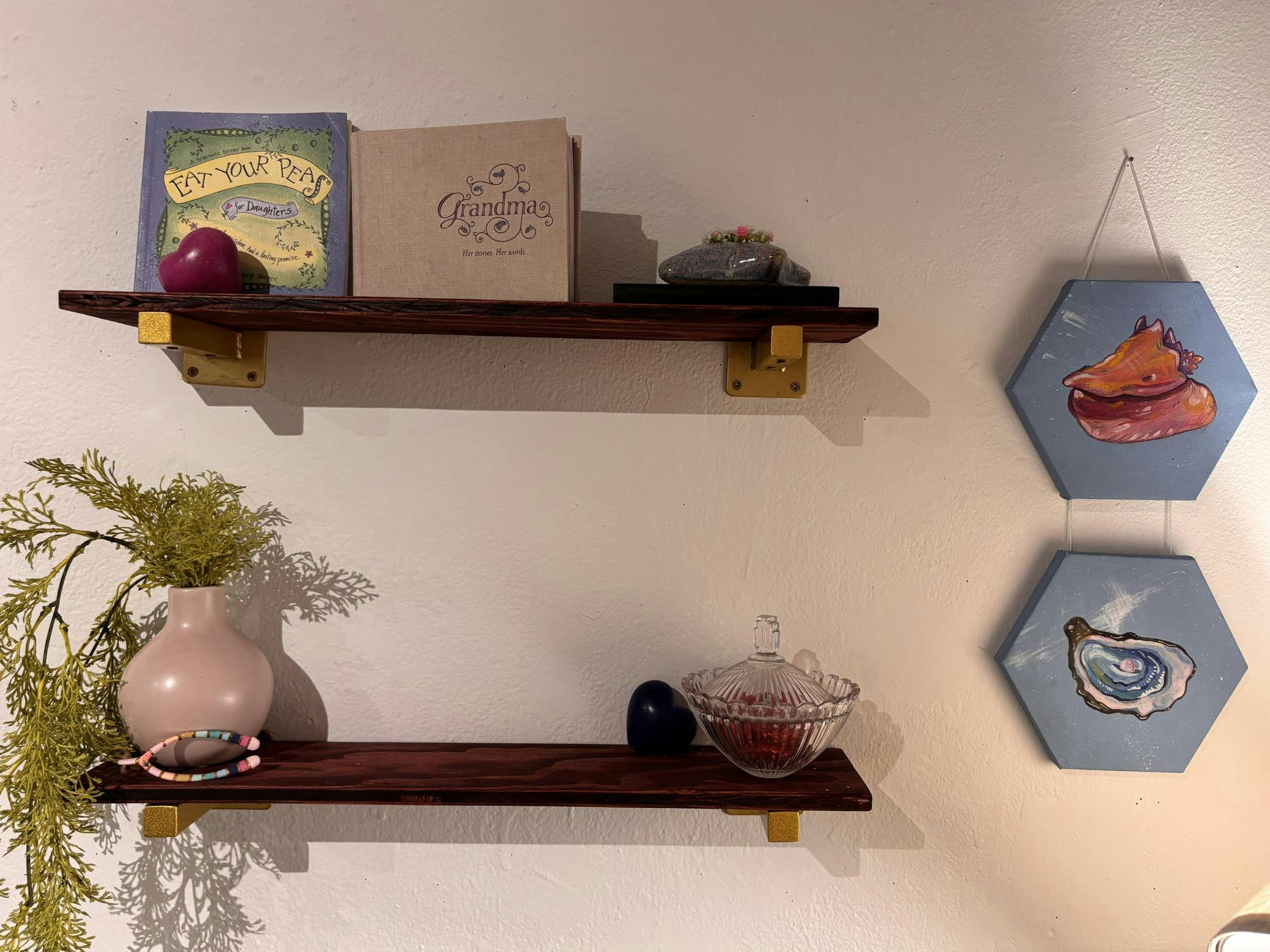
Two shelves with a myriad of trinkets, books, and other items are hung next to a piece of ocean-themed art, Wednesday, March 25, 2026.
Kaichen Chou / The Daily Princetonian
When I first walked in, I was simultaneously overwhelmed and underwhelmed. Visually, there was much to take in, but the emptiness of the gallery lingered with me as I wandered from one wall to the next. Though I initially expected a busier energy, I soon realized that the magic of the exhibit came not from the presence of others, but from careful observation. With imagination and curiosity, this viewing experience quickly morphed into a scavenger hunt as I searched for motifs, stories, and connections between the objects.
Although the room itself was empty, it wasn’t completely lifeless. To the left, a screening of a short film called “Bunyip Country” by Joe McCauley ’26 flickered across the wall, illuminating the room with hues of turquoise while blips of audio drifted from headphones resting on the sofa in front of it. On the far right, two posters donned the same pattern as the soft gray floral wallpaper, their text reflecting on themes of memory, discovery, and something elusive yet ever present.
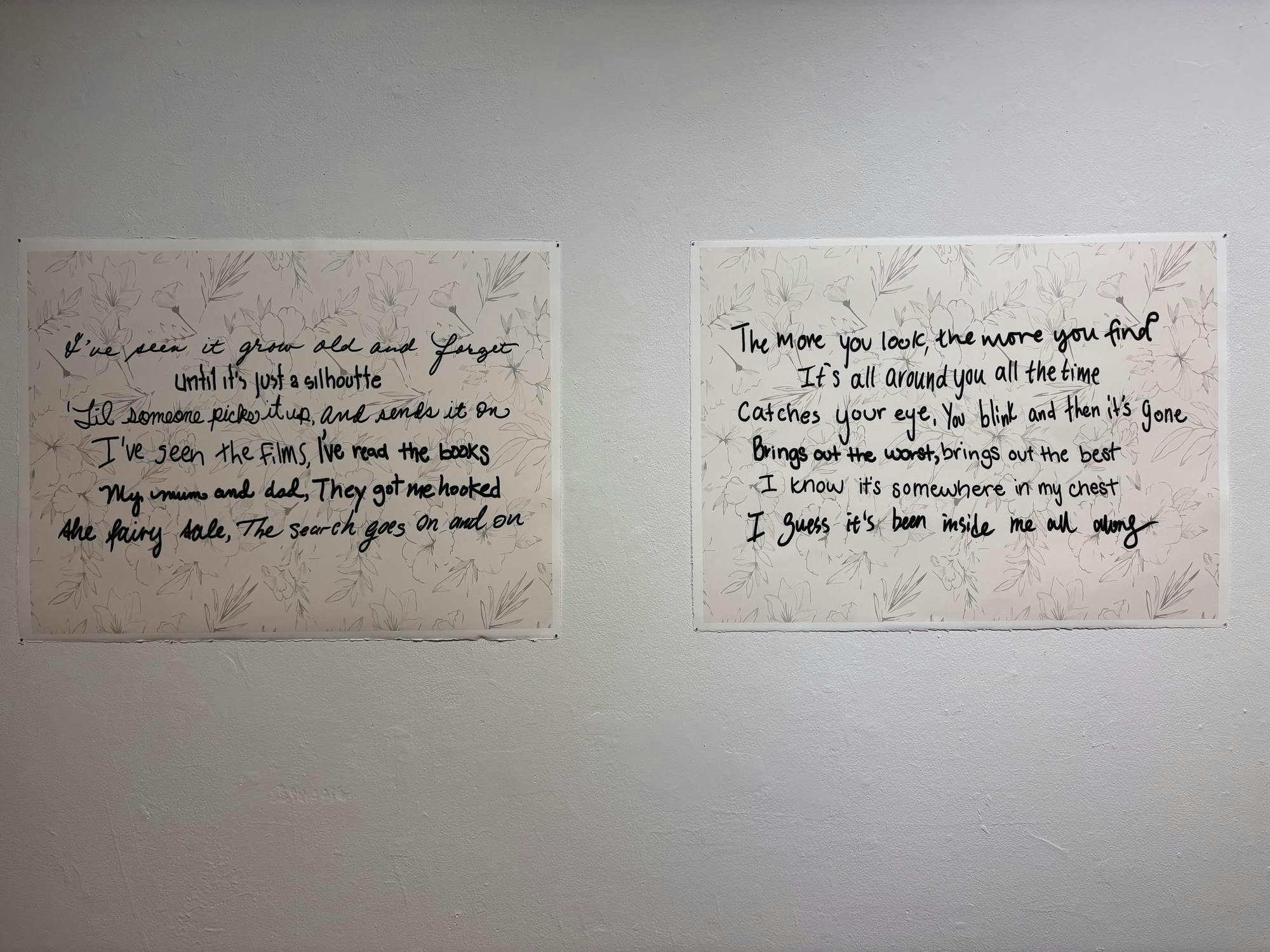
Two posters with text in the Keepsakes exhibition, Wednesday, March 25, 2026.
Kaichen Chou / The Daily Princetonian
One line stood out in particular: “The more you look, the more you find / It’s all around you all the time.” This sentiment perfectly captured the essence of “Keepsakes” — the more you looked, the more you discovered. Without close attention, it was easy to look past the significance of each piece, but with time, each object revealed its own quiet weight. This quote also speaks to the idea that everyday wonders are often hidden in plain sight.

What struck me most was how convincingly the exhibit mimicked a lived-in space. It was easy to forget that every trinket, photograph, and decoration had been deliberately curated by Mudd. Each item felt extremely personal, yet its meaning remained just out of reach, preserving an enjoyable sense of mystery.
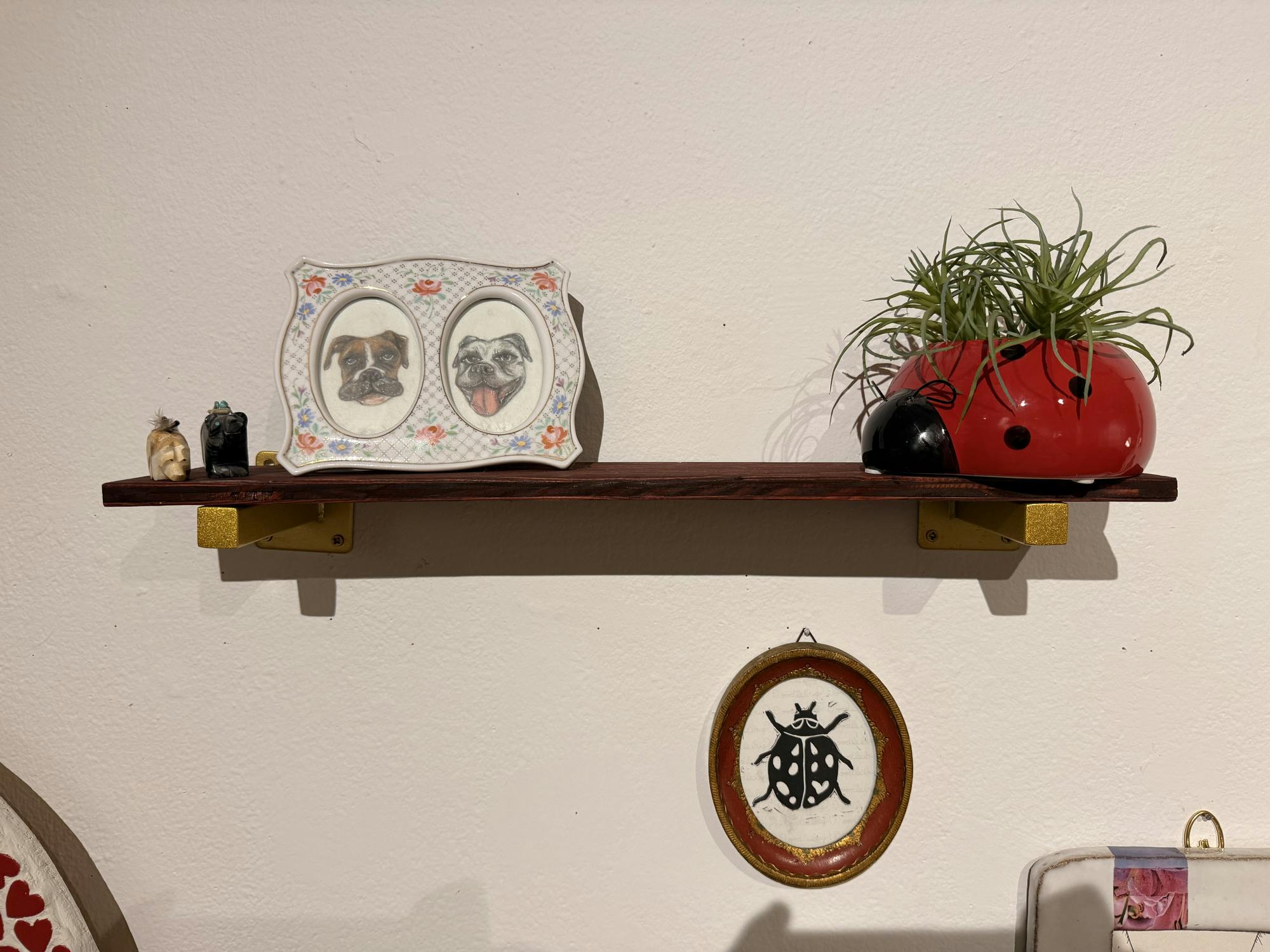
Framed dog art, a red ladybug planter, and two small trinkets sit on a brown shelf, Wednesday, March 25, 2026.
Kaichen Chou / The Daily Princetonian
My personal favorites were definitely the sections with shelving. The stand-alone shelf beside the flamboyant heart-patterned mirror served as a nostalgic reminder of my own youth and sparked a deep curiosity within me. I found myself wondering about the somewhat silly, intrusive details: the names of the dogs in the illustration, how they act, and the stories behind certain objects on the shelf. It felt as though I was truly peering into the life and home of a stranger, into a space where intimacy and ambiguity coexisted.
Another set of shelves, fixed above a floor plant and to the left of the shell and clam paintings, carried a more overtly sentimental tone. Themes of hope and family emerged through objects like a rainbow-colored wishbone and a photo album filled with a grandmother’s stories. The soft pink of the vase on the shelf and rosiness of the tiny flowers in the miniature pot neatly tied into the section’s theme of unconditional love and nurturing.
The exhibit itself was inherently inviting. Warm lighting and subtle color accents created an atmosphere of comfort, while the simple wooden chair to the left of the exhibit introduced an interesting contrast, suggesting presence yet emphasizing absence. It ultimately felt like a space waiting to be returned to.
Mudd describes “Keepsakes” as a reflection “on how we shape spaces — and how those spaces shape us,” and this idea resonates throughout the exhibition. Quotidian objects, often dismissed as insignificant or unworthy, are transformed into vessels of memory and identity through this thoughtfully arranged space.

What lingered most ultimately wasn’t the stillness or any specific object. Instead, it was the feeling of suspended time. Standing alone in the gallery, I felt like a bystander in someone else’s life — close enough to observe, yet distant enough to never fully understand. “Keepsakes” reveals that the meaning of a home is not simply in its material objects, but in the quiet, invisible stories they hold.
Kaichen Chou, member of the Class of 2029, is an assistant Prospect editor and a staff Copy editor. She can be reached at kc2050[at]princeton.edu.
Please send any corrections to corrections[at]dailyprincetonian.com.
Read More

DISPATCH | The sound of music: discovering Geneva at the Fête de la Musique
Annika PlunkettStaff writer for The Prospect Annika Plunkett explores how a music festival in Geneva allowed her a greater understanding of the city’s culture.
Staff writer for The Prospect Annika Plunkett explores how a music festival in Geneva allowed her a greater understanding of the city’s culture.

New recipients of endowed professorships reflect on the importance of research amid higher education uncertainty
Luke GrippoPrinceton recently named 11 faculty members to endowed professorships, honoring their achievements in scholarship amid growing uncertainty in higher education.
Princeton recently named 11 faculty members to endowed professorships, honoring their achievements in scholarship amid growing uncertainty in higher education.

Princeton continues to back Harvard in lawsuit against federal government
Gray Collins and Giselle MorenoIn July, Princeton joined 35 other universities in backing Harvard in a lawsuit against federal research funding cuts, as higher education institutions continue to push back against the Trump administration’s funding restrictions.
In July, Princeton joined 35 other universities in backing Harvard in a lawsuit against federal research funding cuts, as higher education institutions continue to push back against the Trump administration’s funding restrictions.