



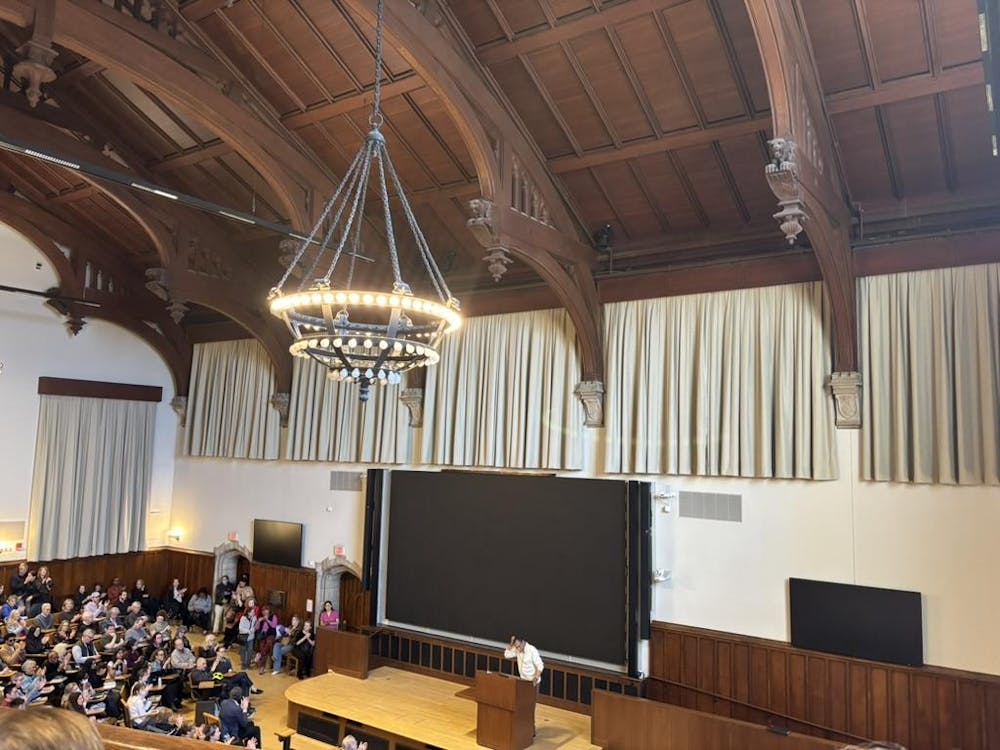
Public lectures at Princeton are often headlined by huge names, but not every celebrated speaker can command the room as well as they command the pen. Author Percival Everett possesses both literary prestige and charisma in equal measure, captivating the audience the moment he stepped on stage for his Princeton University Public Lecture in McCosh 50 last Wednesday.
Everett discussed his most recent novel, “James,” which won the Pulitzer Prize for Fiction in 2025. The book is a reimagining of Mark Twain’s “The Adventures of Huckleberry Finn” from the perspective of Jim, who travels with Huck on his way to escaping enslavement just before the Civil War.
Everett has written more than thirty works of fiction and poetry, including most famously “I Am Not Sidney Poitier” (2009) and “Telephone” (2020). In addition to writing, he teaches English at the University of Southern California. However, he started his career in the arts not as an author, but as a musician, playing blues and jazz guitar to pay for school. In his talk, Everett highlighted his experiences working on ranches in Idaho and Oregon, downplaying his literary expertise. “I want a world, a culture that embraces ignorance,” he remarked, emphasizing the importance of curiosity.
Everett's humility was on full display throughout the event. He warned that it was “not a lecture” because that would technically imply he “knew anything.” Instead, he instructed the audience to “imagine I’m funny,” as if such a feat would be near impossible. On the contrary, Everett had McCosh 50 roaring with laughter at each of his dry, witty comments. His not-a-lecture lecture was just as inspiring as it was funny, and many audience members eagerly jotted down his words.
Everett didn't shy away from the elephant in the room surrounding academia and the arts: AI. After introducing himself in Chinese, he segued into The Chinese Room Argument, a hypothetical about how learning the patterns of Chinese characters doesn’t actually teach you their meaning that he used as a metaphor for AI. Among the many artists who have spoken out against AI, it was heartening to hear Everett declare that “a digital machine cannot actually think.”
“A machine does not create art,” he continued, “I would argue that it cannot create art, unless we change the notion of how we understand art.” Everett was skeptical about ChatGPT’s literary capabilities. He admitted AI can write a somewhat convincing imitation of renowned authors’ work but wasn’t convinced that we should care — “Who gives a f--k?” He placed more emphasis on the human meaning of art as opposed to the speed with which technology can imitate it.
But Everett didn't linger on AI for too long, swiftly transitioning to the role of language in “James.” One of the most striking aspects of the novel is its focus on language and the “slave dialect,” which many works of literature and even historical documents erroneously attribute to enslaved people. Everett cited WPA recordings of formerly enslaved African Americans from the 1930s as inspiration, in which the interview subjects speak modern English and “don’t sound very different from the way I sound right here,” yet their answers were transcribed in slave dialect. Everett claimed that this reflected a desire to paint enslaved people as less intelligent in order to perpetuate racial prejudice.
“James” destabilizes the power dynamic this false dialect presents in “The Adventures of Huckleberry Finn.” In the novel, Jim and the other enslaved characters speak fluent English, only using the dialect with white Americans as a self-defense mechanism in an oppressive society.

A film adaptation of “James” is in the works. Taika Waititi is in talks to direct, and Steven Spielberg’s Amblin Partners will produce. Although Everett is currently writing the screenplay, he joked, “I am so sick of this novel.”
One of Everett's previous books, “Erasure” (2001), was adapted into the Oscar-winning film “American Fiction” (2023), which Everett said he enjoyed. “The idea of one work of art generating another makes me happy,” he said, echoing his earlier emphasis on the human-centered nature of art that AI cannot reproduce.
Throughout the talk, Everett continually returned to the political value of reading. “The scariest thing to me about this culture is the inability to read fiction,” he noted. Everett pointed to a lack of empathy, imagination, and willingness to learn about the world that seems to be present in our culture today, which he argues reading fiction would resolve. He made few direct political statements but said at one point, “I don’t think 54 percent of Americans are stupid — I think 54 percent of Americans are uneducated … they don’t read.”
As an English and creative writing student myself, I appreciated Everett’s ability to speak on the importance of language with such wit and lightheartedness. When asked how he’s able to produce so much work, he quipped, “I never feel stress. It’s just books.” Even in the midst of threats to literature like politics and AI, Everett’s talk was a reminder that they can also be a source of community, joy, and fun.
Lily Hutcheson is a member of the Class of 2028 and a senior writer for The Prospect and a contributing constructor for the Puzzles Section.
Please send any corrections to corrections[at]dailyprincetonian.com.
Read More

Princeton Council discusses community resources, e-bikes during summer meetings
Hifza Kaleem, Kevin Jin, and Michelle HarrisOver the summer, the Princeton Council surveyed residents’ needs, discussed new state legislation around e-bikes, and chose to hold off on updating the municipality’s public parking fees and regulations following community pushback.
Over the summer, the Princeton Council surveyed residents’ needs, discussed new state legislation around e-bikes, and chose to hold off on updating the municipality’s public parking fees and regulations following community pushback.

Princeton considers AI and data science-focused ‘evolution’ for ORFE department, specifics unclear
Sena Chang and Luke GrippoThe ORFE major could undergo changes in the coming years as a new ad hoc faculty committee considers how the University can strengthen its research and scholarship in AI and data science.
The ORFE major could undergo changes in the coming years as a new ad hoc faculty committee considers how the University can strengthen its research and scholarship in AI and data science.

Upperclassmen receiving financial aid see no increase to food budget for first time in 18 years
Joann Kim, Rajbir Toor, and Grace MeyerleThis year marks the first year without an increase to the budget since Princeton began to cover the average cost of eating club dues in 2007, sparking concerns among low-income students.
This year marks the first year without an increase to the budget since Princeton began to cover the average cost of eating club dues in 2007, sparking concerns among low-income students.