



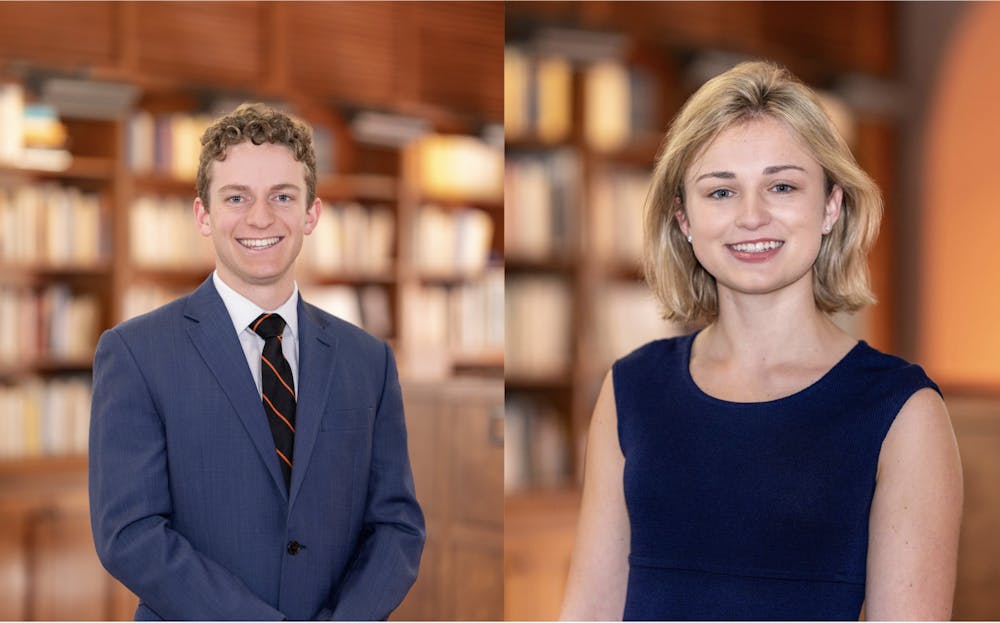
Katie Daniels ’26 and Braeden Carroll ’26 have been awarded the Moses Taylor Pyne Prize. The award, considered the highest general distinction for an undergraduate, honors “seniors who have most clearly manifested excellent scholarship, strength of character, and effective leadership.” Both Daniels and Carroll were honored at Alumni Day on Saturday.
From Newtown, Pa., Daniels is majoring in neuroscience and on the pre-med track. Since she was raised just 30 minutes away from Princeton’s campus, the University has been present in Daniels’ life since childhood.
In her time at Princeton, Daniels has received the George B. Wood Legacy Prize, the Shapiro Prize for Academic Excellence, and the Boyce Batey Senior Thesis Award. She is also an early inductee to the Phi Beta Kappa Society.
Daniels described being recognized with the Pyne Prize as “an overwhelming moment of just entire shock, and even thinking back on it, complete awe.” She credits the achievement to the communities that existed before she even enrolled at Princeton.
“The New College West Team, and my peer academic advisor at the time … made me feel like this was a place where I could succeed, and it could be my home. And over time, I’ve just seen that grow,” said Daniels.
She is now a PAA herself, and fulfills other roles in student support, serving as a senior fellow at the Office of Disability Services and a health professions adviser.
“I think being a PAA has actually been one of my favorite parts of my Princeton experience,” Daniels noted, “Getting the opportunity to make someone else feel like they have the internal drive and the internal strength to accomplish what they set out to do is probably one of the most meaningful things.”
After taking MOL 214: Introduction to Cellular and Molecular Biology, Daniels found a “phenomenal mentor” in professor Daniel A. Notterman, who now serves as her senior thesis advisor.

Her thesis research followed concussed fruit flies in their recovery, focusing on the cellular and molecular levels that lead to different outcomes, and looking at genetic variants commonly associated with Alzheimer’s disease. Her passion for this topic stemmed from personal experience, as she experienced concussions in her youth.
“[The Pyne Prize is] a culmination of all the effort that I think the Princeton community has placed in me,” Daniels said, “and I feel really grateful to have had their support in guiding me through this journey is also being recognized.”
Carroll, majoring in civil and environmental engineering, is from Kinnelon, N.J. In his time at Princeton, he has received both the George B. Wood Legacy Prize and the Shapiro Prize for Academic Excellence twice each, and has also been announced as an early inductee into the Phi Beta Kappa Society.
“I’ve been blessed in the past to win a couple things from Princeton, and each of them, I feel like, has been my crowning achievement. And then you get another one and you just have to pinch yourself,” Carroll said.
While he pursues an engineering degree, Carroll has dedicated his collegiate career towards exploring all corners of academia at Princeton.
“In terms of combining different disciplines, I think that is the most powerful part of the Princeton academic program, and why I chose Princeton in the first place. I’ve been able to study engineering and economics and history and politics and everything at such a high level,” explained Carroll.

Carroll’s thesis will focus on historic timber barns at the Howell Living History Farm, exploring how walls in a barn contribute to the stiffness of the structure. He is advised by professor Branko Glisic and supported by Moriah Hughes GS.
Apart from his academic honors, Carroll is also a rower for the Princeton men’s lightweight rowing team. After walking on to the team his freshman year, Carroll has represented Princeton in the third and fourth boats on the water.
“I think rowing is a sport that requires you to be both very personally motivated and driven … but also, when you’re in a boat with eight other people you have to be doing it for them,” Caroll said.
Carroll also attributes his academic success to the structure that rowing creates. Carroll has practice weekdays from 4:30 to 6:30 p.m., and morning practices four times a week.
“It forces me to really focus on spending my time in a measured way,” Carroll noted.
Carroll has also devoted his time to STEM to Stern, a nationwide program that addresses access barriers for underserved communities in the rowing community. The Princeton University Rowing Association partners with the Princeton National Rowing Association to engage with a chapter of STEM to Stern.
“It’s an opportunity for kids who otherwise would not be exposed to rowing to get a chance to kind of come to the Princeton boathouse and learn how to row,” Carroll said.
“Because [rowing has] had such a positive impact on my life, it’s great to give back and hopefully have a positive impact on others,” added Carroll.
In reflection on his four years, Carroll noted, “I think that that’s probably my biggest advice: don’t make Princeton what you expect it to be. Let Princeton be what it is, and then let yourself change.”
Vanessa Catalano is a News contributor for the ‘Prince.’ She is from Los Angeles and can be reached at vc6233[at]princeton.edu.
Lulu Mangriotis is the assistant News editor for the ‘Prince’ leading student life coverage. She is from New York City and can be reached at lm8001[at]princeton.edu.
Please send any corrections to corrections[at]dailyprincetonian.com.
Read More
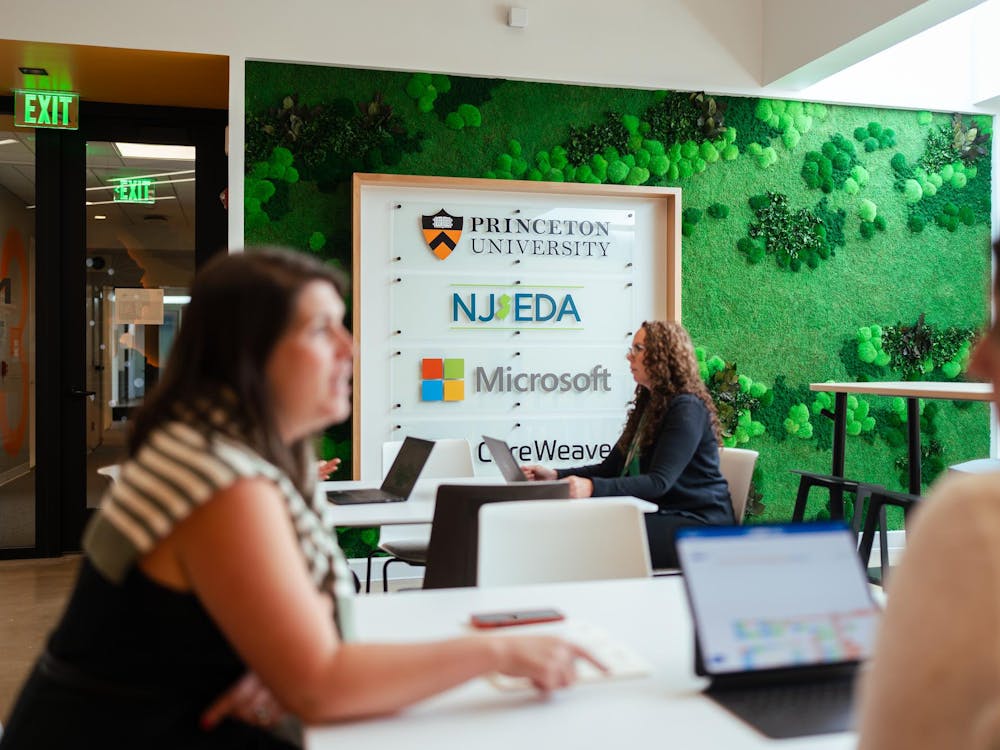
NJ AI Hub marks first anniversary with inaugural startup cohort
Zihan (Frank) XuFourteen selected start-ups receive weekly workshops, reverse pitches, corporate introductions, among other guidance over 12 weeks. The “AI accelerator” helps to test each company’s technology and fast-track its path to commercialization.
Fourteen selected start-ups receive weekly workshops, reverse pitches, corporate introductions, among other guidance over 12 weeks. The “AI accelerator” helps to test each company’s technology and fast-track its path to commercialization.
Three Princeton alumni awarded 2026 Fields Medal
Clara DochertyThe three alumni who received the medal are Yu Deng GS ’15, John Pardon ’11, and Jacob Tsimerman GS ’11.
The three alumni who received the medal are Yu Deng GS ’15, John Pardon ’11, and Jacob Tsimerman GS ’11.

How Charles Plohn ’66 brought his classmates together on the shelves
Nikki HanFor decades, Charles J. Plohn, Jr. ’66 has been collecting books published by members of his class. With nearly 700 titles in this collection, Plohn is attempting to find his library a permanent home.
For decades, Charles J. Plohn, Jr. ’66 has been collecting books published by members of his class. With nearly 700 titles in this collection, Plohn is attempting to find his library a permanent home.