



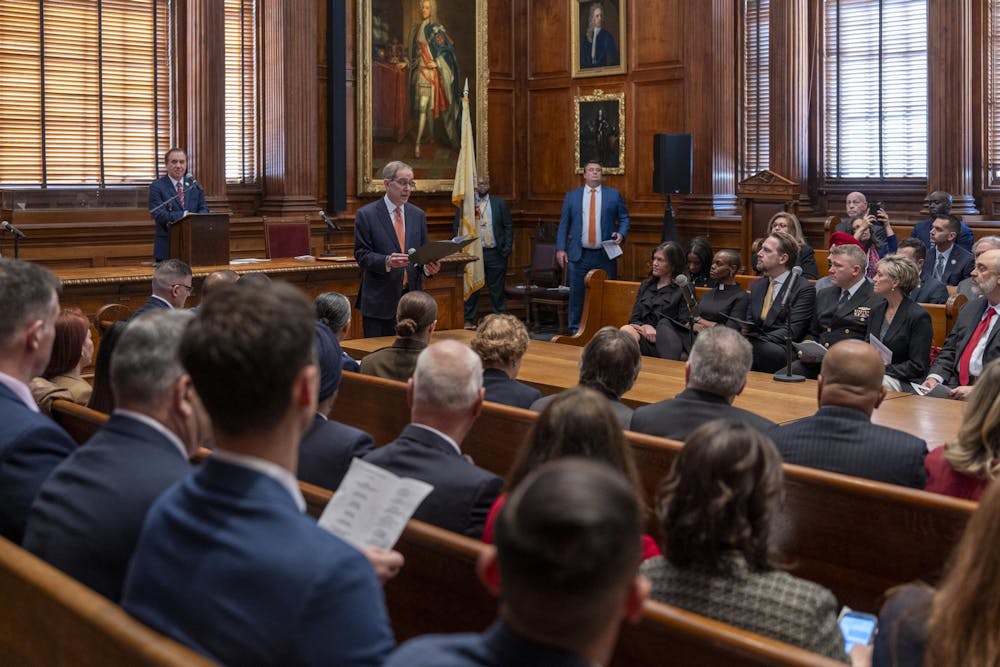
Two hundred fifty years ago, the New Jersey Legislature held its first-ever session in the Faculty Room in Nassau Hall. On Thursday, the New Jersey General Assembly, the lower house of the legislature, convened in the historic building once again in honor of the 250th anniversary of the signing of the Declaration of Independence.
Speakers included University President Christopher Eisgruber ’83, Speaker of the New Jersey General Assembly Craig Coughlin, British Consul General to New York and HM Trade Commissioner for North America Oliver Christian, and recently-elected Lieutenant Governor Dale Caldwell ’82, shadowed by large portraits of George Washington on the left and King William of Orange on the right.
65 of the 80 members of the assembly were present. Two assembly members represent each of the 40 N.J. legislative districts. Both the assembly members representing District 16, which includes Princeton, Mitchelle Drulis and Roy Freiman, were present.
An hour before the start of the session, climate change protesters congregated in front of Nassau Hall and greeted assembly members as they filed in. The rally was sponsored by Sunrise Princeton, the Climate Revolution Action Network (CRAN), Empower NJ, and the Food & Water Watch.
None of the assembly members addressed these issues during the meeting. When the meeting concluded, assembly members walked through the protesters to return to their bus.
Eisgruber was the first to speak, identifying four core moments of Princeton and the ivy-adorned hall’s association with the beginnings of the country: “Father of the Constitution” James Madison studied at Princeton when it was just Nassau Hall; George Washington liberated Nassau Hall from the British during the Battle of Princeton; the hall served as the nation’s capital from June to November 1783; and the N.J. State Legislature’s first meeting and inauguration of the state’s first governor, William Livingston, was held in Nassau Hall in August 1776.
Eisgruber concluded his speech with a re-commitment to the relationship between the University and the State of New Jersey.
“For many of you, this may be your first time on Princeton’s campus. I hope it is not your last,” Eisgruber said.

Next to speak was Coughlin, who described the University as the centerpoint of the state’s historical, intellectual, industrial, political, and social developments.
“Princeton has always had an important role in the state of New Jersey. It’s the intersection of intellect and public service, and for generations, it has helped cultivate talents and ideas that strengthen our state and our nation — an enduring partnership for which we are deeply grateful,” Coughlin said.
“Today isn’t simply a change in venue for us — it’s a return home, a return to our beginnings, to the place where our legislature first met in 1776 at the dawn of the new and uncertain democracy,” Coughlin added.
Following Coughlin’s address was Christian, who delivered remarks regarding the “shared history” between the enemies-turned-friends of the Americans and the British.
He expressed pride at having “over 39,000 New Jerseyans … employed by British companies” — an accomplishment he acknowledged in his role as trade commissioner.
He also praised Daniel Yu ’26 and Maya Butani ’26, who were awarded the Marshall Scholarship to study for two years in the United Kingdom — “two outstanding students” receiving the “illustrious” scholarship, according to Christian.

Directly after Christian’s remarks, Caldwell took the podium, praising Eisgruber’s “wonderful stewardship of the University,” before handing the microphone to Joseph Klett, the executive director of the New Jersey State Archives, and Sara Cureton, the executive director of the New Jersey Historical Commission, for a brief overview of N.J. Revolutionary-period history.
To finish the session, eight resolutions were voted on by the Assembly, each unanimously approved. The second resolution, presented by Freiman, commemorates the University’s 280th anniversary.
He placed specific emphasis on Princeton’s alumni, including two presidents; twelve who have been named to the U.S. Supreme Court including three current U.S. Supreme Court justices; and the eleven who have served as N.J. governor.
The other resolutions included honoring the history and service of the U.S.S. New Jersey battleship, the role of Princeton in the American Revolution, and honoring unsung New Jerseyan heroes in the Revolutionary War, among others.
Following the session, Freiman and Drulis spoke about their thoughts on the event and Princeton’s regional-national significance in an interview with the ‘Prince.’
Drulis shared that there is a synergy between the political issues of the post-Revolutionary War epoch and the current political climate. She specifically highlighted that “there was national political crisis, there was divide among neighbors — a lot of the same issues we’re still struggling with today, unfortunately.”
Freiman discussed his hopes for the relationship between the General Assembly and Princeton on a shared commitment to free discourse.
“We’re working very closely on trying to make it an environment where people feel safe; safe to discuss issues, safe to challenge ideas, and explore,” he said.
Both assembly members acknowledged parallels between the trepidations of the first assembly and the assembly that met on Thursday.
“We are struggling with making sure we have a balance of power,” Freiman said. “This year, our election is sending a message of dissatisfaction of what's taking place in Washington.”
“There’s uncertainty about what the future brings. And I think those are all feelings that that legislature [then] was definitely grappling with,” Drulis said.
However, Drulis believes that Princeton remains at the forefront of addressing this uncertainty. “From the very founding of our state, Princeton University has led the way,” she added.
“When you travel outside of N.J. … Your reference point is Princeton. So you can’t speak of New Jersey without really talking about Princeton itself and the importance it has.”
Luke Grippo is a head News editor for the ‘Prince.’ He is from South Jersey, and typically covers high-profile interviews and University and town politics. He can be reached at lg5452[at]princeton.edu.
Amaya Taylor is a staff News writer and Associate Prospect editor from Memphis, Tenn. She can be reached at at9074[at]princeton.edu.
Toby Chang contributed reporting.
Please send any corrections to corrections[at]dailyprincetonian.com.
Correction: A previous headline of this article incorrectly claimed that the Assembly had only met once before in Nassau Hall, which is not the case. A previous version of the article misspelled Assemblyman Roy Freiman’s name. It is Freiman, not Frieman. A previous version of this article also incorrectly identified the lower house of the New Jersey Legislature. It is the New Jersey General Assembly, not the New Jersey State Assembly. These errors have since been corrected. The ‘Prince’ regrets these errors.
Read More

Students voice mixed reactions to new room draw process after draw times released
Caitlyn TabladaPrinceton students praised new visualization tools in the University’s updated housing draw system, but many said technical issues and limited transparency around draw times made the process confusing and stressful.
Princeton students praised new visualization tools in the University’s updated housing draw system, but many said technical issues and limited transparency around draw times made the process confusing and stressful.
Princeton-led study finds global wastewater emissions may be underestimated
Razvan VerdeA Princeton study led by Zhiyong Jason Ren found that countries may be undercounting greenhouse gas emissions from wastewater systems by a significant margin.
A Princeton study led by Zhiyong Jason Ren found that countries may be undercounting greenhouse gas emissions from wastewater systems by a significant margin.

Collective memories in the museum collections
Lucas EscobarAt the Princeton University Art Museum, The Daily Princetonian interviewed visitors who didn’t come alone. Families, couples, and affinity groups expressed that they often find greater meaning when in the company of others.
At the Princeton University Art Museum, The Daily Princetonian interviewed visitors who didn’t come alone. Families, couples, and affinity groups expressed that they often find greater meaning when in the company of others.