



As I entered Abigail DeVille’s latest exhibition, I was greeted by a short moment of silence before I began to hear the “lub-dub” of a heart that’s not my own.
This exhibit, located at Hurley Gallery in the Lewis Center for the Arts, was a dynamic and immersive experience that combined sound, light, and space. The exhibition, titled “the heart knows its own bitterness (Manifest),” opened on Nov. 11 and ends Jan. 9, drawing from a shipping manifest, or a detailed document listing all transported goods, filed in New Orleans from 1807 to 1860. In this context, the “goods” are over 135,000 people sold into slavery, and DeVille’s work serves to commemorate the often disregarded or erased histories of their humanity.
“The heart knows its own bitterness” is a phrase originating from the Book of Proverbs that emphasizes the private experiences of human emotions. The title highlights humans’ limitations to fully understand one another’s suffering. I thought this was an appropriate theme for this exhibit, as it displays the elaborate exteriors of the hearts with the shipping manifests protected inside, slightly obscured from view. This archival layer addresses an indescribable type of pain that enslaved people experienced throughout history: a type of hurt one may never fully comprehend, but must still acknowledge.
The entire gallery was illuminated with indigo-hued lighting, and a few speakers were scattered along the walls. Perhaps the most fascinating element of DeVille’s exhibit was her use of sound. The audio alternated from hypnotic, soul-stirring ambient music to loops of a healthy pulsing heartbeat, to voices that repeatedly said “lub dub,” which further evoked the surreality of the experience. The voices could be heard from multiple speakers at once, alternating between a harmonious and unsynchronized rhythm. The audio was an innovative touch that created an unexpectedly multi-sensory experience.
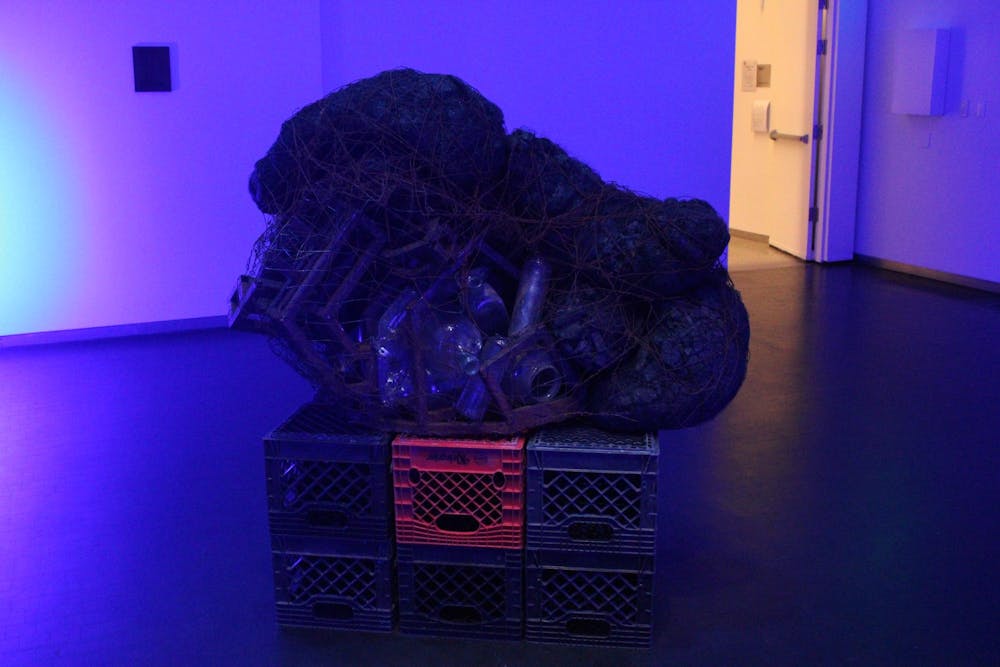
The physical aspect of the exhibit centers on four anatomical heart-shaped structures, each crafted with an intricate combination of found objects. The sculptures are coated in coal, and a net-like wire enshrouds each heart.
The sculpture closest to the doorway sat on a pedestal of 12 crates, with rusted metal serving as a sharp, geometric casing for the assemblage of glass bottles inside. The heart across from it was similarly constructed on a stack of wooden platforms, with a higher-reaching net of rusted wires.
The next sculpture used a collection of rocks and large tree branches as its core, with the branches stretching outside of its casing towards the ceiling. I perceived this to symbolize the heart’s aorta and superior vena cava. Although many of the hearts used similar materials, it was interesting to see the subtle differences in each one. In particular, the variations in size effectively presented each heart at different stages in development.
My favorite variation of the heart lay atop a blue quilt, with shells scattered along the edges and across the sculpture’s body, which was made from a cacophony of glass bottles — mouths pointed in all directions — and golden bells draped above them. It almost resembled a shipwreck washed up against a shore, appearing to symbolize loss and destruction, but also resilience, transformation, and new beginnings.

If you’re looking for more ways to appreciate art on campus, your next favorite exhibition might be in the LCA’s Hurley Gallery. DeVille’s “the heart knows its own bitterness (Manifest)” is a narratively cohesive exhibit that embodies the philosophy that remembrance is a form of resistance through its material design, color scheme, and complementing audio elements.
The exhibition is free and open to the public.
Amaya Taylor is a contributing writer for News and The Prospect and a member of the Class of 2028. She can be reached at amayataylor[at]princeton.edu.
Please send any corrections to corrections[at]dailyprincetonian.com.
Read More

Ryan Forrest named 17th head coach of Princeton baseball
Alex Beverton-SmithThe former Boston College assistant coach replaces Scott Bradley who concluded his 28th year with the program in the summer.
The former Boston College assistant coach replaces Scott Bradley who concluded his 28th year with the program in the summer.

DISPATCH | The sound of music: discovering Geneva at the Fête de la Musique
Annika PlunkettStaff writer for The Prospect Annika Plunkett explores how a music festival in Geneva allowed her a greater understanding of the city’s culture.
Staff writer for The Prospect Annika Plunkett explores how a music festival in Geneva allowed her a greater understanding of the city’s culture.

New recipients of endowed professorships reflect on the importance of research amid higher education uncertainty
Luke GrippoPrinceton recently named 11 faculty members to endowed professorships, honoring their achievements in scholarship amid growing uncertainty in higher education.
Princeton recently named 11 faculty members to endowed professorships, honoring their achievements in scholarship amid growing uncertainty in higher education.