



Within blocks of the University reside several professors, diplomats, senators, one U.S. president and a signatory of the Declaration of Independence. And they live together.
They rest in what one historian termed the "Westminster Abbey of the United States": Princeton Cemetery, a small plot of land on Witherspoon Street, across from the Princeton Public Library.
Established in 1757 and located at the end of Greenview Avenue, the cemetery houses the graves of numerous prominent figures, including leaders of the town, University and nation.
President Grover Cleveland, arguably the cemetery's most famous resident, is buried in the northwest corner of the grounds alongside First Lady Frances Cleveland. Cleveland's birthday is celebrated every March with a eulogy and wreath-laying ceremony by a Fort Dix military guard. First daughter Ruth Cleveland, known as the inspiration for the "Baby Ruth" candy bar, is also buried there.
Tours of the cemetery are offered two weekends a year, typically around Memorial Day. Elizabeth Evans and her husband, Bill, have conducted these tours on a voluntary basis for 42 years.
"We traveled around to different states and interviewed family members to find interesting stories to tell about these people," Elizabeth Evans said.
Along the way, the family learned the story of Jimmy Johnson, a runaway slave who sold pencils, apples and candy on campus in the mid-to-late 19th century. When he died in 1902, students took up a collection to have him buried in the cemetery.
All but four of the dead presidents of Princeton are buried in the Presidents' Plot on the south side of the cemetery, referred to as the "Old Graveyard." Many of these tombs are located above ground with detailed Latin inscriptions.

The oldest surviving tomb in the Presidents' Plot is that of Aaron Burr, Sr., former president of the University. Burr is perhaps better known as father of Aaron Burr, Jr., who served as vice president during Thomas Jefferson's first term as President of the United States before killing Alexander Hamilton in a duel. Burr, Jr. is buried next to his father.
Some of the people buried in the cemetery are familiar to Princeton students in name only. Arnold Henry Guyot, Moses Taylor Pyne and the McCosh family are among the people whose names have since been attached to buildings on campus.
Another familiar name on a gravestone is that of Paul Tulane, whose donations led to the creation of Tulane University. Theologian Jonathan Edwards, pollster George Gallup and Jose and Kitty Menendez, the slain parents of Erik and Lyle, are also buried there. Lyle Menendez attended Princeton in the late 1980s.
In certain areas, inscriptions have eroded over time and distinct names and information can be hard to discern. The cemetery, though, has plaques next to some of the more prominent tombs to indicate what the stones originally said.
New gravesites in the Princeton Cemetery might soon become limited. "This is basically one of the only cemeteries that's been around so long, it is being sold out to capacity," said Douglas Sutphen, superintendent of the cemetery. The cemetery is now closing down some old stone driveways and using those areas for gravesites as well.
According to Sutphen, a few hundred people visit the cemetery annually. "Though some people do come to mourn at graves, I'd say about 80 percent come just for the historical value," he said.

George Brown, who previously ran the Memorial Day tour, said that few students seem to care about the cemetery. "They aren't interested or they don't know about it," he said.
Sutphen, however, said that many of the cemetery's current visitors are University students.
In some cases, it is the visitors themselves who add to the tradition of the cemetery.
"A father of the Olympics is buried in the cemetery," Elizabeth Evans said, referring to Princeton professor William Milligan Sloane, who founded the U.S. Olympic Committee in the 1890s. The Olympic torch was carried through the cemetery on the way to the 1996 Summer Olympics in Atlanta.
"One of the good aspects of this cemetery is that it has its own maintenance and preservation fund," Sutphen said. "It will be taken care of for years and years to come."
Read More

Men’s volleyball clinches spot in EIVA tournament with back-to-back weekend wins over Harvard
James LiThe Tigers kept their momentum from Friday with a straight-set win on Saturday, clinching an EIVA Tournament berth.
The Tigers kept their momentum from Friday with a straight-set win on Saturday, clinching an EIVA Tournament berth.

PSafe alerts community of driver harassing students on campus
Nora LinssenThe Department of Public Safety issued a delayed alert four days after initial reports, warning that a man in a dark vehicle allegedly harassed multiple students near campus on April 16–17 by offering cash and attempting to lure them into his car, and is now under investigation with local police.
The Department of Public Safety issued a delayed alert four days after initial reports, warning that a man in a dark vehicle allegedly harassed multiple students near campus on April 16–17 by offering cash and attempting to lure them into his car, and is now under investigation with local police.
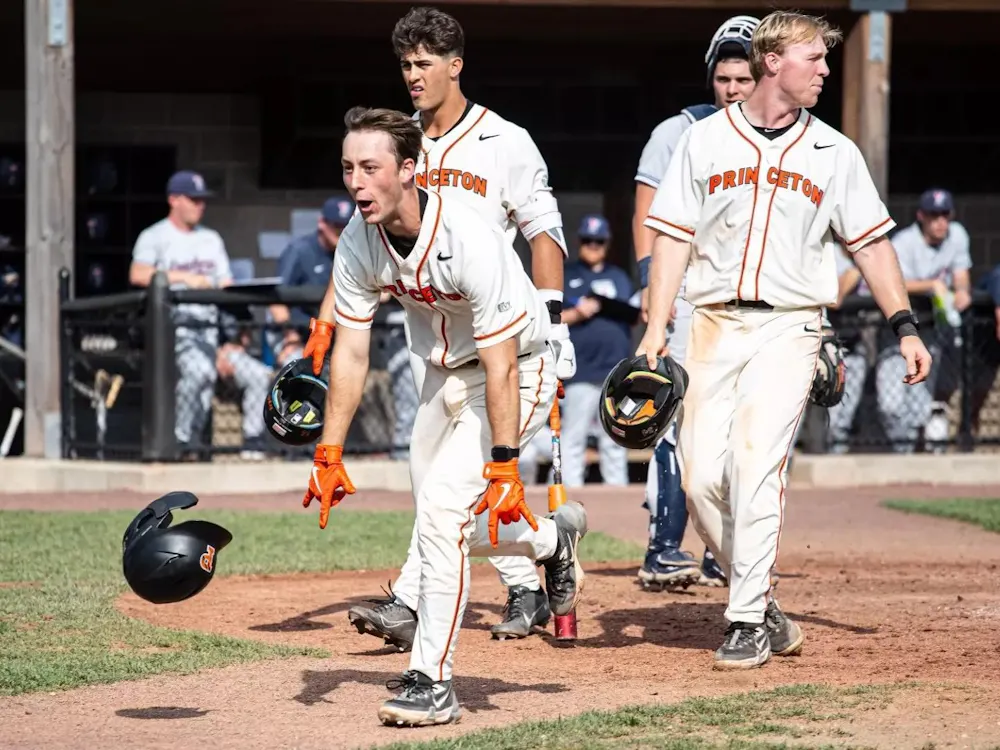
Claiming victory at Clarke: Princeton baseball wins home series against Penn 2–1
Siena SydenhamIn a weekend series full of high pressure moments, Princeton was able to remain focused and finish the job, winning two of three games at home against Penn. Major offensive success in the fourth innings of games one and three helped secure the series win for the Tigers.
In a weekend series full of high pressure moments, Princeton was able to remain focused and finish the job, winning two of three games at home against Penn. Major offensive success in the fourth innings of games one and three helped secure the series win for the Tigers.