



Retired Firestone Library curator Alfred Bush recently discovered a diary written by one of Albert Einstein's closest friends which chronicles the famed scientist's musings and everyday activities during the last years of his life.
In the diary, Johanna Fantova, a map curator at Firestone Library in 1953, describes Einstein's opinions on everything from current events and politics to music and physics.
"Fantova's manuscript concerning Albert Einstein and their friendship is full of human interest," Don Skemer, University curator of manuscripts, said.
"This material will be of interest to the many Einstein researchers around the world, as well as to people here and in Germany who are interested in the life and times of one of the 20th century's greatest thinkers," Skemer added.
Fantova and Einstein
Fantova met Einstein in 1929 in Berlin and renewed the friendship in the United States during World War II, according to Gillett Griffin, curator of the University's pre-Columbian art collection and mutual friend of Einstein and Fantova.
Fantova's manuscript reveals that the two often spoke on the telephone, went sailing on Lake Carnegie and saw films together.
"Fantova kept a diary of Einstein at the same time I was going to Einstein's house for dinners," said Griffin, who still possesses the cushion Einstein sat on in his sailing boat.
Fantova compiled notes from her conversations into a 62-page manuscript written in German, with more than 200 diary entries.

According to Griffin, Einstein realized Fantova was recording their conversations and also gave her an important scientific manuscript on unified field theory, knowing that Fantova could sell the works in the future.
"He knew Fantova was poor and sent her poems and a scientific manuscript as an insurance for her financial security," Griffin said.
Fantova hesitated for many years to take notes on her conversations with Einstein but was convinced in the last years of his life that "these monologues were of great interest as historical documents, since they illuminate the man and his era," she wrote.
Conversations
In Fantova's accounts, much of Einstein's ruminations were devoted to the political affairs of the day. Fantova wrote that Einstein considered President Eisenhower's $60 billion budget for rearmament a "waste of money."
"Einstein felt that the world could be a nice place if people were different, if they were concerned more about the common good than only about themselves," Fantova wrote.
The McCarthy congressional hearings about alleged communists in America were also a frequent subject of conversation between Einstein and Fantova, especially since Einstein's boss, Robert Oppenheimer at the Institute for Advanced Study, was pursued by McCarthy.

"Einstein was amazed at the masses, whose voice counts as much as anyone else's, as they show their support for McCarthy," Fantova wrote.
She continued, "Einstein believes it's horrible that Communists are making the most of this tragedy, and the poor children [of Soviet spies Ethel and Julius Rosenberg] are paying the price."
In addition, Einstein discussed many old colleagues and friends who visited him at his home at 112 Mercer St. He received visits from physicist Werner Heisenberg, who had led the Nazi atomic bomb effort, and Aage Bohr, son of physicist and Heisenberg rival Niels Bohr. Fantova wrote that after the visits, Einstein called Heisenberg "a big Nazi" and commented that Bohr was "more pleasant . . . but talked constantly."
Fantova and Einstein even discussed University life during the 1950s.
Fantova wrote, "Einstein says he does not believe in giving exams, that they distract from the students' interest . . . if the students seem interested and listen, he would give them their diplomas."
Discovery
Bush discovered the manuscript in Fantova's archived employment file while conducting research on Fantova.
"Fantova's 'Conversations with Einstein' and some personal papers were separated from the rest of her personal papers around 1981. For some reason, the typescript was put in her personnel files in University Archives," Skemer said.
Once found, librarians moved Fantova's manuscript from University Archives to the Manuscript Division to be filed with her other personal papers, including photographs of Einstein and poems and letters that Einstein had sent to her.
Alice Calaprice, former senior editor at Princeton University Press and editor of "The Quotable Einstein," has already translated and summarized part of Fantova's manuscript.
The University's 'Library Chronicle' will publish an article by Calaprice on Einstein and Fantova's relationship, Skemer said.
Fantova's diary is currently available to researchers through the Department of Rare Books and Special Collections in the University library.
Griffin reflected on the significance of the discovery. "While tremendous literature exists on Einstein's theories and family life, Fantova's manuscript really shows his human side," he said.
He stressed, "The diary paints a vivid picture of a truly brilliant, humble and warm man."
Read More

Princeton University Orchestra and men’s ultimate frisbee team named in University’s latest hazing report
Andrew ArthurTwelve students in the Princeton University Orchestra and Men's Ultimate Frisbee team were found responsible for hazing violations in the University's latest Campus Hazing Transparency Report. Sanctions ranged from Dean's warnings to disciplinary probation.
Twelve students in the Princeton University Orchestra and Men's Ultimate Frisbee team were found responsible for hazing violations in the University's latest Campus Hazing Transparency Report. Sanctions ranged from Dean's warnings to disciplinary probation.

Murray-Dodge Café celebrates 50th Anniversary, drawing over 260 students
Hifza KaleemOn Wednesday, Murray Dodge Cafe celebrated its 50th anniversary, drawing more than 260 students to celebrate with free cookies and merchandise.
On Wednesday, Murray Dodge Cafe celebrated its 50th anniversary, drawing more than 260 students to celebrate with free cookies and merchandise.
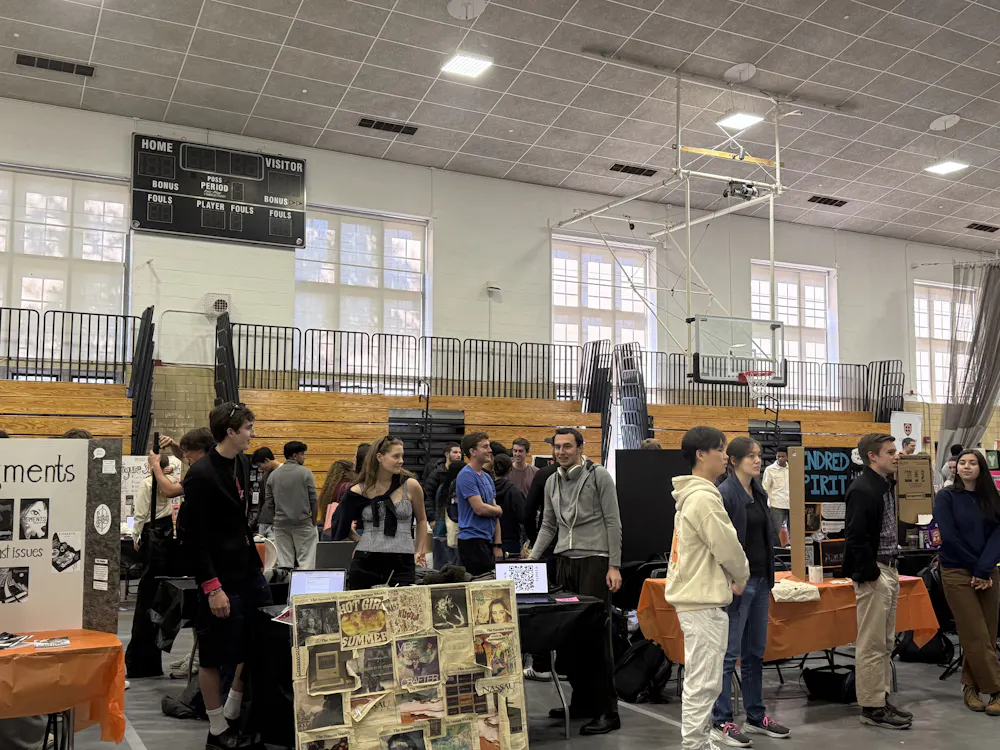
Students share mixed reactions as mandated officer and treasurer trainings return to in-person format
David EstradaThe University's student organization officers and treasurers returned to mandatory in-person training this fall after years of online sessions. Student reactions found parts of the training redundant or tedious, though most agreed the sessions were important.
The University's student organization officers and treasurers returned to mandatory in-person training this fall after years of online sessions. Student reactions found parts of the training redundant or tedious, though most agreed the sessions were important.