



Who is a B.S.E.? And where can they be found?
In 1999, The Daily Princetonian attempted to answer this question with a deep dive into the spaces, culture, and lives of the students relegated to the farthest end of campus.
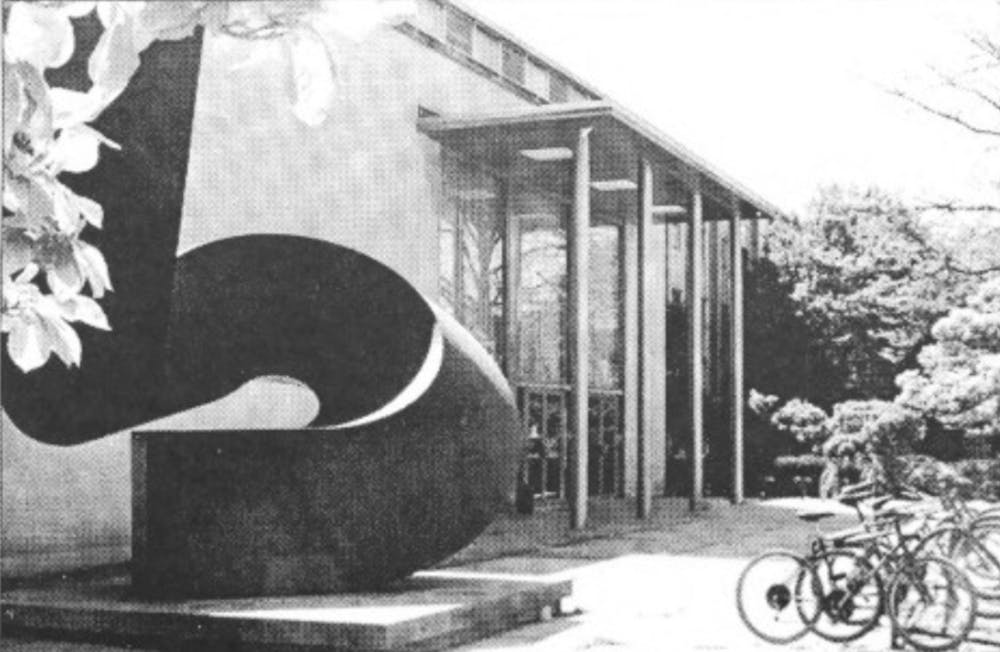
The University first created the B.S.E. degree in 1921, after realizing that the existing Department of Civil Engineering did not offer sufficiently broad courses. The fledgling school included Chemical, Electrical, Mechanical, and Mining Engineering departments, and was originally housed in Palmer Laboratory and the Green Engineering building. The University unveiled a new hub for engineering life in 1962, which included the six-building engineering quadrangle, extending all the way from Olden Street to the back of Moore.
Students occupying the E-Quad late at night were affectionately known as the “Enginerds,” majoring in “Chem-E (chemical), MAE (mechanical and aerospace), ELE (electrical), or CIV (the most popular major, including the environmental, operations research, structural, transportation engineering and EMS programs).”
While still part of the “engineering faction,” the Computer Sciences degree was moved to a complex of buildings across Olden Street in 1986, “because the majors kept hogging all the computer clusters doing high-level work on [computer games] Doom, Snood and Quake,” joked the author Greg Ayres ’99, an MAE major himself.
Despite the unification of different concentrators under the B.S.E. label, there existed a rivalry between them. EMS (the precursor to today’s ORFE) students, faced accusations of majoring in “Engineering Made Simple,” by Chem-E majors. The E-Quad served as a “second home for many,” but the building complex was a house divided, with the different resources provided to the departments fueling separatism between the branches.
Mechanical and Aerospace Engineering concentrator Ely Lopez ’27 reflected that much has changed today, as there is more academic crossover within the engineering degrees. Although there is “not a lot of collaboration between majors, we take courses that intersect with our interests, so we have classes that we share,” she said. “For example, someone interested in materials would be in a class with CEE.”
Undergraduate lounges were the most intense battlegrounds for rivalry. “The combinations needed to unlock the doors to these places are carefully guarded secrets known only to each faction, though spies have been known to infiltrate other groups’ parlors and report back on the quality of the others’ headquarters,” reported Ayres.

The Civil Engineers were known to have the worst lounge with just a few chairs, “suggestive of a dentist’s waiting room more than relaxation.” Electrical Engineers and Chemical Engineers were slightly upgraded with better furniture, mini-fridges, and a Dell computer. At the top of the hierarchy were the Mechanical and Aerospace engineers with the best lounge. Equipped with coffee makers and free sandwiches provided by anonymous donors, one MAE student said, “We get the most stuff because we’re the ones who actually make stuff.”
Such spaces today have shifted from battlefields to sites of collaboration. As Lopez noted, “common spaces are lively and are often busy with homework support and group collaboration.”
Engineers were unified by a few key qualities besides simply graduating with a diploma distinct from their A.B. counterparts. Ayres wrote that the engineers tended to be “conservative dressers, attracting the disdain of J.Crew-wearing humanities majors.” There also existed a particular “engineer personality” that embodied the collective “regularity and disciplines, i.e. anal-retentiveness” of the group.
The engineers cultivated their own traditions, unable to enjoy the A.B. “luxuries” of having four-course semesters with no Friday classes, partying late on Thursdays, and waiting until the end of Sophomore year to declare a major. Instead, B.S.E. underclassmen would travel to Stevenson Hall, a now obsolete upperclassman dining hall, or they would watch the sun rise from their fourth-floor lookout.
The imagined divide between liberal arts students and the engineering-minded persists. As Lopez reflected, “There are stereotypes that B.S.E. cannot write, but most of us frequently write for proposals and learn scientific writing.” On the differences between the degree types, she shared that it is also a commonly held belief that “A.B.s have it easier.”
Ayres wrote in 1999 that engineers are the ones thinking, designing, creating, and filling “one of the most important roles in society.” Nevertheless, the reminder that Ayres humorously gives to A.B. students contains a serious element of truth regarding the noble B.S.E. student: “[T]his Thursday night while you’re tossing back a few cold ones at the clubs, remember the engineers who are slaving away a block north, and take some time to thank the guy to whom all collegians owe a great debt, Princeton chemical engineer alum Adolph Coors.”

Jillian Ascher is the head Archives editor for the ‘Prince.’
Please send any corrections to corrections[at]dailyprincetonian.com.
Read More

Staff Picks: Football vs. Brown
Saad Akhtar, Alex Beverton-Smith, and Juha ImPrinceton football is set to take on Brown this weekend at home. The Daily Princetonian Sports section makes their picks for the game.
Princeton football is set to take on Brown this weekend at home. The Daily Princetonian Sports section makes their picks for the game.

Roundup: Marvel Jem Roth and Isaac Barsoum on their advocacy related to the Title IX process at Princeton, ‘hearing math,’ and proctors in the classrooms
Tendai Jobarteh, Devon Rudolph, and Danny ShingAn in-depth interview with Undergraduate Student Government treasurer Marvel Jem Roth ’28 and U-Council chair Isaac Barsoum ’28 on their advocacy related to the title IX process at Princeton, ‘hearing math,’ and proctors in the classrooms, ‘hearing math,’ and proctors in classrooms during the midterms.
An in-depth interview with Undergraduate Student Government treasurer Marvel Jem Roth ’28 and U-Council chair Isaac Barsoum ’28 on their advocacy related to the title IX process at Princeton, ‘hearing math,’ and proctors in the classrooms, ‘hearing math,’ and proctors in classrooms during the midterms.

Women’s rugby sees early success under new coaching staff
Devon RudolphPrinceton women’s rugby made several strides in their team with hopes to participate in the championship league next season.
Princeton women’s rugby made several strides in their team with hopes to participate in the championship league next season.