




Recent favorites in media, trends, and food, brought to you by The Prospect editors.
“Dominoes” — Twin Shadow
Gavin McLoughlin, Head Editor
As with most new music I find these days, I first encountered this song deep within a randomly generated playlist during a brisk walk to morning lecture. Yet from the moment the song’s lush, fluttering synths hit my headphones, swelling into an immersive, rhythmic landscape, I was hooked. “Dominoes,” the opening track of Los Angeles-based, Dominican-American artist Twin Shadow’s seventh album, “Cadet,” is a sweeping reimagination of the song “Totally Blue” from the artist’s minimalist album, “Georgie.” Unlike the song’s sparse, somber twin, “Dominoes” is a breath of fresh air, bridging sonic elements of eminent ’90s techno found in Orbital’s “Halcyon and On and On” with abstract, wistful lyrics reminiscent of post-punk icons like The Cure. With lyrics first featured on “Georgie,” an album dedicated to his father’s passing, Twin Shadow’s delicate, unadorned delivery of “If I had a clue / I would play with devotion / I would melt where you’re frozen / All that for you” feels especially resonant against the song’s maximalist musical backdrop. This contrast results in a brilliant song whose infectious instrumentation will make you dance, while its moving lyrics of vulnerability and love despite tragedy might bring you to tears.
Resurgence of Polka Dots
Kaichen Chou, Assistant Editor
As a staunch hater of last year’s camo print craze, I am beyond delighted by the recent return to a classic favorite: polka dots. Each year, the fashion industry seemingly colludes to redesign our wardrobes, most habitually through prints. After a steady stream of misses — in my books — over the past few years, from cow print in 2020, to cheetah print in 2023, and finally bow print in 2024, I have immensely appreciated the resurgence of polka dots as a print, which have appeared more frequently since late 2025 into this year.
Though polka dots have been commercially available as a clothing print since the mid-1800s — when working sewing machines were finally able to produce perfectly round and evenly spaced circles — the pattern has an unrivaled degree of elegance and timelessness.

Beyond being able to twin with Minnie Mouse and Marilyn Monroe whenever you don this spotted pattern, the best part about this print is its versatility: they fit most occasions and are a stylish pattern for shirts, tanks, and skirts alike. This spring, I would love to see a whimsier, more polka-dotted campus.
“On the Nature of Things” by Lucretius
Zane Mills VanWicklen, Assistant Editor
Has philosophy ever sounded so bouncy, so rapid, so exhilarating as when it dripped from the quill of Lucretius in the first century BCE? His great poem De Rerum Natura, Latin for “On the Nature of Things,” delivers philosophy not as dry argument but as kinetic verse written in dactylic hexameter — the same propulsive meter used by Homer to tell stories of gods, heroes, and epic battles. Lucretius was packaging philosophy into the modern cultural equivalent of a blockbuster film. The result is startlingly readable and witty. Drawing on the ideas of Greek philosopher Epicurus, he argues that invisible atoms form the basis of everything and that thunder, plagues, love, and even the soul can be explained without appealing to myth. Superstition, he insists, clouds our understanding of the world. Reason and observation clear it. And yet this dazzling work nearly vanished from history. After antiquity, it was all but forgotten until a manuscript was rediscovered in 1417 by the Italian humanist Poggio Bracciolini in a German monastery. Its rediscovery helped reignite interest in classical thought during the Renaissance.
Today, the poem feels astonishingly curious, irreverent, and alive. If you read it now, especially in the playful modern translation by A.E. Stallings, which recreates the poem’s rhythm with lively rhymes in English, you begin to understand the sensation Lucretius must have caused: philosophy that moves, crackles, and sings.
Blueberry Lavender Cold Foam Matcha Latte at Junbi

Amy Jeon, Associate Editor
Delicate and floral one moment, rich and smooth the next, Junbi’s blueberry lavender cold foam matcha latte is a surprisingly pleasant definition of love at first sip.
Released in February alongside a strawberry cold foam matcha and sea salt caramel cold foam matcha, this latte is my personal favorite of the three. The drink is exactly what the name suggests: a ceremonial-grade matcha latte with an airy cream topping flavored with blueberry and lavender. Because I’m a true Californian at heart who refuses to order her drinks warm, this iced latte carried me through crisp, wintery February days, my half-frozen fingers suffering against the icy condensation coating the cup. Throughout midterms week, the hours I spent cranking out papers and studying for exams were fueled by Junbi’s stock of blueberry lavender matcha. To me, the drink tastes like hope for spring: sweet and earthy with deep floral notes from the berry and lavender cold foam.
As the grass reemerges from beneath the melted snow and the sun peeks through gloomy skies, this drink is the perfect way to anticipate the incoming spring season.
Your Local Library or Used Bookstore
Amaya Taylor, Associate Editor
As I peruse an array of carefully sorted shelves, I am greeted by some of history’s greatest literary minds. Several editions of revered works by Virginia Woolf, Franz Kafka, and Geoffrey Chaucer are housed under the same roof, each with its own population of dust bunnies living within the crinkled pages. But what gives libraries and used bookstores the special charm that Barnes & Noble or your Amazon cart cannot match? The answer is simple, and it lies in the communal refuge we seek in these sacred spaces.
Besides the fact that you are making a more economically — and environmentally — conscious choice, opting for your local library or used bookstore allows you to experience a form of reading that is no longer as lonely or individual. Whenever you purchase a used book, you become an explorer of the exact world someone has visited before. You can spot insightful annotations in the margins or shaky underlines of quotes you’ll remember for years to come. When you check out a book from the library, you are logged into the everlasting record of those who came before you.
By patronizing local bookstores and libraries, you escape the corporate consumption cycle and play a vital role in sustaining one of the most important cultural pillars of society. The next time you’re itching to find your next read — whether you take Zane’s recommendation for “The Nature of Things” by Lucretius or if something a bit more modern like Ottessa Moshfegh’s “My Year of Rest and Relaxation” is more suited for your taste — consider finding a used copy. You might just join a long lineage of readers or even start a legacy by passing your own books forward.
Rediscovering Alexander Calder
Ysabella Olsen, Head Editor
Right before I left for spring break, I decided to visit the Whitney Museum of American Art in New York City. It was a Friday night, which meant free admission, with twinkling views of Manhattan surrounding the eight-story building. My friends and I roamed around the museum before settling on “High Wire: Calder’s Circus at 100,” co-curated by Jennie Goldstein, Marion Boulton, and Roxanne Smith. Before entering the exhibit, I was excited to reminisce about the colorful and intricate mobiles that I associate with my early exposure to contemporary art. The exhibit featured a few of Calder’s mobiles, yet it was the wire and figure work that drew me in. These works are a part of “Cirque Calder,” a collection of handmade circus animals and characters. In live performances, Calder would physically move the wire creations to give the movement of the circus to otherwise motionless, stiff figures. I loved how the mediums of the exhibition mirrored Calder’s wire mobiles in a different form. The experience allowed me to view the artist’s use of motion on a smaller scale with immobile figures utilized in performance art. It’s always the right time to visit a museum or read a book about a familiar artist; you might just find something unfamiliar that leads you on a path to discovering something new.
Gavin McLoughlin, a member of the Class of 2028, is a head editor for The Prospect. He can be reached at gm9041[at]princeton.edu.
Kaichen Chou, a member of the Class of 2029, is an assistant Prospect editor and a staff Copy editor. She can be reached at kc2050[at]princeton.edu.
Amaya Taylor, a member of the Class of 2028, is an associate editor for The Prospect and News staff writer. She can be reached at amayataylor[at]princeton.edu.
Amy Jeon is an associate editor for the Prospect and a member of the Class of 2029. She can be reached at aj9410[at]princeton.edu.
Zane Mills VanWicklen is a member of the Class of 2029 and an assistant editor for The Prospect. He can be reached at zm6261[at]princeton.edu.
Ysabella Olsen is a member of the Class of 2028. She is a head editor for The Prospect. She can be reached at ysabellaolsen[at]princeton.edu.
Read More

Princeton University Orchestra and men’s ultimate frisbee team named in University’s latest hazing report
Andrew ArthurTwelve students in the Princeton University Orchestra and Men's Ultimate Frisbee team were found responsible for hazing violations in the University's latest Campus Hazing Transparency Report. Sanctions ranged from Dean's warnings to disciplinary probation.
Twelve students in the Princeton University Orchestra and Men's Ultimate Frisbee team were found responsible for hazing violations in the University's latest Campus Hazing Transparency Report. Sanctions ranged from Dean's warnings to disciplinary probation.

Murray-Dodge Café celebrates 50th Anniversary, drawing over 260 students
Hifza KaleemOn Wednesday, Murray Dodge Cafe celebrated its 50th anniversary, drawing more than 260 students to celebrate with free cookies and merchandise.
On Wednesday, Murray Dodge Cafe celebrated its 50th anniversary, drawing more than 260 students to celebrate with free cookies and merchandise.
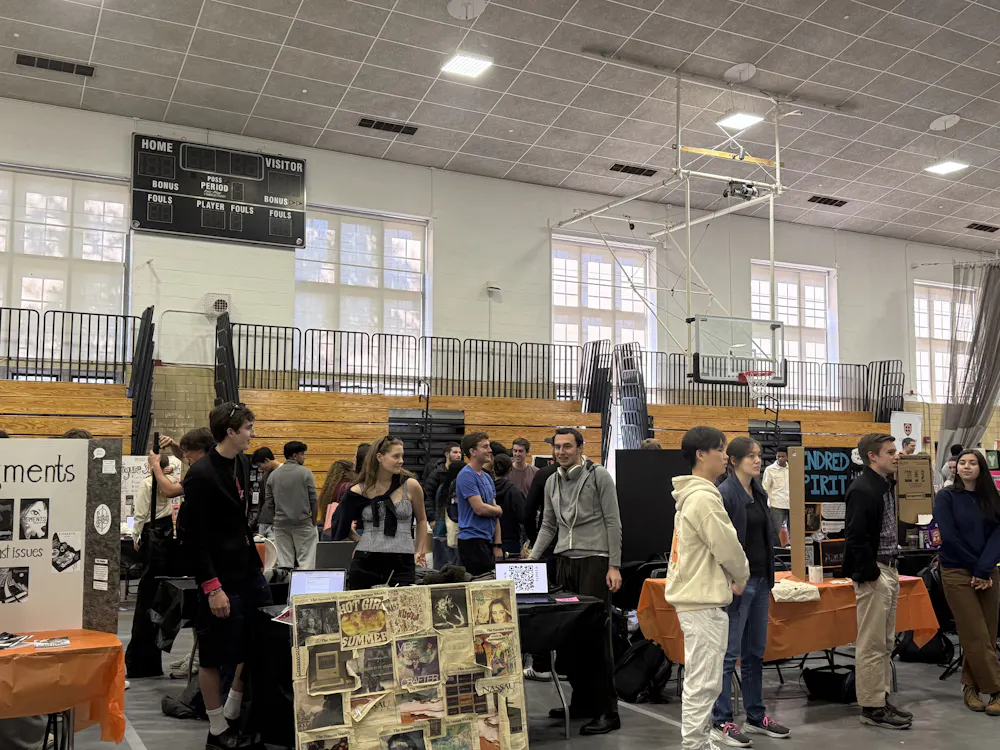
Students share mixed reactions as mandated officer and treasurer trainings return to in-person format
David EstradaThe University's student organization officers and treasurers returned to mandatory in-person training this fall after years of online sessions. Student reactions found parts of the training redundant or tedious, though most agreed the sessions were important.
The University's student organization officers and treasurers returned to mandatory in-person training this fall after years of online sessions. Student reactions found parts of the training redundant or tedious, though most agreed the sessions were important.