



Nader Al-Naji ’14 was getting on a flight to Turkey with his wife in summer 2024 for his first family vacation in years when he was arrested by the FBI. He was then charged by the Department of Justice and the Securities and Exchange Commission for crypto fraud.
“I’m getting on the airplane, and these FBI agents are like, ‘Hey, we are arresting you.’ And I’m like, ‘What the hell is going on?’ It shocked me,” Al-Naji told The Daily Princetonian four days after the charges were dismissed with prejudice. “The following Monday, the Wall Street Journal’s writing about it — everybody’s writing about it.”
After a joint stipulation filed on March 12 by the SEC, all charges related to crypto fraud against Al-Naji have been dismissed. This follows the DOJ charges being dismissed last February.
Al-Naji was a B.S.E. Computer Science major and a member of Princeton’s men’s lightweight rowing team. He has previously worked for the D.E. Shaw Group and Google, and founded Basis, an AI accounting system.
Two summers ago, the SEC announced that the agency was charging Al-Naji with the misuse of investor funds and inaccurately portraying his social media platform, BitClout, as a decentralized project with “no company behind it … just coins and code.” BitClout went viral with the “Creator Coins” feature, featuring celebrities like Logan Paul and Katy Perry.
According to the SEC, Al-Naji had raised over $257 million from investors, stating that the funds would be going towards compensating himself and other BitClout employees while allegedly using $7 million of these funds for his own personal conveniences.
Additionally, the SEC’s complaint alleges that Al-Naji launched the project under the pseudonym “Diamondhands” in order to avoid “regulatory scrutiny.”
These actions, according to the SEC’s investigation, had violated the registration and anti-fraud provisions of the Securities Act of 1933 and the anti-fraud provisions of the Securities Exchange Act of 1934.

According to Al-Naji, the claims were entirely unfounded: “Literally anyone who I talked to is someone who backed me with my last company, who I’m on great terms with.”
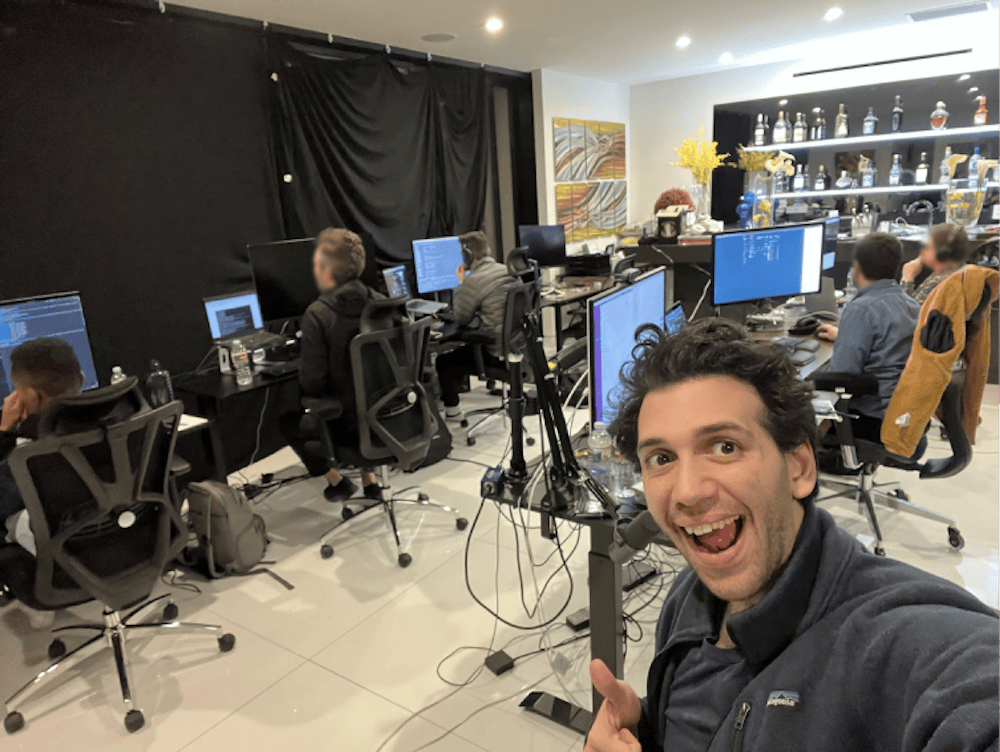
The money that he had been accused of misusing had been used to rent out a “big house” which he and his team had lived out of and coded BitClout in. Further, the pseudonym “Diamondhands,” he explained, had been used to preserve the nouveau, avant-garde industry of crypto.
“When we launched publicly, we just thought it would be cool, kind of like how Bitcoin has an anonymous founder,” Al-Naji said. “So we didn’t do any press. We didn’t do anything. We just shared a link to all the people that we knew, and they started sharing it virally.”
That was six months before Al-Naji and his team began openly sharing his name in communications with users on the platform.
He explained that the DOJ had talked with one investor in the wake of the government’s shift to investigating cryptocurrency. In Oct. 2021, the government created the National Cryptocurrency Enforcement Team (NCET) to double down on efforts to investigate and prosecute criminal misuse of digital assets. The NCET was disbanded in April 2025 by the Trump administration.
Al-Naji’s first move following his arrest, after posting bail, had been to get in contact with this investor, whose identity he ascertained from the context provided by the DOJ.

“Immediately after the charge, I got in contact with them [the investor] and realized that not only were they not upset, but they wanted the government to stop harassing them as badly as I did,” Al-Naji told the ‘Prince’ in a statement clarifying the legalities of the case. “The government had compelled the investor to do an interview and then taken their completely neutral testimony and represented it as adversarial.”
“It was an alleged fraud with no actual misrepresentation nor any actual aggrieved parties,” he added.
The DOJ declined to comment beyond the document announcing the dismissal of Al-Naji’s charges. The SEC did not respond to a request for comment.
“Not only am I on great terms with [the investor], but I had breakfast at their house not that long ago,” he said. “They did not want to have one of their portfolio companies dealing with something like this, especially one that they have a good relationship with.”
Al-Naji did not reveal the identity of this investor, but emphasized that the government’s “star victim doesn’t identify as a victim.”
His experience with these two federal agencies, Al-Naji alleges, exposes flaws in the federal government’s pursuit of crime — who he alleges are “almost removed from actually fighting crime.”
He explained the process defending himself up until this point as complicated and tedious — “like the worst customer service interaction ever.” For Al-Naji, the process involved “explaining to them the facts and how ridiculous those facts are,” while “the person doesn’t get it, or they’re just they’re not really listening to you.”
Furthermore, his experience indicates a de-centralization of the government that punishes more than it helps, he alleges.
“It’s funny how bureaucratic the government is … you would think the government is pretty put together: If they bring a case, then it’s really a lot of people who looked at it and thought really hard about it, and that's not really how it is,” Al-Naji said. “It’s more decentralized — someone in some office can think they have something and do a lot of damage with that thought, until eventually someone you know who really thinks about it and takes the time to look at it reverses the decision.”
At one point, he shared that his lawyer was in a room pleading the case against “20 to 30” SEC employees.
Al-Naji shared, however, that the experience has shown him a Princeton community that is, as he put it, “strangely loyal.”
Although he has not been invited back to give lectures since the charges were levied in 2024, Al-Naji shared that “everyone I know, the professors I’m friendly with, and my alumni who I know, and also even people who I haven’t talked to in a long time, reached out and said, ‘This is ridiculous. I know you’ll get through this.’”
“The Princeton community was really supportive … in a way that even though they didn’t know the actual situation, they knew that something was off with what the government was saying, which was great,” he said.
Now, Al-Naji is excited to move past the case.
DeSo, the rebranded version of BitClout, is currently active. In addition, Al-Naji shared that his team “is still here, and we’ve been working on some interesting stuff that we’re going to announce probably in the next few months.”
“Not being distracted anymore… is really amazing,” he added.
Al-Naji and his wife went on their trip to Turkey shortly after the DOJ dismissed his case in 2025.
“Not even one week later, I was in Bozön in Turkey. We were excited to celebrate, and we didn’t waste any time, man. We just were like: This is great. Let’s go.”
Luke Grippo is a head News editor for the ‘Prince.’ He is from South Jersey, and typically covers high-profile interviews and University and town politics. He can be reached at luke.grippo[at]dailyprincetonian.com.
Please send any corrections to corrections[at]dailyprincetonian.com.
Editor’s Note: The abstract for the piece has been lightly updated to reflect that the nature of the dismissal of the charges was not an exoneration. Additionally, the piece has been lightly updated to clarify what a decentralized project is referring to.
A correction was made on March 23, 2026: A previous version of this article contained a claim that the DOJ charges against BitClout were dismissed last March, citing Al-Naji. The charges were actually dismissed last February, and the article has been updated with this information.
Read More

Princeton University Orchestra and men’s ultimate frisbee team named in University’s latest hazing report
Andrew ArthurTwelve students in the Princeton University Orchestra and Men's Ultimate Frisbee team were found responsible for hazing violations in the University's latest Campus Hazing Transparency Report. Sanctions ranged from Dean's warnings to disciplinary probation.
Twelve students in the Princeton University Orchestra and Men's Ultimate Frisbee team were found responsible for hazing violations in the University's latest Campus Hazing Transparency Report. Sanctions ranged from Dean's warnings to disciplinary probation.

Murray-Dodge Café celebrates 50th Anniversary, drawing over 260 students
Hifza KaleemOn Wednesday, Murray Dodge Cafe celebrated its 50th anniversary, drawing more than 260 students to celebrate with free cookies and merchandise.
On Wednesday, Murray Dodge Cafe celebrated its 50th anniversary, drawing more than 260 students to celebrate with free cookies and merchandise.
Students share mixed reactions as mandated officer and treasurer trainings return to in-person format
David EstradaThe University's student organization officers and treasurers returned to mandatory in-person training this fall after years of online sessions. Student reactions found parts of the training redundant or tedious, though most agreed the sessions were important.
The University's student organization officers and treasurers returned to mandatory in-person training this fall after years of online sessions. Student reactions found parts of the training redundant or tedious, though most agreed the sessions were important.