



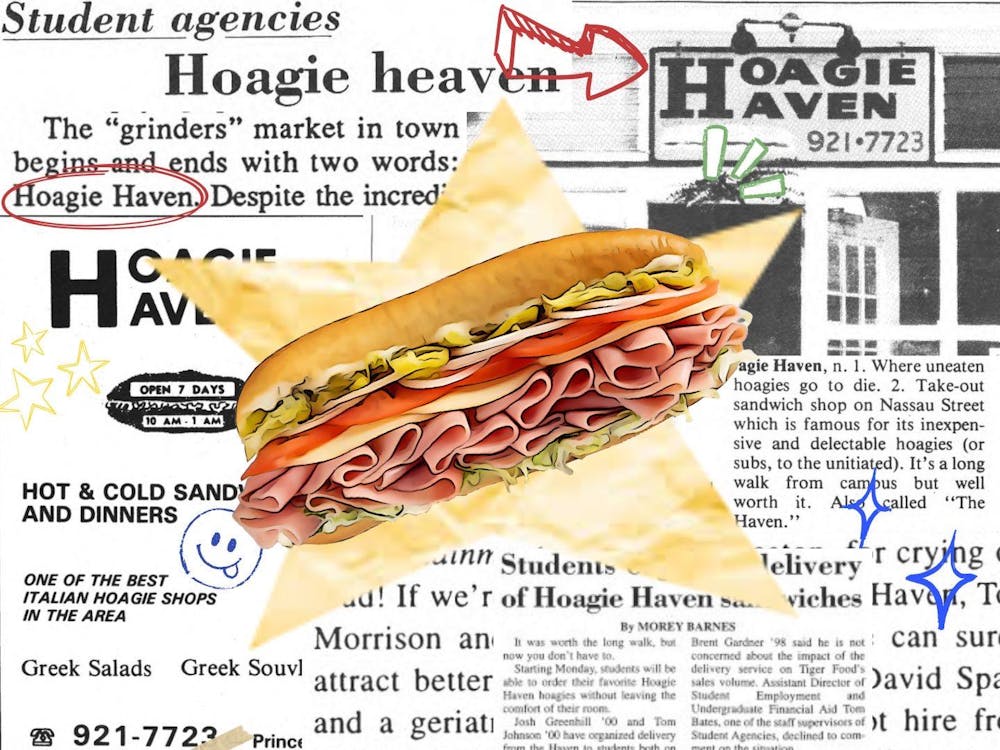
It’s not a sub. It’s not an Italian sandwich, or a grinder, or a wedge, or a hero. And definitely don’t call it just a sandwich.
For more than 50 years, Princetonians have turned to a little shop far down on Nassau Street as the signature spot for sandwiches loaded with sliced deli meat, gooey cheese, lettuce, tomatoes, onions, and even mini tacos — hoagies, in distinctly south-central Jersey parlance. A Hoagie Haven sandwich was a delicious, affordable, grease-stained offering for students at all hours of the day and night, whether they were crawling out of Firestone Library or stumbling out of a drunken reverie on Prospect Avenue.
“I got homesick, and I was a stranger in a strange land, so I definitely took comfort in [Hoagie Haven]. And it was bad for you, but it was good for the soul,” Roben Farzad ’98 told The Daily Princetonian.
But over the years, Hoagie Haven has had to contend with stiff competition. Students can now satisfy their late-night cravings at Frist Campus Center, Butler College’s Studio 34, or Wawa clear on the other side of campus. After the family-owned shop cut hours over the pandemic, the flood of student customers has slowed to a trickle. And having hiked their prices, “The Haven” is no longer a budget-friendly option for students to escape the high costs of Nassau Street.
“We’re not that late-night stop anymore. I think Wawa is really winning there,” current Hoagie Haven co-owner Niko Maltabes said.
Traditional town staples like The Haven are falling to newer, trendier alternatives. Alfalfa, opened in December 2024, and has quickly asserted itself as a dominant player in the Nassau Street food scene. Its popularity seems to mark a wider trend of students favoring healthy options over the comfort of a foot-long hoagie, leaving places like Hoagie Haven behind for nostalgic alumni. Has The Haven simply fallen victim to college town gentrification?

Malia Gaviola / Daily Princetonian
The era of the ‘Hoagie men’
When Hoagie Haven opened its doors to the Princeton community in 1974, the hoagie was already a beloved staple within the student diet. Prior to The Haven, a Princetonian could enjoy the Philadelphian delicacy from A&S luncheonette, Aljon’s, or from one of Princeton’s many “Hoagie men” that roamed campus.
The Hoagie men were employees of the “Hoagie Agency,” started in the early 70s by Peter Joseph ’72, who already had the Student Weenie Agency, which sold hot dogs out of a New York-style cart. Armed with a combination of tuna, Italian, and cheesesteak hoagies supplied by A&S luncheonette and a styrofoam cooler, the “Hoagie man” covered campus from 9 p.m. to 1 a.m.
“Everybody ended up kind of developing their own shtick when they would go out and sell, whether they would sing or chant poetry or hurl invectives,” recalled Michael Rodemeyer ’72, the manager of the Hoagie Agency in 1971. “Whatever was needed to kind of get people out.”
Rambunctious “Hoagie men” would serenade the campus, yelling “Take them [hoagies] to bed with you,” and “Pet them. Make them your friends.”

When it opened in 1974, Hoagie Haven was quickly deemed by a ‘Prince’ reviewer to be superior to its primary competitor (and supplier of the Hoagie men) A&S Lunchonette. Hoagies had cost around $2, and Hoagie Haven was open from midday to 2 a.m. on Mondays to Saturdays and 1 a.m. on Sundays. Its late hours quickly earned praise from students: “One of its chief virtues is that it stays open until 1 a.m.,” lauded the ‘Prince.’
The Hoagie and Weenie Agencies, however, quickly faded into the abyss of hoagie history. The two agencies merged in 1976 and began making sandwiches in the Edwards kitchen. The following year, the Agency stopped selling hoagies and refocused its attention on Weenies.

Malia Gaviola / Daily Princetonian
The rise of Hoagie Haven
Despite the ‘Prince’ ranking Hoagie Haven’s cheesesteak as only the second best in town, behind The Athenian, by the early 80s, Hoagie Haven had solidified its place on Nassau Street as a go-to for students.
Andy Russell ’82 recalled the particular significance of The Haven for Princeton engineers. Russell noted that indulging in a hoagie was one of the few options available late at night. Spending all hours of the night in the E-Quad, when people would start to get hungry, Hoagie Haven was close and convenient spot.
In 1988, ‘Prince’ writer Craig Stuart captured how Hoagie Haven quickly became a Princeton staple. “For many Princeton students, Hoagie Haven is as much a part of their college experience as Firestone Library or the eating clubs,” he reported. George Roussos, the co-owner of Hoagie Haven at the time, was such an integral part of Princeton life that he received an honorary membership from the Class of 1988 on Class Day.
Another part-owner and Roussos’s cousin, George Angeletopoulos, attributed the loyalty and popularity of the establishment “to efforts by The Haven to keep quality high and prices low.” At the time, a full-sized hoagie measured 15 inches long and cost a little over $3. Stuart fondly noted that if you referred to your order by the corresponding number on the pinboard menu, you signaled you were a regular.
But Hoagie Haven had not yet cemented its status as the chosen carbohydrate to soak up the beer of the Street. At the time, it only stayed open until 1 a.m. Instead, it offered a comforting meal all day long, rain or shine, for both the late night studier and mid-day snacker. One cold and rainy New Jersey day, Stuart and friends even suited up in ski goggles and a jacket to bike and head out on a hoagie run for everybody.

Malia Gaviola / Daily Princetonian
Hoagie’s Hey-Day
By the 1990s, Hoagiemania hit its stride. In October 1990, B. Curtis Williams ’91 and Douglas Anderson ’91 started “Cutting Edge,” a delivery service solely dedicated to Hoagie Haven. Anderson and Williams bought from Haven as regular customers, took orders over the phone, and delivered the hoagies all over main campus and to the eating clubs.
The venture was extremely successful, and the duo made $80–150 a night despite an official, competing fast food student agency delivering hoagies from The Athenian, Hoagie Haven’s onetime cheesesteak competitor. Without the deterrent of a long walk, students placing delivery orders added 40–60 extras to Hoagie Haven’s regular 150–200 walk-in orders each night.
At the time, Williams attributed the success of their venture, despite the competition, to The Haven’s reputation. “I remember in my freshman year, everybody was just nuts about it. We also have the best service, 20 to 30 minutes.”
Just a few months later, the success of the Cutting Edge caught up to the entrepreneurial pair, and Angeletopoulos, overwhelmed by the additional orders, shut down the delivery business. Luckily, students remained willing to make the trek and still viewed the store as central to their Princeton experience.
Will Borden ’94 recalled going there late at night. “[After] nights when we were out at the Street, we’d go there and order cheesesteaks … the lines were long whenever you got there,” Borden said.
In a 1995 report on town dining, the ‘Prince’ described The Haven as reigning supreme over the town as the best late-night study snack. “By whatever name you call them — hoagies, subs, heroes or grinders — The Haven’s sandwiches are enormous and cheap.” Compared to rival restaurants, Hoagie Haven was lauded as cheaper and heftier.
That was a key focus of Angeletopoulos, who told the ‘Prince’ in 1996 that his goal was to keep prices low.
“Anybody can go to the business, you see. Some people put the prices high on Nassau Street, but we know the students don’t handle a lot of money, so we like to care for them,” he said. Then, he said he had only changed the prices three times since opening in 1974.
“It was a machine, and it was just so cheap, we’re talking ’94 to ’98 but it seemed to have 1970s pricing,” said Farzad, who wrote the profile. “It defined us, and it connected us … If you say the word salt-pepper-ketchup-mustard, everybody would know,” he said, referencing the classic combination of hoagie condiments customers could choose from.
Hoagie Haven also established itself as the premier stop for late-night food, despite the opening of other late options like Wawa and Victor’s Pizza, a shop on Nassau Street.
The restaurant had a cult following, as the ‘Prince’ wrote in 1997: “The legendary eatery is known to have denizens who eat there three times a day. But be careful, if the stories of the students who contracted scurvy after eating nothing but chicken parms while on campus for fall break are true, you can have too much of a good thing.”
In 1998, student delivery of Hoagie Haven reemerged on campus with the Hoagie Haven Delivery Agency, started by Tom Johnson ’00 and Josh Greenhill ’00. To establish their business, Greenhill and Johnson approached Angeletopoulos and asked to put a phone line in the back of the restaurant. Just like its predecessor, Cutting Edge, with students answering the phone and employing drivers with cars on campus to deliver the food to campus, Hoagie Haven just had to make the sandwiches. Greenhill noted that the agency “made a little bit of margin on the food and then the drivers basically worked for tips.”
Greenhill recalled having 50 orders on the first night of the venture and Johnson remembers being “very busy for the short period of time that it was in existence.” The Agency closed after a few years, but Greenhill attributed the short-lived widespread success of his venture to Hoagie Haven itself: Hoagie Haven was “part of the fabric of the University.” “It wasn’t anything we did that was special,” said Greenhill. It was simply The Haven.
Missing from the delivery service, though, was the community: “There was a social aspect to Hoagie Haven, meeting people there, sitting on the benches outside, getting it on the way to or from the street,” Johnson recalled.
By 1998, co-owner Gus Liras estimated that half of his business came from the University.

Malia Gaviola / Daily Princetonian
Changing of the guard
Throughout the early 2000s, the shop continued to be a hallmark of the Princeton student experience, even with a change in ownership in 2005 when current co-owners Niko Maltabes and his brother Costa Maltabes took over from their uncle.
“I was able to make good friends with all the staff over the course of those four years. They certainly knew me by name when I was a junior and a senior,” Sándor Kovács ’07 recalled. An engineering student, he included Hoagie Haven in the dedication page of his senior thesis.
In a 2002 review of the Best Food in Princeton, the ‘Prince’ characterized The Haven as a Princeton cornerstone.
“Spending four years at Princeton without ever going to Hoagie Haven is like graduating without ever going to a football game. It can be done, but you’d be missing out on more than chicken parm and the occasional touchdown,” the reviewers wrote.
But The Haven’s star status was beginning to slip. The reviewers awarded Olives, which opened in 1995, the title of best “Sandwich” with “quality ingredients, quality presentation.” Hoagie Haven did not snag the title of best late-night haunt either, with Wawa earning the honor “for its cornucopia selection.” The Haven, with a 12-inch chicken parm costing less than $5 and late hours, received the titles of “Student Friendly” and “Place to go on a Tight Budget.”
In 2008, the Princeton University Store reopened, selling healthier alternatives like fruit cups, yogurt, and hummus. Following the opening of Butler College’s Studio 34 in 2009, students living down campus also found a new, more convenient late-night option. Studio 34 joined Frist Late Meal, which opened in 2000.
Wawa also served as “an additional option for students craving late-night snacks.” Its pastries, hot hoagies, and drinks drew students to the franchise. In 2010, a Wawa roast beef and American cheese hoagie cost $5.19, while the meatier, larger 12-inch Hoagie Haven steak sandwich cost $6.00.
Hoagie Haven's menu in the 2000s included 'fat sandwiches' like the Phat Lady, a cheesesteak featuring mozzarella sticks, french fries, ketchup and hot sauce, and the “Sanchez” made with chicken tenders, mozzarella sticks, fries, cheese, and a special sauce. In 2012, the ‘Prince’ published “Street vs Hoagies: Street staffers sample Hoagie Haven’s finest and fattest.” Writer Sara Wallace wrote a “Haven” review on “El Mexicano,” a cheesesteak stuffed with chicken tacos, sour cream and hot sauce. In a recent interview with the ‘Prince,’ while she recalled her now-husband going to Hoagie Haven after the Street, Wallace preferred to go to the much closer Frist Campus Center if she wanted greasy, take-out food. Despite her positive review of the tasty, artery-clogging hoagie, Wallace reflected, “I honestly cannot believe that someone’s ordering a taco in a sandwich.”
Despite Frist, Studio 34, and Wawa all remaining open late, students and tourists thought of Hoagie Haven as the leader in affordable, after-hours eats. The late-night student crowd still made up 20 percent of Hoagie Haven’s business, even with competing options and a seeming shift to prioritize healthier eating.
In the 2010s, the shop was grappling with increasing competition, the draw to maintain tradition, and small modernizing changes. The Maltabes brothers started an active Twitter and Facebook for the store and featured innovations on their menu, serving “novelty hoagies piled high with fries, mozzarella sticks and chicken tenders.”
Despite those innovations, students were starting to raise eyebrows at the distance of the shop, especially with respect to the other options on campus. In 2015, the Prince published a “Frosh Food Guide for Under $10,” lauding Hoagie Haven as the affordable “Princeton classic,” but also “an unfathomable distance from Princeton civilization.”
Despite the changing food scene on campus, Hoagie Haven in the 2010s was still open late, remained remarkably affordable, and served giant portions. On The Haven, the Frosh Food Guide wrote: “Often the ultimate destination for a night on the Street, Hoagie Haven is open really late. Also, buy a half-sub, not a full. Trust us, it’s plenty of food. We wish the best of luck to your arteries. Subs start at $5.50.”

Malia Gaviola / Daily Princetonian
Who still goes to Hoagie Haven?
The decline of Hoagie Haven’s popularity on campus was cemented by the pandemic. Despite maintaining its visual old-school charm, the shop has raised prices and now closes its doors by 10 p.m. on weekdays and 12 a.m. on weekends. The cost of a whole hot hoagie now ranges between $13.79 for a meatball parm to $22.99 for The Haven’s specialty “Wake-Up Call” cheesesteak with bacon, eggs, pork roll, and hash browns.
In 2020 and 2021, the ‘Prince’ First-Year Dictionary referred to Hoagie Haven as a “Princeton institution.” It further describes the establishment as a “small Hoagie shop on Nassau Street that serves sandwiches filled with things like french fries, chicken tenders, multiple burger patties, and buffalo sauce, often in combination. The most dangerous of drunk food destinations.”
Yet following the reduced hours from the pandemic, things began to subtly change. The First-Year Dictionary in 2022 and 2023 continued to denote Hoagie Haven as a “Princeton institution” but noted the “earlier closing times” and said it was “tied with Wawa for the most dangerous of drunk food destinations.”
In the Senior Survey 2025, only 0.6 percent of the Class of 2025 said that Hoagie Haven was their favorite late-night meal option. Wawa — the favorite of 34 percent of seniors — was the most popular.
Niko Maltabes, one of the current owners, acknowledged this shift. “We’re not that late-night stop anymore. I think Wawa is really winning there.” He said he believes this is likely due to the decrease in hours of operation since the pandemic. Currently closing at 12 a.m. on Saturdays and Sundays, fewer students populate the store after nights out.
Now, local town residents comprise the majority of Hoagie Haven’s customer base.
Steven Feng ’27 is one of the few student regulars at the shop, trying to go at least once a week. He attended the Hun School of Princeton, a nearby boarding school which he said was the beginning of his love for Hoagie Haven. Feng grew up in China and said going to high school in Princeton was an adjustment for him.
“I felt that [Hoagie Haven] was my way into American life, in a way,” Feng said. “It was very different from what I was used to, but I still loved it.”
Hoagie Haven became an instrumental part of Feng and his friends’ high school experiences. His habit of frequenting the shop has carried into his college life, but while attending Princeton, he noticed that significantly fewer of his college peers visit the store than town locals.
“I see a lot of regulars that are not students,” Feng said. He largely attributes this fact to students being unwilling to walk the half-mile all the way to the store from campus. Feng said, “If it were [closer] and everyone saw it, people would go more often.”
Like Feng, Hadley Hempel, a 43-year-old marketing executive who grew up in Princeton, has a relationship with Hoagie Haven dating back to high school. Hempel attended Princeton High School and recalled that back then, Hoagie Haven was very popular among kids. “I don’t live here anymore, so I’m in town visiting. [Hoagie Haven] is on the bucket list anytime I’m here,” she said.
Some faithful alums still make the occasional appearance at The Haven, too. Keith Wilbur ’96, who now coaches the Santa Clara men’s water polo team, returns to Princeton annually. Almost every year, his team travels to Princeton for a tournament in early September. Without fail, Wilbur brings the team to Hoagie Haven after their last game.
“So there are guys at Santa Clara walking around with Hoagie Haven t-shirts because they all love going there,” Wilbur said.
So, where have all the hoagies gone? They’re still there, awaiting their revival.
While the old-school charm of Hoagie Haven remains, its popularity in the University community has undoubtedly decreased over the past decade. The store used to be a hub of student culture, dominating the late-night scene following weekend activities on the Street or fueling engineering students studying late into the night in the E-Quad. Now, the existence of closer alternatives, less competitive pricing, and the Covid-related change in hours has diminished its appeal for many students.
“Whenever I go out with my friends, we are always headed to Witherspoon Street, so no one really goes to Hoagie Haven,” said Helena Purves ’28.
Although Hoagie Haven is now less frequented by students, it remains popular among town residents and is still a celebrated institution in the town of Princeton.
“Professors, students, town workers, the garbage man, we serve everybody,” Niko Maltabes said.
But today, students are definitely a lesser percentage of that “everybody.”
Ask a friend: have you ever been to Hoagie Haven before? Purves’s answer is “No, I have never gone.” Today, it seems that most students have not experienced the gut punch experience that is a full-size hoagie from The Haven. But that’s not to say they never will.
Jillian Ascher is a head Archives editor for the ’Prince.’
Mara DuBois is a contributing Features writer for the ’Prince.’
Please send any corrections to corrections[at]dailyprincetonian.com.
Correction: A previous version of this piece said that the Phat Lady and The Sanchez first appeared on the menu in the 2010s. In fact, the Phat Lady was featured on the menus early as 2004. The Sanchez was adopted in the mid-late 2000s. The ‘Prince’ regrets this error.