



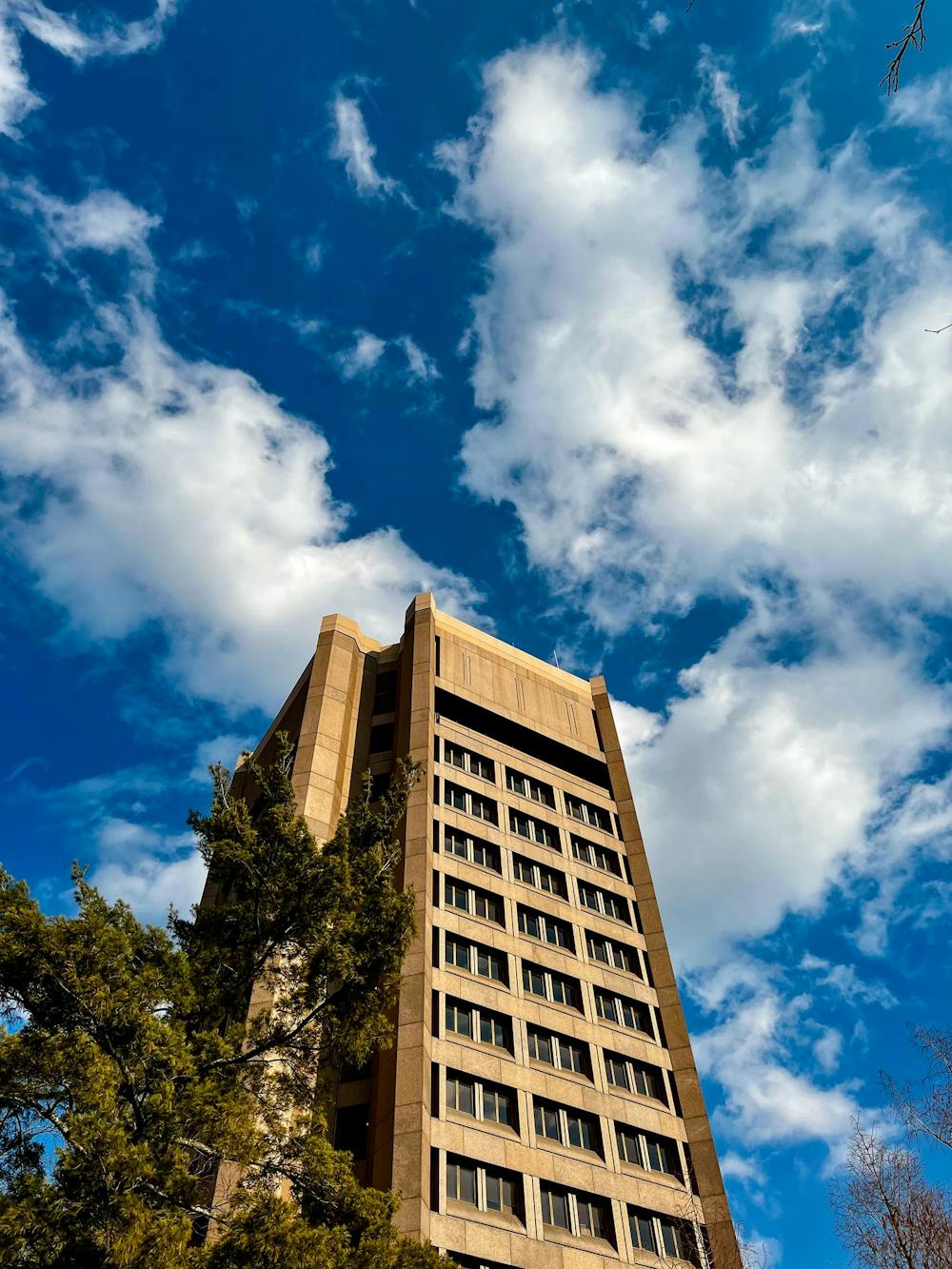
In the skies above Princeton’s campus, peregrine falcons have been spotted near Fine Hall for almost a decade. Now, Diego Segura ’27 is leading an initiative to provide nest boxes for the birds.
Segura, the co-president of Princeton’s Conservation Society, has been working on creating a nest box for these birds since last summer. The idea began in his conservation biology class last spring when his professor mentioned wanting to see the falcons nest.
“I thought, ‘well, why not? Let’s get this done,’” Segura told The Daily Princetonian.
So far, the project has been in the process of getting permission from the University, as well as the companies that have antennas on top of Fine Hall, such as AT&T and Verizon. The nest box looks and is sized similarly to a dog house and would provide a space for the falcons to safely lay their eggs on Princeton’s campus. It would also provide a space for scientists and curious students to observe the birds from windows or cameras.
In 2019, before his passing, Professor Henry Horn worked alongside the Office of Sustainability to film a video of a falcon on top of Fine Hall. Horn was known for leading nature walks to involve the community with the birds. Since then, there have not been any efforts to preserve these birds.
Peregrine falcons — the fastest animals on earth — are drawn to high buildings, typically in urban areas. Fine Hall is the tallest building on Princeton’s campus, standing at about 170 feet, making the University a potential hotspot for peregrine falcons. The falcons were first spotted in 2014 near Fine Hall, according to EBird, an online bird tracking service.
“You see these urban areas have these higher entities of the species, because they really like living high up so they can see a lot of the species they want to eat,” Segura told the ‘Prince.’
Still, understanding where the falcons are coming from is difficult. The falcons are mostly spotted in pairs or individually. Because the birds do not have tracking information, it is difficult for birdwatchers to know if these are the same two birds that they see every year, or if there are different ones each time.

“They’re pretty high, and I’ve never seen one actually land. But if you’re on the 12th floor, you can make one out pretty decently,” said Jack Leventhal ’28, a prospective Mathematics major who frequents the 12th floor of Fine Hall.
Peregrine falcons typically nest in the spring, but the location of where they currently nest is unknown. Segura speculates that they could either migrate from far away and nest there or that they lay their eggs somewhere close to Princeton.
If successful, Segura hopes the nesting box will be a place of community for Princeton. He hopes to involve the student body by installing a live camera showing the falcons nesting once the box is set up. While the cameras would not be used for research, they would provide a rare opportunity for people to watch peregrine falcons nesting on Princeton’s campus.
“I think it’s so important that people engage, so one, they know about it, and two, they feel connected to it. Having [the falcon nest] in Princeton would be super amazing,” Segura said.
Segura hopes to install the box in February or March next year, just in time for nesting season.
Clara Docherty is a staff News writer for the ‘Prince.’ She is from Lafayette, N.J., and typically covers campus clubs and institutional legacy. She can be reached at clara.docherty[at]princeton.edu.

Please send any corrections to corrections[at]dailyprincetonian.com.
Read More

New Indigenous mosaic unveiled in University Chapel
Lucy HarperThe University Chapel welcomed a new mosaic by Marianne Nicolson over the summer. The artwork, titled “Presence,” incorporates traditional Native American motifs.
The University Chapel welcomed a new mosaic by Marianne Nicolson over the summer. The artwork, titled “Presence,” incorporates traditional Native American motifs.

PSafe report shows decrease in liquor violations, includes new hazing data
Joshua KimPrinceton’s 2026 Security and Fire Safety Report showed that motor vehicle theft continued to be the most reported crime in Princeton. It also shows a continued decline in liquor law violations, and an increase in drug referrals since 2025.
Princeton’s 2026 Security and Fire Safety Report showed that motor vehicle theft continued to be the most reported crime in Princeton. It also shows a continued decline in liquor law violations, and an increase in drug referrals since 2025.

What’s funny anymore? On comedy with Jack and Jack
Lola HorowitzJack Goodman ’27 and Jack Musser ’27 are host and co-host for Season 15 of All-Nighter, Princeton’s student-run late-night talk show. They reflect on what makes their partnership effective, their approaches to comedy, and the state of comedy in the political climate.
Jack Goodman ’27 and Jack Musser ’27 are host and co-host for Season 15 of All-Nighter, Princeton’s student-run late-night talk show. They reflect on what makes their partnership effective, their approaches to comedy, and the state of comedy in the political climate.