



We all got into Princeton. The ordeal of college admissions was stressful enough for all of us, but an unsettling new book reveals just how unfair the process can be.
Jerome Karabel, a sociology professor at Berkeley, takes a dive into the oft dicey world of college admissions with his mammoth study, "The Chosen: The Hidden History of Admission and Exclusion at Harvard, Yale, and Princeton."
Weighing in at a hefty 557 pages, one wonders whether Karabel's book leaves anything "hidden" at all. For leisurely reading, the book is simply too long. In the sheer number of hours it would take to read, an industrious traveler could probably stage a marathon tour of the 'Big Three' — a term coined for Princeton, Harvard and Yale (or HYP) during their heyday of football power.
But length aside, there are reasons why the already overextended Princeton student should leaf through sections of this book.
As a whole, Karabel's work explores the history and evolution of selective admissions at the Big Three. The admissions process should be of concern to Princetonians past and present; it is the reason we go to school here and it will determine who will join us. The caliber of students has as much to do with defining Princeton as its outstanding faculty and incredible endowment.
But how, precisely, does one determine caliber? That is the underlying question of this book. Karabel looks at the ever-shifting criteria for entry and what he has to say about past standards should prove unsettling to the modern undergraduate.
A significant proportion of the book deals with how, during the first part of the 20th century, HYP addressed the "Jewish problem" — the concern among administrators that the Big Three were enrolling too many Jews.
Today's application system — the well-known ordeal involving evaluations of extracurriculars, essays, interviews and recommendations — is in many ways a legacy of past attempts to exclude Jews. When 'character' evaluations were adopted to supplement exams scores and grades, they appealed to firmly entrenched WASP notions of personal excellence and, in practice, rejected many qualified Jewish applicants.

And the exclusion certainly didn't stop there. In a series of clear mini-histories, Karabel navigates the changing tides of admissions regarding race and coeducation.
Yet Karabel's most startling insight comes not from the outline of past injustices in the system, but from a sobering observation of admission processes today. There's a very real sector of society missing from the Big Three but one that might not be obvious at first: a mere three percent of students at selective colleges come from families in the lowest socioeconomic quartile.
"Class-based affirmative action programs ... would be a useful first step," Karabel writes. But any real change will have to come through a "reassessment of the very meaning of 'merit' " that, he charges, will be the responsibility of this generation, our generation.
Still, "The Chosen" holds value beyond its status as an institutional critique. Karabel peppers the larger history with smaller profiles of figures in admissions that are a pleasure to read; a biography of Harvard's president emeritus James Bryant Conant deserves particular note.

Also, chapters specifically on Princeton would interest even the casually engaged Princeton student. As we finish up Bicker season for another year, Chapter 10, titled "Tradition and Change at Old Nassau" should be required reading.
In 1958, Harvard reporter John McNees wrote an article called "The Quest at Princeton for the Cocktail Soul," detailing his experiences with what he called "Dirty Bicker." That process appears, from the outsider's perspective, to have been a very cruel system.
It would be neither pleasurable nor reasonable to add the full 557 pages of "The Chosen" to your spring reading load but if you rifle through the book, you will learn that Old Nassau has more than a few skeletons in its closet.
Pros: Chapters 10, 13, and 14 are, respectively, "On Princeton," "Racial Conflict," and "Coeducation"
Cons: Length
Read More
Terence Tao GS ’96 receives James Madison Medal for mathematical contributions
Aitana CamponovoPrinceton awarded the James Madison Medal to Terence Tao GS ’96 at Alumni Day last month, recognizing his achievements in Mathematics and advancing the cause of graduate education.
Princeton awarded the James Madison Medal to Terence Tao GS ’96 at Alumni Day last month, recognizing his achievements in Mathematics and advancing the cause of graduate education.

USG meeting kicks off second half of semester with club funding and athletics updates
Gray CollinsHolding its meeting over Zoom due to student travel, USG approved funding for upcoming cultural events, reviewed its spring budget, and shared updates on athletics engagement initiatives.
Holding its meeting over Zoom due to student travel, USG approved funding for upcoming cultural events, reviewed its spring budget, and shared updates on athletics engagement initiatives.
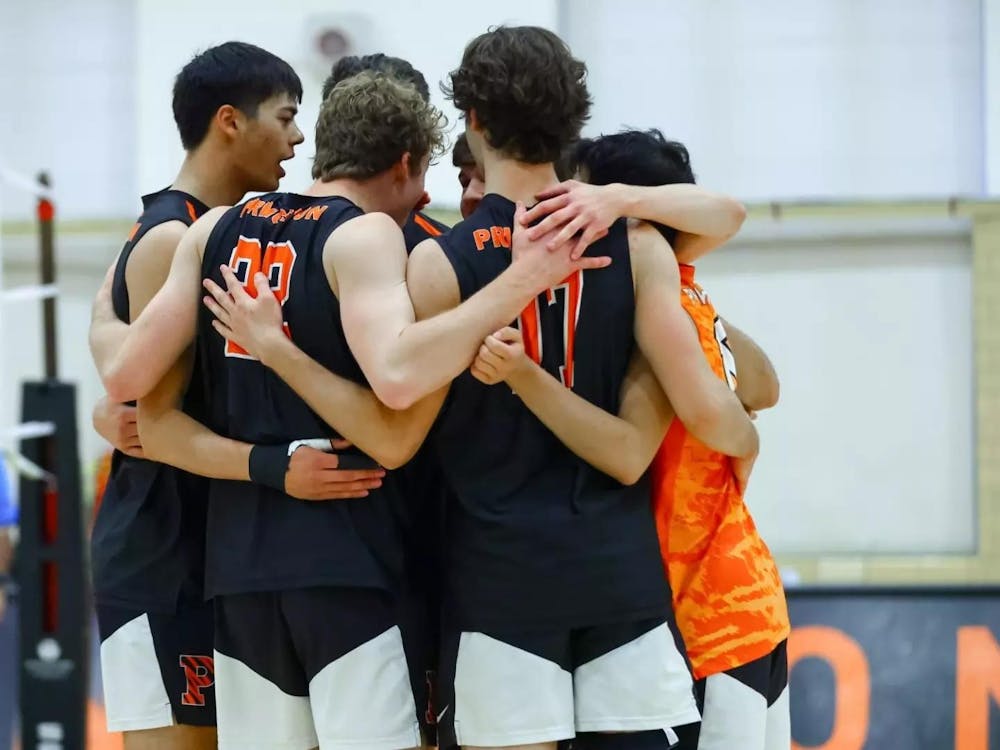
Men’s volleyball cuts its winning streak short after loss to CSUN
Andrew KangPrinceton men’s volleyball ends its road trip with a loss against CSUN.
Princeton men’s volleyball ends its road trip with a loss against CSUN.