



President Tilghman's first semester in office has seen significant turnover among the top officers of the University administration. A new vice president for development has already been named, but seven key administrative vacancies remain to be filled.
Vice President and Secretary Thomas Wright '62 — who was in charge of the search committee that named Brian McDonald '83 the new vice president for development — has been asked by Tilghman to lead the searches to replace Vice President for Finance and Administration Richard Spies GS '72 and General Counsel Howard Ende.
According to Wright, it is natural for there to be turnover when a new president takes over.
"Some administrators typically plan their own careers around the terms of presidents they serve under, postponing retirements that would otherwise take place when they believe that the president will stay another year or so," Wright said in an e-mail. "In other cases, administrators are explicitly asked by a president to stay until the end of the president's term."
Currently, six search committees are working to find replacements for Spies, Ende and the deans of the architecture, engineering and graduate schools and the Wilson School. An additional search committee for a new vice president for human resources will be formed once the new vice president for finance and administration is named.
Each committee is chaired by a faculty member and, according to Wright, aims to have the new appointments finished by June.
According to Provost Amy Gutmann, a search committee typically undergoes a rigorous process to find a new administrator.
"A committee is formed, ads are sent out and the committee spends a lot of time considering the most relevant qualifications for the position," Gutmann said. "The committee typically interviews a set of finalists, deliberates among itself and recommends one or more finalists to the president."

Gutmann said Tilghman is playing a major role in the work of the search committees.
"[Tilghman] has been very active in meeting with all the committees and overseeing the processes for all the searches," she said.
According to Wright, Tilghman works in concert with the University Board of Trustees, though the board typically accepts the recommendation of the president.
"[Tilghman] is directly and intensely involved in all of these searches," Wright said. "In the final analysis, each of the individuals chosen will be by her decision."
There has been more turnover in the transition from former President Shapiro to Tilghman than there was between Shapiro and his predecessor President Bowen. Wright said the numerous simultaneous searches for key administrators are likely the result of a generational transition.
"Presidents Bowen and Shapiro are of the same generation," he said. "There was not a general change of administrators, such as commonly takes place . . . in some measure we are experiencing now, in effect, a postponed such generational transition. A good number of administrators are simply reaching normal retirement ages at about the same time."

Even with the transition and temporary uncertainty, Gutmann said Nassau Hall has been "dynamic" and Wright said he saw much promise for the future.
"This is an exciting time in Nassau Hall — as is the beginning of each new administration," he said. "There is a great sense of expectancy and of renewal."
Read More

Princeton University Orchestra and men’s ultimate frisbee team named in University’s latest hazing report
Andrew ArthurTwelve students in the Princeton University Orchestra and Men's Ultimate Frisbee team were found responsible for hazing violations in the University's latest Campus Hazing Transparency Report. Sanctions ranged from Dean's warnings to disciplinary probation.
Twelve students in the Princeton University Orchestra and Men's Ultimate Frisbee team were found responsible for hazing violations in the University's latest Campus Hazing Transparency Report. Sanctions ranged from Dean's warnings to disciplinary probation.

Murray-Dodge Café celebrates 50th Anniversary, drawing over 260 students
Hifza KaleemOn Wednesday, Murray Dodge Cafe celebrated its 50th anniversary, drawing more than 260 students to celebrate with free cookies and merchandise.
On Wednesday, Murray Dodge Cafe celebrated its 50th anniversary, drawing more than 260 students to celebrate with free cookies and merchandise.
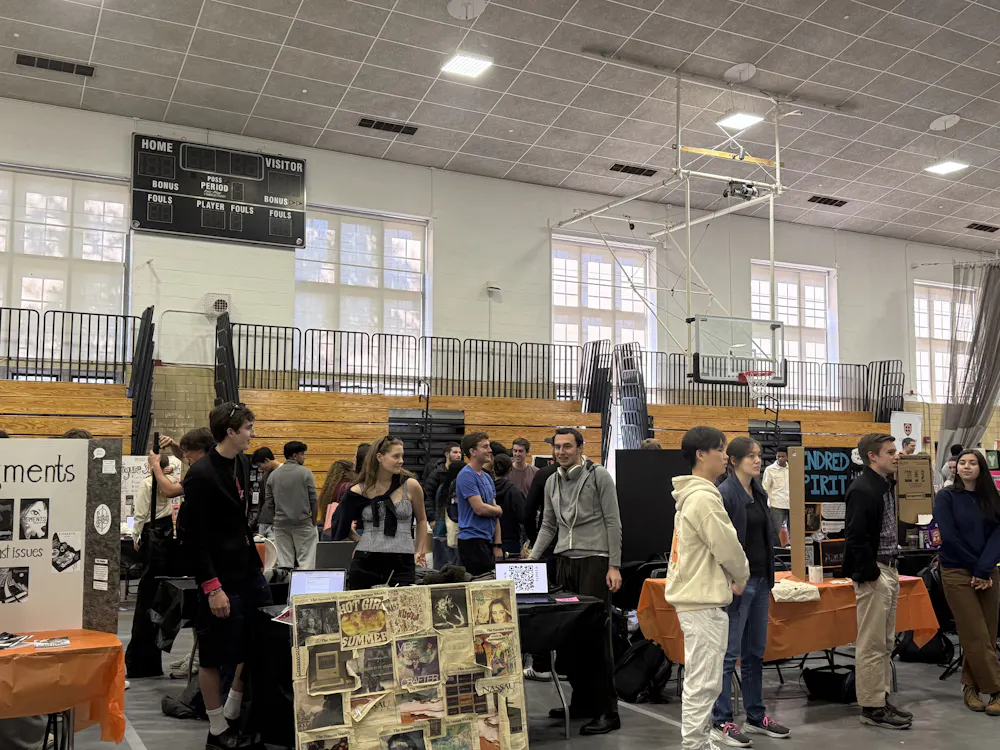
Students share mixed reactions as mandated officer and treasurer trainings return to in-person format
David EstradaThe University's student organization officers and treasurers returned to mandatory in-person training this fall after years of online sessions. Student reactions found parts of the training redundant or tedious, though most agreed the sessions were important.
The University's student organization officers and treasurers returned to mandatory in-person training this fall after years of online sessions. Student reactions found parts of the training redundant or tedious, though most agreed the sessions were important.