



Donald Clayton Spencer, mathematics professor emeritus, died of a heart attack on Dec. 23 in Durango, Colorado. He was 89.
Over the course of his accomplished career, Spencer received several prestigious awards, including the American Mathematical Society's Bocher Memorial Prize in 1948 and the National Science Foundation's National Medal of Science in 1989. The National Academy of Sciences made him a member in 1961, as did the American Academy of Arts and Sciences in 1967.
Spencer completed some of his best-known work at the University, such as his collaboration on the modern theory of deformation of complex structures with Kunihiko Kodaira of the Institute for Advanced Study, located in Princeton.
Perhaps more extraordinary than all his mathematical accomplishments, though, were Spencer's energy, character and compassion.
Born in Boulder, Colo. in 1912, Spencer was an adventurous nature lover who, in the late 1920s, dared to fly small planes over the Rockies, said his son, Donald Spencer Jr.
Spencer attended Colorado public schools before completing a Bachelor of Arts degree in physics from the University of Colorado. From there, he planned to go to Harvard Medical School and become a doctor, like his father.
"He went to Harvard Medical School for one day," Spencer Jr. said. Apparently Spencer changed his mind, because "that afternoon, he took the train over to MIT and they accepted him as an undergrad."
At MIT, Spencer completed another bachelors degree, this time in aeronautical engineering — influenced, no doubt, by his early fascination with flying. As valedictorian, he received a scholarship to Cambridge University's Trinity College, where he earned a Ph.D. in mathematics.

Before coming to Princeton in 1953, Spencer taught at Stanford University and MIT. He forfeited a full professorship with tenure at Stanford for a lesser offer at Princeton because, Spencer Jr. said, he considered Princeton "the greatest center of math in the country."
"Aside from being a wonderful mathematician who made great advances [in his field] . . . he was tremendously dedicated to his students and teaching," said University professor Joseph Kohn, who studied under Spencer.
A stark contrast to the stereotype of the introverted, anti-social mathematician, Kohn said, Spencer was "always enthusiastic, outgoing and had a good sense of humor, mostly at his own expense. He was macho and always popular."
At a joint Russian-American mathematics conference in the 1960s, Kohn added, the female participants voted Spencer "most handsome mathematician."
Spencer was an extremely loyal and compassionate friend. In 1963, when Princeton failed to match an offer Kodaira had received from Johns Hopkins, Spencer resigned in protest and returned to Stanford. However, he came back to Princeton some years later.
An adviser and friend of John Nash GS '50, the subject of the movie "A Beautiful Mind," Spencer tried to find funding to treat Nash's schizophrenia.

Despite of his accomplishments, Spencer was always humble, and took time to explain his work, in the simplest terms possible, to anyone interested.
"He used to say [of his deformation theory], 'Think of a quilt, a patchwork quilt. Now, imagine moving the pieces around,' " said his daughter, Marianne Pearlman.
Pearlman described her father making some of his difficult, complicated discoveries in very simple circumstances.
"Once, he was outside helping my brother build a snowman, and all of a sudden, he saw things in a new, different way. He suddenly saw the solution [to a problem he'd been struggling with] so clearly," Pearlman said.
Spencer retired in 1978, returning to Colorado. There, he liked to hike up "fourteeners" — 14,000-foot-high peaks — and travel treacherous passes in his Jeep.
Donald Spencer will not only be remembered for his profound personal impact on mathematics and mathematical physics, but also as a dynamic mentor and teacher who stimulated some of the greatest minds of the following generation.
"His greatest contribution was the number of people he inspired," Kohn said.
Spencer survived by a son, Donald Spencer Jr., of Brighton, Mass. and Marianne Pearlman of Columbia, Md.
Read More

Princeton University Orchestra and men’s ultimate frisbee team named in University’s latest hazing report
Andrew ArthurTwelve students in the Princeton University Orchestra and Men's Ultimate Frisbee team were found responsible for hazing violations in the University's latest Campus Hazing Transparency Report. Sanctions ranged from Dean's warnings to disciplinary probation.
Twelve students in the Princeton University Orchestra and Men's Ultimate Frisbee team were found responsible for hazing violations in the University's latest Campus Hazing Transparency Report. Sanctions ranged from Dean's warnings to disciplinary probation.

Murray-Dodge Café celebrates 50th Anniversary, drawing over 260 students
Hifza KaleemOn Wednesday, Murray Dodge Cafe celebrated its 50th anniversary, drawing more than 260 students to celebrate with free cookies and merchandise.
On Wednesday, Murray Dodge Cafe celebrated its 50th anniversary, drawing more than 260 students to celebrate with free cookies and merchandise.
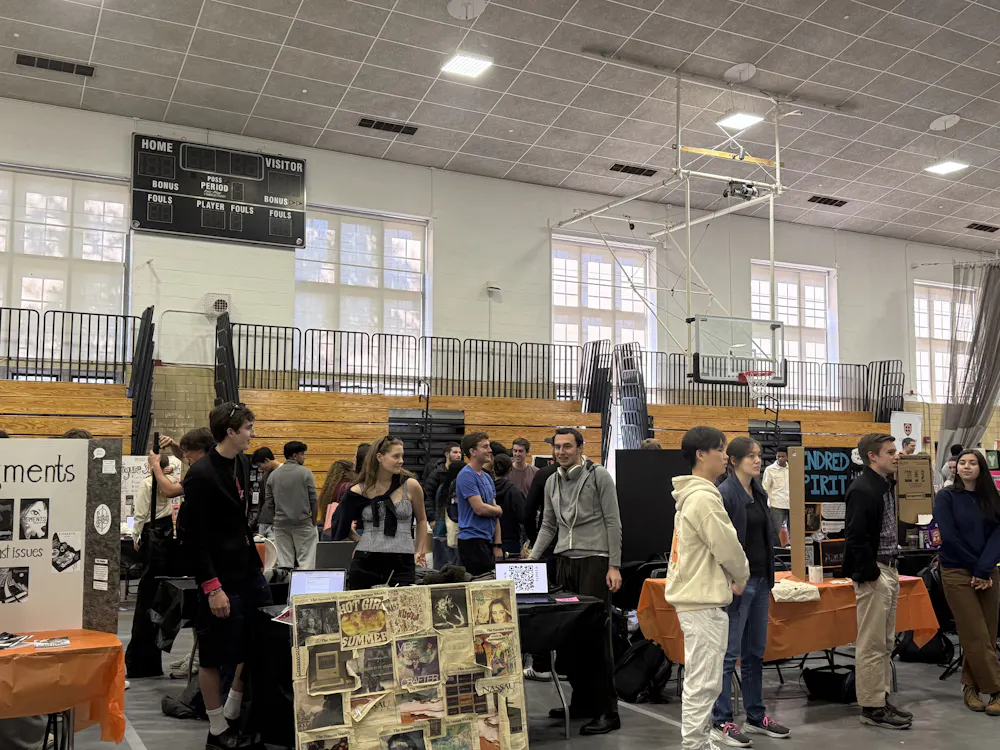
Students share mixed reactions as mandated officer and treasurer trainings return to in-person format
David EstradaThe University's student organization officers and treasurers returned to mandatory in-person training this fall after years of online sessions. Student reactions found parts of the training redundant or tedious, though most agreed the sessions were important.
The University's student organization officers and treasurers returned to mandatory in-person training this fall after years of online sessions. Student reactions found parts of the training redundant or tedious, though most agreed the sessions were important.